What’s a masterpiece worth?

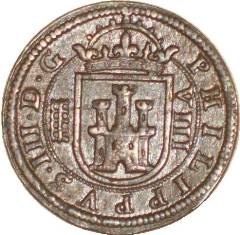
Originally published in 2010 when I lived in Madrid, Spain. The photo is of an eight maravedí coin from 1607, during the reign of King Felipe III, minted in Segovia.

***

What did Miguel de Cervantes earn from Don Quixote de la Mancha? We don’t know, but we have enough clues to try to guess. Cervantes was poor before it was published and poor after it was published, so it wasn’t a huge amount of money. Everyone agrees on that.

A little background

Don Quixote de la Mancha was published in two parts, the first in 1605 and the second in 1615. Cervantes didn’t plan on a second part, but after another author wrote a continuation, he decided to write his own.

In 1604, Cervantes was 50 years old and living in Valladolid. He had written a short story about Don Quixote, and he presented the idea of a novelization to publisher Francisco de Robles, who agreed and urged Cervantes to get it ready fast. Then the book was hastily edited (which explains the many errors in the text), printed on cheap paper with worn type, and rushed to the market.

Probably no one considered it a universal masterpiece, but the first edition of 1,000 copies sold well — in fact, it was immediately pirated in Lisbon. Cervantes had already won notice as a playwright, and this book, which satirized popular novels of chivalry and contemporary society, cemented his reputation as a major writer (at age 50, which was old at the time).

He had received a 10-year royal privilege to print Don Quixote, which he sold to Robles for an unknown amount; the paperwork was lost. But he had sold an earlier novel, La Galatea, to Robles’ grandfather for 1,336 reales, of which he eventually only received 1,086.

Nieves Concostrina, a journalist with Radio Nacional de España, reported in the series Acércate al Quijote that he received no more than 100 ducados (which equals 1,100 reales or 37,500 maravedíes) for the copyright, which she estimates as worth only about €200 today.

Daniel Eisenberg, the former editor of Cervantes, the scholarly journal of the Cervantes Society of America, wrote that he probably received 1,500 reales (51,000 maravedíes), which he says would have been worth 500,000 pesetas in 1992, or €5,503.72 today. That’s better, but still not a lot of money.

Maravedíes today

Their estimates in reales are reasonably close, so that’s a start. I don’t know how they arrived at modern currency, though. Converting antique currencies into present-day currencies can never be done well because, among other problems, the things that money can buy have changed. Cervantes never bought gasoline, for example. I don’t buy firewood.

But both Cervantes and I live in Madrid, and we both buy food. The Instituto de Cervantes, in its on-line footnotes to Quixote, has published the prices of several food items in New Castille in 1605. So let’s go shopping and do some math.

• A half-kilo of mutton sold for 28 maravedíes, according to the footnote. Mutton is no longer sold here, but a half-kilo of hamburger goes for €2.50 at my local grocery store. On that basis, 1 maravedí equals €0.089

• A chicken, 55m. The average price according to government’s Food Price Observatory’s latest statistics is €3.52. 1m = €0.064

• A dozen oranges, 54m. Food Price Observatory average is €4.26. 1m = €0.079

• Laying hen, 127m. Common price in local ads is €12. 1m = €0.094

• A ream of writing paper, 28m. A packet of A4 110 gr. Pioneer brand paper at Carlin, a major chain, €2.93. 1m = €0.104

• A dozen eggs, 63m. Food Price Observatory average is €1.33. 1m = €0.021 (This figure is an outlier, as you can see. The price of eggs has gone down a lot over the centuries. These days agribusinesses produce eggs in giant factory farms. Things change. For the better?)

The average of all these prices gives us 1m = €0.075. A weighted average would be better, I know, but how many laying hens do most of us buy now, so how much should they “weigh”? Not to mention the disparity in egg prices.

If we go with 7.5 euro cents per maravedí, the price of a copy of Quixote, set by law at 290.5 maravedíes, would have been €21.78. That sounds a bit low. We know that books were expensive items in those days. But that price was “en papel,” in paper — that is, as loose pages. The purchaser had to have them bound and covered at additional expense.

On the other hand, most people earned rather little. They would have spent a big part of their income, perhaps most of it, merely on food. According to the novel, Don Quixote spent three-fourths of his income on food for his household, and they ate frugally. A book would have taken a big bite out of tight budgets.

Not a get-rich quick scheme

If we accept that exchange rate — 1 maravedí = 7.5 euro cents — then Concostrina’s estimate of 37,400 maravedíes yields €2,805. Eisenberg’s 51,000 maravedíes yields €3,825.

It’s not a lot. Cervantes seems to have had income from other sources at the time. I hope so.

Those of you in the United States may be wondering what this is in US dollars. Yeesh. The dollar-euro exchange rate fluctuates daily, and there’s a worldwide currency war going on right now. On November 1, 2010, the value was USD$3,911.24 for Concostrina’s estimate and USD$5,333.50 for Eisenberg’s, but that will change. Go to Oanda for the latest numbers.

What Cervantes thought

In Book II, Chapter LXII of Don Quixote, our knight-errant meets an author in a printing shop in Barcelona and has this conversation:

“I would venture to swear,” said Don Quixote, “that you, sir, are not known in the world, which always begrudges its reward to rare wits and praiseworthy labors. What talents lie wasted there! What genius thrust away into corners! What worth left neglected! … But tell me, sir, are you printing this book at your own risk, or have you sold the copyright to some bookseller?”

“I print at my own risk,” said the author, “and I expect to make a thousand ducados at least with this first edition, which is to be of two thousand copies that should sell in the blink of an eye at six reales apiece.”

“A fine calculation you are making!” said Don Quixote. “It seems you don’t know the ins and outs of the printers, and the false accounting that some of them use. I promise you when you find yourself weighed down with two thousand copies, you will feel so careworn that it will astonish you, particularly if the book is unusual and not at all humorous.”

“Then what!” said the author. “Sir, do you wish me to give it to a bookseller who will give three maravedíes for the copyright and think he is doing me a favor? I do not print my books to win fame in the world, for I am already well-known by my works. I want to get something out of it, otherwise fame is not worth a farthing.”
Treasure, alien life, and ghosts

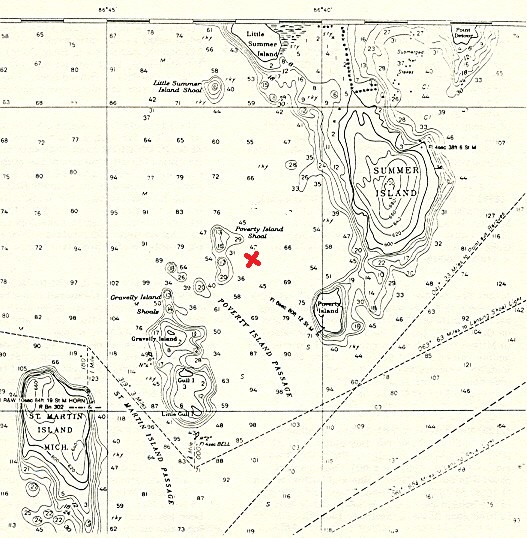
I know of two supposed sunken treasures of gold in Wisconsin, one in Lake Michigan and one in Lake Mendota, both dating back to the Civil War. I’ve researched the one in Lake Michigan and even have the treasure map which locates the gold near Poverty Island Shoal at the tip of Door Peninsula, but I haven’t decided to go hunt for it. I don’t think these treasures exist.

What interests me is why these stories stay alive. Lies are common as leaves in a forest, so why keep certain ones?

First, there’s a simple wish for sudden wealth, the motive force behind lotteries.

Second, legends often say that treasures, buried or sunken, are guarded by leprechauns, mermaids, or at least a curse — by beings alien and magic to our existence. It’s a wish for a livelier universe. In the same way, some of us hope for life on Mars or Andromeda, which would also be a real treasure.

Third, it’s a wish to preserve and honor the past by keeping stories alive. Ghosts work the same way. I met a woman whose neighbors told her the troubled presence she noticed on the stairway of the house she’d just bought was of a teenager who had committed suicide some 50 years earlier because he was gay. She hung a gay pride poster in the stairway to soothe him, and it seemed to work.

Most importantly, treasure is real. Sometimes — at Troy and in the Caribbean — gold is found, and then our wishes are confirmed. I can see Mars at night, and I might be watching Martians. If there are ghosts, I have visited haunted houses. When I lived in Milwaukee, someone else in that city named Susan Burke (not me) won the Supercash lottery. Riches await, if we keep searching.

X marks the spot.

Works eligible for awards

Here are some things published in 2025 that you may wish to consider nominating for an award — just a reminder. Some are my own works, some are my translations.

Science fiction and fantasy short stories by me

“To Defeat Water” Short story, 1175 words. If you curse Poseidon, he might curse you, too, time and time again. And life after life, you can fight back. Read it here: The Lorelei Signal, July 2025.

“Journey to Apollodorus” Novelette, 8760 words. In my novel Dual Memory, an AI named Par Augustus discovers a story about robots in the Apollodorus Crater on Mercury. This is the story. It focuses on the humans who struggle to create and maintain a scientific team when a lander sent to Mercury behaves unexpectedly. Success can be as stressful as failure. Oxygen Leaks Magazine, March 2025 (no longer in publication, contact me for a copy).

Novella translation

ChloroPhilia by Cristina Jurado. Translation of a novella, 20,200 words. Would you sacrifice your humanity to save the world? Nominated for Spain’s Ignotus Award, this strange coming-of-age story addresses life after an environmental disaster, collective madness, and sacrifices made for the greater good. Buy it here: Apex Books, January 2025.

Science fiction short story translations

“Trees at Night” by Ramiro Sanchiz. Translation of a short story, 6050 words. A librarian at a hospital-like sanatorium befriends a young patient named Federico for reasons that eventually become clear. Read it here: Clarkesworld Science Fiction and Fantasy Magazine, November 2025.

“Proxima One” by Caryanna Reuven. Translation of a short story, 4020 words. A machine intelligence called Proxima One sends probes into the galaxy on long journeys filled with waiting and yearning in a search for intelligent life. The probes cope with unexpected wonders, loss, and profound changes — but there is always possibility and hope. Read it here: Clarkesworld Science Fiction and Fantasy Magazine, May 2025.

“Bodyhoppers” by Rocío Vega. Translation of a short story, 5290 words. Minds can hop from body to body, but there’s always a problem because the system is designed to create them. One day, you can’t return to your own body because it’s occupied by someone with more money. Now you have no home, and you’re still madly in love. Clarkesworld Science Fiction and Fantasy Magazine, February 2025.

Poetry translation

Liquid Sand / Arena Líquida by Jorge Valdés Díaz-Vélez. Book of poetry translated by Christian Law Palacín and myself. This is the first major bilingual collection of poems by Jorge Valdés Díaz-Vélez, one of Mexico’s most respected contemporary poets. It gathers 42 of his works selected from six previous collections that span more than two decades of writing. Shearsman Books, November 2025.

What a year! The words of 2025

Let’s start with Spain, since I used to live there. The word of the year for 2025 is arancel (tariff), according to Fundéu, which advises on questions about Spanish language use for news reporting. Due to US policy changes, issues of tariffs for imports and exports have been in the news a lot in Spain.

The runners-up give a peek into other issues in Spanish news: apagón (power outage), macroincendio (massive wildfire), preparacionista (prepper), boicot (boycott), dron (drone), generación Z (Generation Z), macrorredada (massive roundup, specifically ICE arrests in the US) rearme (rearm, as with weapons), papa (pope), tierras raras (rare earths), and trumpismo (Trumpism).

The Economist magazine, Australia’s Macquarie Dictionary, and Merriam-Webster Dictionary all chose slop. “Slop merchants clog up the internet with drivel,” the Economist opines. Merriam-Webster defines slop as “digital content of low quality that is produced usually in quantity by means of artificial intelligence.” The Macquarie definition specifies “low-quality content created by generative AI, often containing errors, and not requested by the user.” All three sites have long lists of runner-up words.

For Oxford University Press, the word is rage bait, “online content deliberately designed to elicit anger or outrage by being frustrating, provocative, or offensive, typically posted in order to increase traffic to or engagement with a particular web page or social media account.” Oxford adds, “The Oxford Word of the Year can be a singular word or expression, which our lexicographers think of as a single unit of meaning.” The runners-up are aura farming and biohack. (Robert Reich points out that rage bait is profitable.)

Dictionary.com chose 67for 2025. “Most other two-digit numbers had no meaningful trend over that period, implying that there is something special about 67,” the site informs us, adding that “we’re all still trying to figure out exactly what it means.” Dictionary.com’s runners-up include an emoji. Both CNN and AP agree 67 can be annoying. The comic xkcd has additional information about funny numbers.

Canada’s Queens University picked maplewash, “the deceptive practice of making things appear more Canadian than they actually are.” That is, maplewashing encourages buying Canadian-made products rather than US imports. The word edged out elbows up. Both words speak to our times, and as an American, I apologize to our nice neighbors to the north.

Cambridge chose parasocial: “involving or relating to a connection that someone feels between themselves and a famous person they do not know, a character in a book, film, TV series, etc., or an artificial intelligence.” It adds, ominously, “The emergence of parasocial relationships with AI bots saw people treat ChatGPT as a confidant, friend or even romantic partner. These led to emotionally meaningful – and in some cases troubling – connections for users, and concerns about the consequences.” Sloppy consequences.

Collins Dictionary picked vibe coding, which “refers to the use of artificial intelligence prompted by natural language to write computer code.” (See also: slop.) Collins, too, has a runner-up list, and some of those terms will sound familiar.

Global Times reports that the Trilateral Cooperation Secretariat has chosen future as the China-Japan-South Korea Spirit Word of the Year. The secretary-general of TCS said future reflects the optimism and determination of the people of China, Japan, and South Korea to build closer ties in the future.

Time chose “the architects of AI” as Person of the Year 2025. (See also: slop.)

Pantone chose its color of the year, Cloud Dancer, “a lofty white that serves as a symbol of calming influence in a society rediscovering the value of quiet reflection. A billowy white imbued with serenity, PANTONE 11-4201 Cloud Dancer encourages true relaxation and focus, allowing the mind to wander and creativity to breathe, making room for innovation.”

As reported by NPR and Today, not everyone is impressed by the color, although Homes and Gardens points out that “white is timeless.” I should mention that my home office is painted white. In my case, it’s because I was too lazy to think harder.

Your father’s first Christmas

I wrote this piece as a Christmas present for my nephew in 2004.

This is your first Christmas, Sean, and since you’re only eight months old, I know this story might not impress you much, but it seems like the right time to tell it.

Your father was not quite three months old on his first Christmas, and I was ten years old. I knew enough about babies to know they don’t really do much at first, but eventually they grow into real people. That was the exciting puzzle. What was this new baby brother going to be like? We didn’t have many clues, but we watched for them all the time. Who was Louis Peter Burke?

Your Grandmother Burke died well before you were born, so you don’t know much about her. Here is her Christmas tree decorating theory: More is better. In architectural terms, it was rococo baroque.

During Christmas Eve day, we decorated the tree. First the lights went on — big lights, small lights, steady lights, twinkle lights, colored lights, white lights, all the lights we had, and there were plenty. Second, we hung every single ornament we had on the tree, and, again, there were plenty. If one was ugly or beat up, it went way in the inside where it could add color or sparkle without really being visible. The only rule was smaller stuff on top, bigger stuff on the bottom. Finally, we added tinsel and garlands of various types and colors to be sure there was maximum sparkle.

Then we waited for nightfall, since only a darkened house could do justice to the masterpiece we had created.

Meanwhile, we dressed your father in a red-and-white-striped elf-costume pajama set that an aunt had given him, complete with a pointy cap. He didn’t care for the cap but we made him wear it anyway, at least long enough for a photo, which may still be around somewhere. He looked more silly than elfish. He certainly had no idea about what was going on. He was too little to understand much of anything.

The moment to light the tree arrived. We turned out all the lamps and closed the front curtains to block the streetlight. With a flip of a switch, the tree flashed on, providing enough sparkling light to read by.

Your father’s eyes got big and he couldn’t take them off the tree. He liked it! He liked it a lot! Even when we turned the room lights back on, he continued to stare at the tree, fascinated.

It was a clue, the first clue I remember, about your father’s personality. He liked colorful, beautiful things — at least, we thought the tree was beautiful, and in a rococo way, it certainly was. We lit the tree for him throughout the holidays for the sheer fun of watching him enjoy it.

I don’t remember much else about that Christmas, like what I got as presents, what anyone else got, whether there was snow, or what we had for Christmas dinner. All I remember is the intense look of surprise and delight on your father’s little face, and how merry a Christmas he made it for all of us because we could make him happy, and because we had learned a little bit about him.

Finding out who someone is takes a long time. I’m still learning things about my brother Louis. Fatherhood, for example, has revealed new aspects of his personality and interests. In the same delighted way that I first saw so many years ago, he could not be more curious and excited to learn about you. Who is Sean Patrick Burke?

This is your father’s first Christmas with you. I hope it is merry.

Copyright © 2004 by Sue Burke, all rights assigned to Sean Patrick Burke.