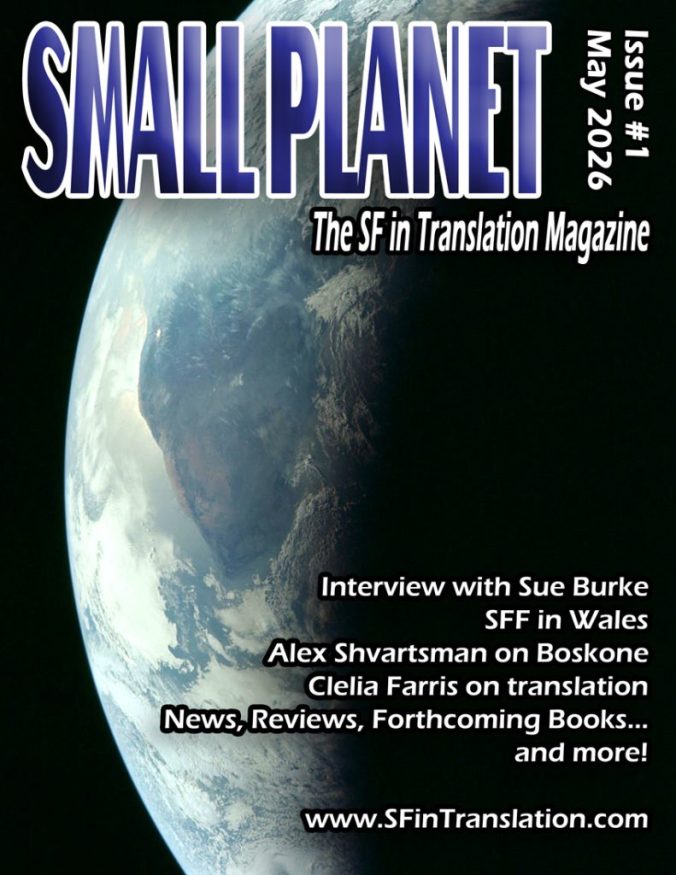
Cristina Jurado interviews me for Small Planet: the Science Fiction in Translation Magazine, Issue #1.
—
1. You translate into Spanish—what is it about this language that appeals to you?
Spanish can be enormously expressive: elegantly formal, voluptuously intimate, deliberately obtuse, beguilingly poetic, vulgar (oh the many curse words!), comic, colloquial, or straightforward. Like every language, it has unique linguistic resources in its grammar, vocabulary, and literary inheritances. Spanish can also create complex associations among the elements of a sentence. Can I make my translations equally expressive? That’s the fun and the challenge.
2. What made you become a translator? Do you remember when and where were you when you took that decision?
It started slowly around 2005. I was a writer in Spain hanging around with a lot of Spanish writers, and they needed translations, and I had just earned a high-level certificate in Spanish from the Instituto Cervantes, so I occasionally translated. Then I decided to get serious, studied translation (there are technical and craft-related techniques to know), and obtained certification from the UK’s Chartered Institute of Linguists in 2013. With the appropriate papers now in hand, I kept going.
3. Are there translators that have influenced or inspired you, and why?
The translation community has been warm and welcoming. I have developed friendships, and I admire many translators for their work. However, I can think of two translators, whose names I don’t know, who taught me something important a long time ago. In high school, for some reason, I wanted to read the ancient Greek play Lysistrata by Aristophanes, and I selected two very different translations at the public library. One was serious and employed beautifully elevated language, and the other was full of vulgar humor: a terrified old man declares, “I have beshit myself!” (May I someday achieve such nuance.) Both were “faithful” translations, and their differences helped me understand the breadth of transmitting culture. Translation means more than retyping words in another language.
4. From Spanish medieval novels like Amadis de Gaula and science fiction to poetry—like your recent translation of Liquid Sand (Arena Líquida) by Jorge Valdés Díaz-Vélez—you have translated countless stories. What genre do you find more challenging?
Among translators, it’s a well-known secret that the most challenging (that is, frustrating) work to translate is something badly written in the first place. Bad writing crosses genres, and it poses an ethical conundrum: If a few little changes would make the original work objectively better, should you make them? No. But then will your bad-sounding translation reflect badly on you as the translator?
Whatever the genre, excellent writing in the original work will contain challenges because the author has put the language to its highest use: the yearning assonance in a love sonnet, the playfulness in the names of a child’s imaginary animals, multi-level wordplay, or the confusion of a character teleported to another time and place. This is where you as the translator can do your best work. Occasionally I’ve spent an hour on one paragraph to try to preserve the author’s brilliance. If I found a good solution, it was time well spent and a happy memory.
5. How do you typically organize your translation workflow?
First, I read the piece all the way through. A lot of questions will be answered about the precise meanings of terms, as well as the authorial intent and overall tone and style. I might also decide if I’m interested in translating it at all. (See Question 4.)
After that, the workflow is much like the process for my own writing. First, a Zero Draft, which is too rough to count as a first draft. It may contain notes to myself. I will also be developing a glossary for specific terms that need to be constant throughout the work, and I might be compiling questions for the author. (Computer-aided translation tools like Trados excel at technical translation, but I think they are too constraining for literary translation, so I don’t use one.)
Draft One compares my translation and the original document, and I look for errors including accidentally omitted lines, glossary reconsiderations, and formatting slips.
Draft Two is an on-screen edit for flow and style; it can be repeated as many times as necessary, and I may need to consult the original work some more.
For Draft Three, I print out the work and edit on paper, and I always discover problems that were somehow invisible on the screen. I can repeat this step until I think all the words are perfect.
Draft Four involves using a read-aloud function on my computer. It should be mere proofreading but always uncovers at least a few glaring imperfections.
At that point, I can turn in the piece, knowing that the author or editor may have further refinements and might catch embarrassing errors. I aim for excellence, but I never hit a bulls-eye.
6. Can you share with us examples of key decisions you had to made in order to translate a story?
Many translating decisions are made by the use for the translation. For contemporary fiction, usually the standard is to recreate what the author would have written if the author were fluent in the target language. But questions remain. If the story clearly takes place in a Spanish-speaking location, do you use “Señor” or “Mr.”? Do you need to explain things for a foreign audience that the native audience would easily understand, such as adding to a mention of Barajas that it is the Madrid airport? How about slang? Curse words? Puns? I might consult with the author or editor and let them struggle with the decision.
Some accepted translation strategies provide approaches to these decisions. For example, in one piece, a passage contained three puns that didn’t work in the target language, so I substituted three similar puns, but I could have used a footnote. For a story that included a chart with symbols for words, I switched the meaning of two of those symbols to entirely different words in English; I could have asked for the chart to be changed, but it was a .jpg and I had pity on the graphic artist.
Other kinds of translation involve different decisions. I translated some handwritten Renaissance documents regarding the slave trade for the Smithsonian Museum, and my translation was as literal as possible with endless footnotes about the context (the horror explained itself). I translated lyrics to a song with great freedom so they could be sung to an existing tune. I turned a Spanish sonnet into a Shakespearian sonnet, which has different rules for syllable count and meter, because English and Spanish have different natural rhythms. I’ve adapted works, fitting a sprawling play to a tiny stage, working with the director.
What will the translation be used for? That’s the key question.
7. Let’s talk about the elephant in the room: AI. It’s entering the industry, raising concerns about job security and the quality of translations. What is your opinion on it?
An AI is just math, and its results are by definition average, homogenized, and mediocre. For people without experience in translation (or writing, or art, or music-making), the results might look right, and for some purposes, mediocre is actually good enough.
Literary translation aims for excellence, nuance, and accuracy. It is an art, which is inefficient and sometimes expensive; certain decision-makers think cheaper is always better.
Expertise must be learned step by step, however, and entry-level jobs in all sorts of fields may disappear as the result of AI substitution. We will lose the opportunities to develop needed skills. “Fixing” AI output dulls rather than improves our skills. The corporations insisting on AI use are effectively telling us that we can send a robot to the gym and become Olympic athletes.
Deep down, I don’t think the AI revolution will succeed in all fields. We need to out-compete AIs, and I believe we can. People value art. In the short term, though, people like us — translators, writers, artists, editors, and musicians — are being hurt.
8. What changes would you like to see in the literary translation market to better reflect the diversity of creativity in today’s world?
Translation is too connected to the “literary fiction” genre. I watch what’s going on in the literary community, and I still see contempt for genre fiction as something so shallow and simple that an AI could actually do it. Literary fiction’s attitude toward works from other countries also leans toward accepting only a single story, usually a sad tale of the oppression of colonization, or a sad tale of the trauma of war, or a sad tale of another stereotypical suffering of that country or culture, especially if written in an idiosyncratic, experimental, anti-narrative format.
The close connection of translation with “literary” fiction hurts translation because literary fiction doesn’t sell well, which makes it seem like translations can’t sell well. And yet, genre literature is so compelling that it inspires fans to create unauthorized translations. The genre fiction that comes out of these “single-story” countries can be amazing and even uplifting. Brazil gave us solarpunk.
As for sales, as an author as well as a translator, I know that the task of self-promotion is hard and necessary — and kind of fun if you do it right. Translators need to do what they can to sell the works they create. They may not always see it as their job, and often they’re not even called upon to do it. Publishers too often ignore translators when they could be allies.
9. What advice would you give to any aspiring translator?
Your skill as a literary translator depends on your skill as a writer in the target language. You may be a native speaker, but without training, you may not know how to write at the level of excellence. How can you make a beautiful sentence in one language sound beautiful in another, fully aware that the standards of beauty vary from one language to another? Your job is to preserve the beauty — or the anguish or humor or whatever, using linguistic resources. You can translate poetry most effectively if you yourself are a poet. I’ve been writing in English professionally for more than a half-century, and I still study how to write every day. There is always more to learn.
Another skill you can acquire (which an AI cannot) is creativity. Transcreation is the process of adapting a message or work from one language to another while maintaining its intent, style, tone, and context. Creativity must be learned, and I still study that relentlessly, too.
As an aspiring translator, you already know that creativity and excellence are where the fun is. Fun can be your career goal.
10. And last but not least, which works would you like to see translated into English in the near future?
I think Mundos en la eternidad (Worlds in Enternity) by Juan Miguel Aguilera and the late Javier Redal is one of the best space operas ever. Through space opera, we science fiction fans are used to exploring life on a distant planet. Can we explore other lives here on Earth, or are some people and some cultures just too distant? I believe that human variety will bring us a sense of wonder, and we can achieve that through wide-ranging translation.
11. Anything you would like to add? The floor is yours 😉
For too long, translation has been viewed as a reactive, passive activity, and one depreciated by canards like “lost in translation” and “traduttore, traditore.” I hope we translators become more assertive. This is an art form in every sense of the word and, of course, in every language.


