On April 26, 1986, the Chernobyl Nuclear Power Plant exploded, creating one of the world’s worst nuclear accidents. A haibun is a Japanese poetic form that combines prose and haiku, usually describing an event or travel. This is a haibun about my guided tour in April 2006 of Chernobyl.
I visited Chernobyl, and I also visited the National Chornobyl Museum in Kyiv, which tells the heartbreaking story of what happened and holds irreplaceable artifacts. Over the weekend, Russia deliberately destroyed the museum.
***
A military checkpoint marks the entrance to the Exclusion Zone, the contaminated area roughly 30 kilometers around the Chernobyl Nuclear Power Plant. More than 100,000 people were evacuated within days of its explosion and meltdown in April 1986. At the Chernobyl Interinform Agency, in a room filled with maps, we met our tour guide, Yuriy, who cheerfully answered our questions in Ukrainian and English. Then we reboarded our bus to head toward the areas marked in red on the maps.
his pocket dosimeter
ticking ever faster
our guide keeps smiling
As we approached the nuclear power plant complex, we passed the rusting cranes and beams of buildings whose construction had been halted overnight. But there is a new building.
Visitor Center —
women plant tulips
wearing face masks
The cesium and plutonium that spewed out during the disaster washed into the soil, so digging requires precautions. Plants pull radioactivity back up through their roots, as a Geiger counter set on the pavement and then on the lawn can prove.
keep off the grass:
twice the dose
as asphalt
We moved on to Pripyat, a city built for the power plant’s workers and families. Its 50,000 inhabitants were told they were only leaving for three days, although authorities knew it would be effectively forever: the radiation will subside to livable levels in one thousand years.
busy ants —
do they notice?
the city is empty
It was a model Soviet city, with lovely tree-lined boulevards and many amenities. Its designer even had one rose bush planted for every inhabitant.
among the weeds
still a few
roses
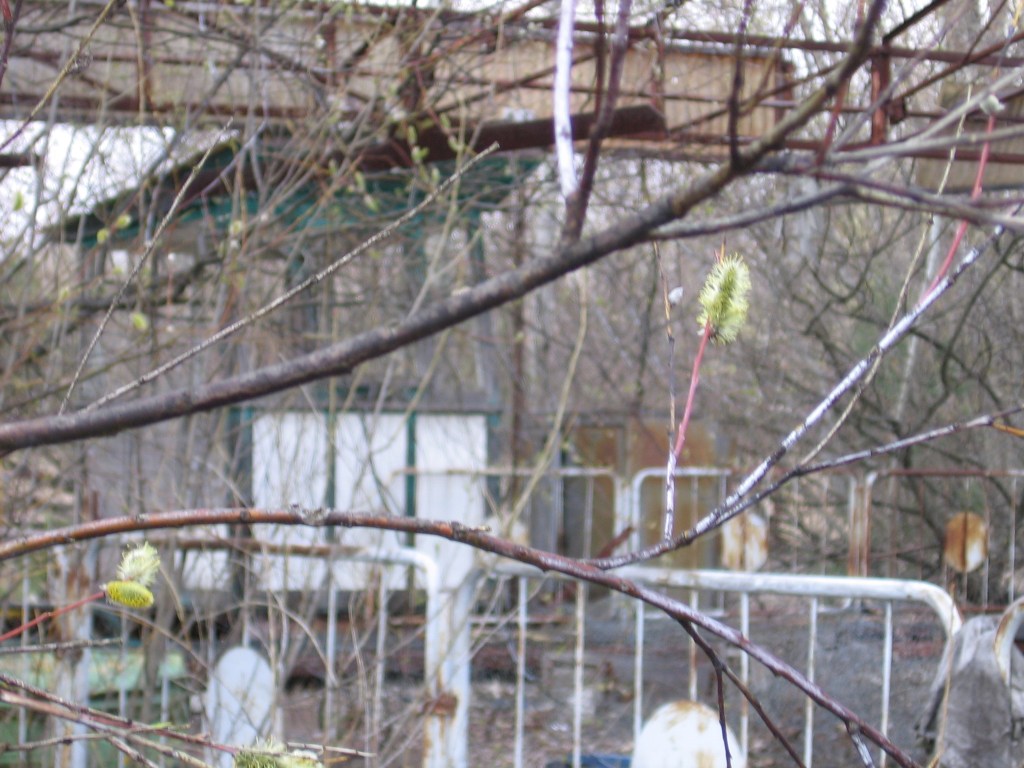
We visited on the day after Palm Sunday. With no palm trees in Ukraine, the faithful gather willow buds and bring them to churches to be blessed. Willows were growing in Pripyat.
pussy willows
nine hundred eighty more
quiet springs
The tour company owner, Alexander Sirota, had been a boy in Pripyat when the disaster happened, a third-grade student at School No. 1. It was partially collapsed, spilling books, furniture, and students’ possessions across the cracked and mossy sidewalk.
a string of beads
on the ground: everyone looks
no one touches
We got back on the bus and passed through the “Red Forest.” These were pine trees growing next to the power plant that were directly under the path of the worst fallout. The pine needles turned red overnight; the trees died, were cut down and buried where they had grown.
Red Forest
dust to dust — only
Geiger counters wail
Our guide pointed out a tall metal grid: the early warning radar screen for Chernobyl II, a supposedly top secret nuclear missile site close to the power plant. An American spy satellite passed over the area 28 seconds after the explosion, and US analysts, who knew about the site, thought a missile had been fired and considered a nuclear strike in retaliation. Then they thought a missile had exploded in its silo because it didn’t move. Finally they realized it was the nuclear power plant exploding.
Chernobyl II
the bigger danger next door:
who knew?
And so we left, with one final stop at a Ukraine Army checkpoint to test our radioactivity. We all passed. Our irradiation during the seven-hour visit had been slight. No tee-shirts, no souvenirs.
like a small x-ray
but with nothing
to show for it


