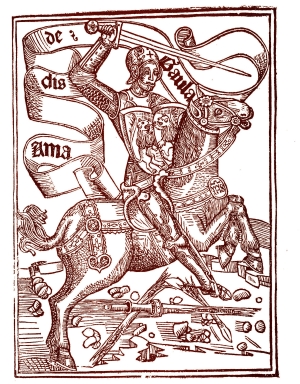
I translated the Spanish medieval novel Amadis of Gaul as a blog and I learned a few things about the Middle Ages. You can read some excerpts here and here.
1. Sword fights and jousts are horrible ways to die. I always knew that, but now I know it with detailed anatomical accuracy: the book was written by people with real-life experience.
This is from Chapter 39: “Agrajes took the sword … and went after him, but the Duke turned to give him a blow or two, and turned again to flee. Agrajes cursed him and followed and gave him such a blow on the left shoulder that it cut through the chain mail and the flesh and bones almost to the ribs, so the Duke’s arm was left hanging from his body. He cried out, and Agrajes grabbed his helmet and pulled, and because the Duke was already partially paralyzed, Agrajes knocked him from his horse. One foot remained in the stirrup, and the Duke could not take it out as the horse fled, dragging him all around the field until … the Duke was dead, his head smashed by the hooves of the horse.”
2. Chastity belts didn’t exist in the Middle Ages, and they certainly don’t appear in this book. In fact, it was eventually condemned for corrupting young women with its sometimes casual attitude toward sex. Amadis’s brother Galaor in particular has quite a way with the ladies.
For example, in Chapter 25 he finds himself alone with a damsel he has just rescued: “and as she was very beautiful and he was eager for such sustenance, before the meal was brought and the table set, together they unmade a bed that was in the hall where they were and made the damsel a woman, which she had not been before, satisfying their desires, which had grown great during the brief time they had spent gazing at one another in the flourishing beauty of youth.”
3. I don’t always get medieval humor. Earlier in Chapter 25, Galaor enters a castle by means of a large basket that was lowered over the walls and brought back up with a winch. I know this is funny because of the way it’s presented, because Galaor is often a comic character, and because I’ve seen passing references to this in other medieval books as some sort of sexual joke. But medieval scholars still don’t know exactly what’s so funny.
The comic strip xkcd got it right when it said, “There’s no reason to think that people throughout history didn’t have just as many inside jokes and catchphrases as any modern group of high schoolers.”
4. Pampered princesses dependent on heroes? Not in this book. And that’s why the book became a favorite among female readers. Women and girls appear in every chapter in all sorts of roles: beneficent sorceress, powerful queen, brave and daring damsel, practical best friend, wise old woman, efficient messenger, beautiful temptress, rebellious daughter, stubborn fool, courtly schemer, capable healer, and even damsel in distress. Although women don’t fight (just as well, see Lesson 1 about horrible ways to die), they can do just about anything else — while riding sidesaddle.
Our romantic fantasies of princesses and women’s roles came from later on in history, from the Renaissance’s supposed progress that ushered in progressively more limited female roles, from Romantic-era depictions, from bad history, and from satire confused with truth.
In short, I’ve found proof of what L. P. Hartley said in the opening line of his 1953 novel, The Go-Between: “The past is a foreign country; they do things differently there.”

