Sophie
by Sue Burke
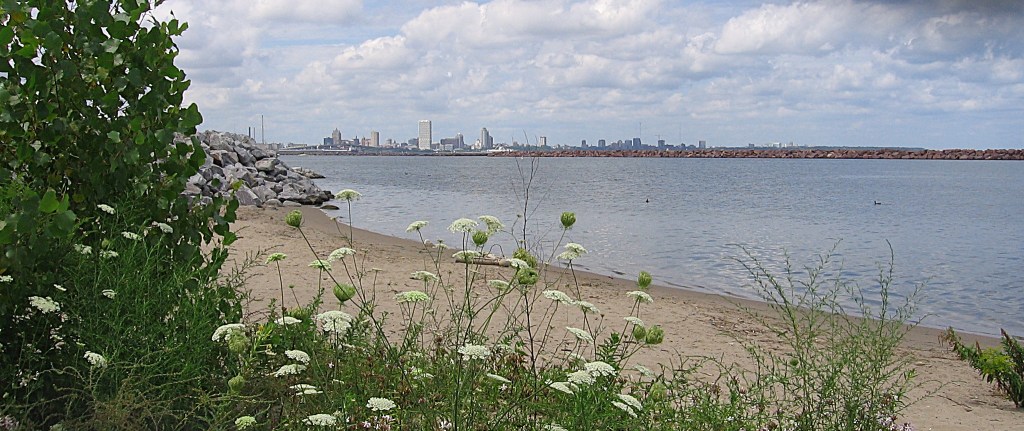
Steep bluffs form a wall protecting Bay View Beach. Trees and brush wrap the wall in some places, but in others, gray-pink clay stands exposed except for scattered weeds and wildflowers.
Gulls work up and down the shore, screeching, while waves splash in long curls. On sunny days, Lake Michigan sparkles blue. On stormy days, the water churns a turbulent brown and beats relentlessly at the sand.
On all days, sometimes sharply focused and sometimes poking through a fog, the Milwaukee skyline rises off to the north like a continuation of the bluffs, a beautiful wall around the bay.
Relatively few people visit that beach. I come often.
I’ve been going there for years. I started one summer while I was a college student, shortly after I began working at the old Plankinton Arcade. That arcade is called the Grand Avenue Mall today, and it has been renovated and enlarged to include the next block. Still, the old part between Second and Third Streets — a long, two-story gallery — looks much the same.
I got a job in a sandwich shop at one end, where a nearby popcorn wagon scented the air. I hadn’t known about the arcade before I applied for the job, and I hadn’t known about the beach. As a teenager, I hadn’t known about much, in fact.
I learned something important from a woman at the shop. Slim and bleached-blond, older than my mother, with a flowing scarf looped around her neck, she looked tired when she smiled at me that first day.
“Hi, I’m Sophie,” she said. The owner brought me to her as she was loading the cooler with drinks — brands I had never seen before. I had arrived early, as instructed, for training.
She found me an apron and a hat, led me on a quick behind-the-counter tour, identified the contents of trays in the cooler, listed the ingredients of various sandwiches, and pointed out the functions of the cash register.
“Got all that?” she teased. “Of course not. Watch me through a couple of customers.” I backed against the cooler, dazzled by the details.
“What can I get you?” She smiled at a man in a suit. She took the order faster than I could follow along and then assembled a sandwich more efficiently than I could at home. “Do you want chips with that? Maybe a cookie? We got some great macaroon cookies today. So what do you think — is that designated hitter rule working out?”
The next customer seemed just as easy for her, a woman who wanted tuna salad with extra tomatoes and a coffee.
My turn. A woman in tall platform shoes clopped in and pulled out a piece of paper. “I need four sandwiches,” she said. She seemed to know what the shop offered: one chicken roll, no mayo, with lettuce on wheat; one Italian with everything; two tunas, one with lettuce and both on white; two chips; one large Tab; one small Coke; two coffees, one with extra sugar.
She handed me the list. It was all there, legible and ready to be filled.
Where was I supposed to start? The bread was in front of me on the counter. Where was the chicken? What went into an Italian? Sophie had just made a tuna salad, right?
The customer was looking at me — impatiently, I felt sure. Sophie casually walked up. “Just make ‘em one at a time,” she whispered. “There are a few Italians behind the Swiss cheese.” Then she turned to the woman. “His first customer,” she murmured to the woman as if it were a delicious secret. They started talking and giggling.
I couldn’t hear much besides my own fumbling thoughts. How many slices of meat on a sandwich? Was that enough mayonnaise? Enough lettuce? I decided to err on the side of generosity. Mayo slopped over the sides as I stacked up the sandwich.
I ripped a wide sheet of white paper from a roll to wrap it. Sophie could enfold a sandwich with a simple flip, flip, flip. When I tried, my sandwich wouldn’t stay together, and the paper sort of creased at odd angles and stuck out in points. It rattled like an angry snake as I tried to tidy the bundle up. I glanced at Sophie and saw to my relief that they remained in deep conversation, ignoring me.
Sandwich by tortuous sandwich, I bumbled through the order. Sophie — maybe to hurry it up, I thought — packed the food into a paper bag and pulled out a cardboard drink carrier as I pecked the prices into the cash register and finished the sale.
When the woman had clopped out of hearing, Sophie turned to me. I expected to get yelled at. “Pretty good for the first time. But let me show you how to wrap a sandwich.” She grabbed a slice of bread and a sheet of paper and demonstrated a deli wrap, then made me try it, then try it again. It worked the third time.
“Nothing to it,” she said. “You just got to stick at stuff till it works out.”
That’s the way it went. While I fumbled around, she covered for me, sometimes by talking to customers she knew, usually by scurrying to fetch part of the order while I muddled through the complexities of roast beef on rye with horseradish.
Then when the lunch rush hit, I was probably a hindrance, not a help. Every time I moved, I was always about to smash into Sophie. She’d veer away and let me dash past, sweating and confused.
My shift was supposed to end by 2 p.m., but by 1:30 things had calmed down.
“You get a free drink every day here, you know,” Sophie said. “You had it rough. Get yourself something and relax. Look around. See where things are.”
I got better as the days passed. Sophie kept teaching me things: how to brew coffee, how to restock the cooler, where to dispose of garbage. One day, when she called in sick, I came in early and successfully handled the whole shop with other part-timers.
When Sophie was at the shop, she never rested. If customers weren’t around, she cleaned, and she wouldn’t let me help her.
“I just can’t stand waiting around,” she said when I first tried. “You take a breather. I’ll just get the sink straightened up.”
She’d clean and we’d talk. She’d tell me about her kids when they were little and ask me about my brother and sister. She’d talk about her high school days and we’d compare them to mine. She was the one who told me about Bay View Beach. She used to go there as a teen, she said, although it didn’t occur to me to ask why she didn’t go there anymore. I started visiting to the beach a lot during that hot summer, and she would always ask me about it.
On one particularly hot day, I asked her why she was wearing long sleeves. “Well, this blouse was clean,” she said, sort of giggling. “And I like this blouse. I don’t really notice the heat, anyway.” She mustn’t have. Sometimes that summer, she wore a scarf around her neck or she kept her collar buttoned, contrary to the fashion at the time.
Another day she came in with a reddish bruise on he cheek, incompletely covered by makeup. “I walked into an open cupboard at home. Would you believe it? I’m just naturally clumsy. It doesn’t hurt that much, anyway.”
She didn’t seem clumsy to me. I thought that maybe I was just too young and inexperienced to know clumsy when I saw it.
I felt sure she was efficient, and so did the shop owner, apparently. As she scrubbed down a counter after the noon rush one day, he asked her to supervise the morning shift. For a moment, her face lit up. Then it faded. “I’ll have to ask my husband.”
I wasn’t in yet the next morning when she turned down the promotion, but I heard about it. The owner, amazed, told me what she had said: “I’m not really smart enough to handle all the details about opening up the store and supervising people.”
“What’s wrong with her?” he asked me. “She could do it. You work with her. You know that. I don’t get it.”
Sophie seemed quiet that day. Or maybe I was the quiet one, wondering why she had said no and not knowing how to ask her.
A week later, in the early afternoon, the power failed at the arcade. We spent a half-hour waiting on customers in the gloom. Eventually the mall manager poked his head in.
“It’s not coming back on,” he said.
The owner, who had been pacing in his office, decided we should close down.
The electricity still worked fine across the river. At my suggestion, we headed to John Hawk’s Pub, happy as children playing hooky. Back then, the tavern occupied a basement on Broadway, and back then, even nineteen-year-olds like myself could drink. Sophie and I and the woman who ran the popcorn cart slipped into a booth, where I drank beer and they drank Bloody Marys with pickled Brussels sprouts on the swizzle sticks.
We talked about the customers. Then we gossiped about the store owners, bus drivers, the Watergate Committee, the end of the war, the start of the energy crisis, and finally everything else. We ordered another round.
I told Sophie about a girl I had met at the beach.
“You know what a woman wants?” she asked suddenly. I didn’t have a clue.
“She wants someone she can trust,” Sophie said. “Someone she doesn’t have to be afraid of, she doesn’t have to worry about, even if she makes mistakes. She wants you to keep your promises. And if you do that, if she doesn’t have to be afraid of you, then — then she’ll love you. Women and kids, they want to trust you.”
She looked into my face and her voice fell. “If you love them, make sure they feel safe around you. Be good to ‘em. Just so they can feel like you’re — you’re a friend, a real friend.”
She was almost getting blubbery. Her eyes looked pleading, but I didn’t know what to say. She looked at me for a moment longer. Then her eyes dropped to her drink and she fidgeted with the soggy Brussels sprout bathed in tomato juice. “That’s my speech.”
She shrugged. “How long before you got to go back to school?”
Relieved to be back on safer subjects, I jabbered about picking out classes, about how I loved mathematics, and about what I might do with math when I graduated. We ordered a third round.
Soon after that, Sophie glanced at a grandfather clock in the corner and cringed. “My god! It’s 4:30!” She grabbed her purse and bolted out of the booth. “I got to get home and have dinner done in time. It can’t be late.”
She left behind an almost-full drink and never said goodbye. I sat there stunned until the woman from the popcorn cart nudged me and pointed out a particularly grumpy customer from the arcade who was bellowing at a cocktail waitress.
The next day, Sophie quit. Actually, she never showed up. The owner tried calling her home that day and for the next few days. At first no one answered, but finally a recorded message said the number was disconnected. I never saw Sophie again.
The summer ended and I returned to college. Eventually I became an actuary, using my mathematics to try to predict life contingencies. I discovered contingencies that I hadn’t recognized in my youth: mortalities, disabilities, risks, and injuries that can happen to anyone, any time, foreseeable only in the aggregate. I look at the figures and I see people. I wish I could warn them, one by one.
Bay View Beach stays pretty much the same over the years, eroded in some seasons and repaired in others. The flowers and whitecaps and gulls remain protected by the steep clay wall.
Sometimes I go with my wife and daughters to the beach. They wade into the water and squeal as the chilly waves wash their ankles. Then they look at me with carefree smiles. “Play with us, Daddy,” the oldest girl calls out, and I do.


