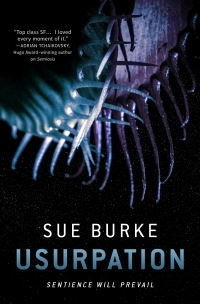
From April 23 to 25, Barnes & Noble is having a pre-order sale: 25% for B&N members for print, ebook, and audio; 35% off for Premium Members for print pre-orders only. Use the code PREORDER25
The trade paperback edition of Usurpationwill be released on October 21, 2025. Plan ahead!
You might have an idea for writing a work of fiction, but is it flash fiction, a short story, a novel, or an epic trilogy? It can be frustrating to begin what you hope will be a short story, but soon it’s grown too long, and you don’t have time for a novel right now. Or, you might start a novel and run out of steam because there isn’t enough of an idea to fill all those pages.
Here are a few ways to help you evaluate your idea before you start.
• How many scenes can you imagine? A novel might have 80 scenes of 1,000 words each, and a short story just a few scenes.
• How many plot points can you imagine for a three-act outline, Hero’s Journey, or other novel plotting tool? A shorter piece may have only one or two pieces of the plot.
• Can you imagine the story as a picture? The artist El Greco will help illustrate this concept.
A simple picture can be a short-short story. Boy Lighting a Candle, by El Greco, 1571.
This story might be:
“The little glowing fairy was fragile and needed help to stay alive.”
Add a few more characters, and you have a longer short story. An Allegory with a Boy Lighting a Candle in the Company of an Ape and a Fool, by El Greco, 1577.
This story might be:
“The little glowing fairy was fragile, but it attracted too much attention, and the boy didn’t think he could keep it safe.”
With more characters and more conflict, you might have a novel. The Miracle of Christ Healing the Blind, by El Greco, ca. 1570.
This story might be:
“The protagonist’s unusual but successful medical techniques often got him into trouble, and eventually he faced a death sentence.”
A big canvas with a lot happening could well be a trilogy. Burial of the Count of Orgaz, by El Greco, 1586. The painting is 15 feet / 4.5 meters tall.
This story might be:
“The Count’s death unleashed an epic conflict between men and God.”
(Notice the lack of women at the Count’s funeral. That could become an important plot point in the story.)
Exercise
Think of an idea you’ve been playing around with. Try to imagine it as a work of art. Would it fit nicely on a postage stamp? It might be flash fiction. Would it fill a wall-sized mural? You might have an epic. The goal is to avoid unpleasant surprises when you finally start to write. If you need an idea, here are a few:
• A medical team must decide if it can ethically flee a deadly situation.
• A technology company begins to operate in increasingly illegal activities, but the change is so slow and the money is so good that one of the engineers, who becomes deeply troubled, can’t afford to quit.
• A family living in a haunted house refuses to believe in ghosts.
• Two individuals initiate a series of gift exchanges, and the gifts tell more about the givers than they realize.
• Friends witness the breakup of a family from different perspectives and have different opinions.
“For centuries, we’ve measured intelligence through a profoundly narcissistic lens. We’ve built entire philosophical and scientific frameworks around the idea that cognition is a uniquely human trait — a linear progression of thinking that starts with simple organisms and culminates in our own supposedly superior consciousness.
“Sue Burke’s Semiosis isn’t just a science fiction novel. It’s a radical dismantling of those comfortable delusions.”
Besides an article and podcast, there are study materials: References, Executive Summary, Briefing Document, Quiz, Essay Questions, Glossary, Timeline, Cast, FAQ, Table of Contents, Index, Polls, 3k Image, and Fact Check.
You will find spoilers — and a lot to think about.
***
My translation of “The Coffee Machine” by Celia Corral-Vázquez has been nominated for the 2024 Best Translated Short Fiction Award by the British Science Fiction Association. It was originally published at Clarkesworld Magazine. Read it here. See the full list for the awards here. The winners will be announced at Eastercon, April 18 to 21.
***
A new review of ChloroPhilia by Cristina Jurado, which I translated, is at Strange Horizons Magazine. Reviewer Rachel Cordasco writes: “ChloroPhilia — an unsettling, enticing novella about evolution in overdrive — is Cristina Jurado’s most recent work in English. Like her collection Alphaland, which came out in English in 2018 and then was reissued in 2023, ChloroPhilia offers readers Jurado’s unique vision of the world, in which the bizarre and grotesque erupts into the mundane world.…”
Here’s a little story from medieval Spain that I translated, and it has a moral and a punch line. It comes from El Conde Lucanor [Count Lucanor], a book written in 1335 by Don Juan Manuel (1282-1348), nephew of King Alfonso X of Castile.
The book is filled with “exemplary stories” to help the fictitious Count Lucanor deal with his concerns. This one, Exemplum XLIII, was cribbed from a popular story at the time. The Count asked how much he should tolerate from bad people. His advisor recounts this story, and the final line became a refrain.
A good man owned a public bath, and a madman came into the bath when people were bathing. He hit them with buckets and stones and sticks and everything else he could find, so no one in the world dared to go to the bath that belonged to the good man, who lost his income.
When the good man realized that the madman was making his business fail, he got up early one day and went to the bath before the madman came. He took off his clothes as if he were a customer and got a bucket of boiling water and a large wooden club. Then the madman who had been attacking people arrived at the bath.
The naked good man, who was waiting, saw him and ran at him with fierce anger. He threw the bucket of boiling water at his head and grabbed the club and began to strike him again and again on his head and body. The madman was afraid he would be killed and thought that the good man was mad.
He ran out screaming, and when he met a man who asked him why he was running and yelling, the madman told him:
“My friend, beware, because there is another madman in the bath.”
The ebook edition of my novel Usurpation is on sale all this week, March 31 to April 6, for only $2.99 at all retailers.
Usurpation is the third book in the Semiosis trilogy. Stevland, the dominant sentient lifeform of Pax, has sent some of its seeds to Earth, but Earth is a powder keg. As more and more conflicts break out, Earth’s rainbow bamboo works in the background to try to control human behavior and — they desperately hope — bring peace to the planet.