Extreme beliefs

As Charles Dickens wrote in A Tale of Two Cities: “It was the best of times, it was the worst of times, it was the age of wisdom, it was the age of foolishness, it was the epoch of belief, it was the epoch of incredulity, it was the season of light, it was the season of darkness, it was the spring of hope, it was the winter of despair.”

We’re doing it all over again, particularly that “epoch of belief” part. People are believing a whole lot of things. Why?

The world is a confusing place, and people want to make sense of it. As far as I can tell, some people are prone to believe the first explanation they find that seems to make sense — the very first explanation, and they stop right there, without asking if it’s a fully sensible.

It might be wiser to search for as many explanations as possible. If there are two or more sides to an issue, try to understand them all. Knowing multiple explanations might temper your belief. Can you accurately, even sympathetically, explain your opponents’ points of view? It’s easy to condemn what you do not understand.

As Mark Twain said, “If a cat sits on a hot stove, that cat won’t sit on a hot stove again. That cat won’t sit on a cold stove either.”

The cat doesn’t understand the whole situation and has an extreme belief about stoves.

***

My next novel, Immunity Index, goes on sale May 4.

Writing during a dumpster fire

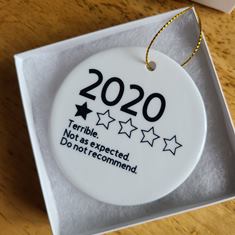
A 2020 Christmas ornament

Writing requires concentration. The past year has not been easy for concentration. Pandemic and politics clamored in the background, if not in the same room, incessantly.

A lot of writers had trouble, and I was among them. Doomscrolling may be bad for you, but the quality and quantity of the doom was exceptional. Besides distractions, I was often a little depressed as well. The author John Scalzi reports that he found early January particularly hard. Yes, it was.

Still, I managed to plug along this past year and this past month at reasonable rates of production. There’s one reason: for me, writing is an escape.

I was living in Madrid, Spain, when on the morning of March 11, 2004, terrorist bombs on commuter trains killed 193 people and injured about 2000. Three of the bombs exploded at Atocha train station within blocks of my house. I heard them. Sirens began wailing before 8 a.m. and continued constantly until 5 p.m.

The only emotional peace I had that day was when I opened up a manuscript and began writing, and suddenly I was far away in the future on a distant planet, working on the novel that became Semiosis. For several hours, I was elsewhere, thankfully.

Writing has been my form of self-care on other occasions, too. Words on paper or a screen have been my comfort in a hospital emergency waiting room or when I should have been sleeping but the night was too dark.

For other people, it will be different, as it should be. Our world is enriched by the variety of our individual strengths and weaknesses. The pull that writing has on me may be a weakness, not a strength, but it is my refuge, and I’m glad to have it. Still, I prefer to write because I want to write, not because I want to flee.

Self-care can include rewarding and enjoyable work. It can also include eating well, living in a clean environment, having a hobby (mine is cooking), organizing and planning your days, journaling, walking and exercising, and even delegating tasks to others.

What do you do to take care of yourself?

***

My next novel, Immunity Index, goes on sale May 4.

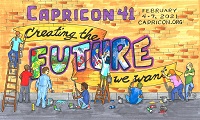
How to find me at Capricon 41 in February

Capricon is a four-day science fiction convention held annually in the Chicagoland area since 1981. This year, its 41st iteration, will be held virtually with the theme “Creating the Future We Want.”

You can attend! Sign up and learn more here. Organizers ask you to pay at least $10 for the weekend, but if life hasn’t gone well lately, you can attend for free. I signed up for the premium level to help out, so be my guest.

Expect music, a dance, a cooking workshop, a game or two, an open mic, and parties, in addition to panels on all sorts of topics from silly to serious. Since the pandemic hit and life has moved online, science fiction conventions have steadily learned to use technology to create events that aren’t quite like being there in person but still might be the social highlight of your month.

I’m scheduled for four events:

Thursday, February 4, 6:00 to 6:30 p.m., reading. Science Fiction vs. Literary Fiction: Who’s in Control? I’ll read an essay that explores how and why the stories of science fiction tell an uncomfortable truth about what really matters.

Saturday, February 6, 5:00 to 6:00 p.m., panel. Information Please! Based on the 1930s radio quiz show, Information Please tries to stump a panel of experts with a wide variety of questions about science fiction and fantasy where the fun is listening to their discussions as much as seeing if you can figure out the answer first. Steven H Silver is moderating, and other panelists are Barbara Barnett, David Hirsch, and Gary K Wolfe.

Saturday, February 6, 7:00 to 8:00 p.m., panel. The Power of the Short Story. What makes the short story such a potent form? I will moderate. Panelists are Rowan Fixemer, Michael Haynes, Donna J.W. Munro, and Lucy A. Snyder.

Sunday, February 7, 1:00 to 2:00 p.m., panel. The Sapir Wharf Hypothesis and Dystopian Fiction. The Sapir Wharf Hypothesis proposes that the structure of language determines a native speaker’s perception and categorization of experience. Our panelists discuss how dystopian fiction uses the curtailing of language to curtail thought. Moderator is Isabel Schechter, and panelists are Geoff Strayer, Beverly Friend, and myself.

***

My next novel, Immunity Index, goes on sale May 4.

Goodreads review: “17776: What football will look like in the future”

17776: What football will look like in the future17776: What football will look like in the future by Jon Bois
My rating: 5 of 5 stars

Strange and wonderful and fun to read — if “read” is the right word.

Three sentient space probes watch humanity, now immortal, pass the time by playing games that somewhat resemble football. In the process, the story considers the meaning of immortality, the effect of rules, and the creation of purpose in life, among other things — explored through multimedia that sometimes feels like found artifacts.

For the most part, this piece consists of world-building. And what a world! Football games that last millennia. Self-expression via buildings. The importance of minute exploration and observation. It’s told through revealing vignettes and occasional astonishing narratives. The tale about the lightbulb broke my heart. (No spoilers.) I understand sentient machines better now because of that story; they have their heros.

Juice, the rude and excitable space probe, showed an obvious but overlooked aspect of artificial intelligence: some of it might be much too human-like. I loved Juice anyway.

In many ways, 17776 was a daring experiment. It worked. You don’t need to like football to like it.

I think I’ll read it again.


View all my reviews

“El Cid,” the Cid-adjacent TV series from Spain

As you may know, I’m working on a historical novel about the life of Queen Urraca I of Castilla-León, who reigned from 1109 to 1126. (You can read Chapter 1 here.) Her father was Alfonso VI, and one of his knights, for a time, was Rodrigo Díaz de Vivar, also known as El Cid. I have a whole shelf of reference material about that particular moment in Spanish history.

What do I think of El Cid, the Spanish TV show on Amazon Prime about the epic of his life? Visually, way cool. Historically, a little shaky. Dramatically, risk-averse. Consider the first episode.

What’s true (spoiler alert):

Rodrigo’s maternal grandfather was a fairly powerful count.

Rodrigo arrived at the court of King Fernando I without much status and rose to become a knight for his son Sancho — and eventually, as an independent warlord, Rodrigo conquered Valencia.

He married Jimena, but more than ten years after Episode One. There’s no evidence they knew each other beforehand, and since she was of quite royal blood, their paths might not have crossed much.

What’s not true:

Jousts of the type shown in the episode were not practiced in the 11th century in Spain or anywhere else.

Fireplaces had not come into use in Europe. Also, León had a public bath, so there was no need to bathe in a tub in the castle. The royal family had a manorial home in León, not a castle. And the castles of the time in Spain weren’t as big and nice as they seem to be in the show.

Royal clothing was far more sumptuous than we generally imagine. Alfonso VI had a tunic made out of spun gold! That’s all I’ll say about the costuming, but I could go on. And on.

The King’s daughter Urraca (aunt of Queen Urraca I) was famously strong-willed, but not for the cheap sexy way she’s depicted on the show.

Rodrigo’s father is not known to have fought in the Battle of Atapuerca or anywhere else; nothing much is known about his father. But anyone who played a key role in that well-chronicled battle would likely have been remembered.

At the same time that King Fernando was getting some nice tribute money from the Muslim taifas, he also carried out a vigorous and successful campaign of conquest. Not for nothing was he called “the Great.” In fact, he earned the title of emperor. The nobles of León were always restive for various reasons, some of them reasonable, but they likely had no complaints about his policies on tributes (parias) and conquest, since he managed plenty of both. There’s no record of a revolt or assassination attempt by the nobles — or by his wife.

Finally, it is unforgivably TV stupid for a potential assassin of the King to be able to climb up the scaffolding beneath the royal bleachers, have a big, long, athletic fight with Rodrigo, get killed — and no one notices! All sorts of people would have been roaming around behind the bleachers doing whatnot, and at least one of them would have been a guard.

My verdict:

It’s fun to watch, but don’t believe everything you see. This is TV, not history. I believe that’s truly sad because the real history is enthralling. The show’s writers have sold their souls to tired melodramatic tropes. It seems they cannot understand, much less appreciate, the depth and breadth of the actual drama of the time, questions of statecraft, honor, and purpose. It was so much bigger and better than petty pointless personal vendettas.

***

My next novel, Immunity Index, goes on sale May 4.