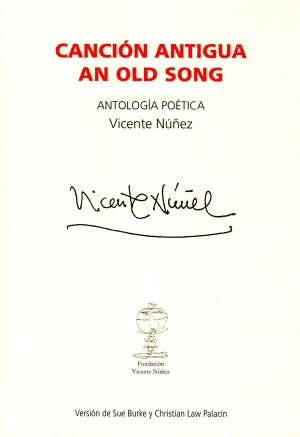
A while back, when I was living in Spain, Christian Law Palacín and I translated a collection of poems by Vicente Núñez for the Vicente Núñez Foundation titled Canción antigua: An Old Song.
Vicente Núñez (June 8, 1926 – June 22, 2002) is considered one of the most important Andalusian poets in the second half of the 20th century. In 1982 he won the National Critic’s Award for Spanish Poetry with his collection Ocaso en Poley. Poley is the ancient name of his home town, Aguilar de la Frontera, near the city of Cordova.
I treasured his poems’ lyric musicality and moving metaphors, often centered on hidden love because for many years in Spain he had to hide his gay identity. But I think there is one poem that I managed to capture especially well in English. It’s the title poem of the collection Ocaso en Poley. Here is the poem, my translation — and, why not, a couple of machine translations.
Ocaso en Poley
Si la tarde no altera la divina hermosura
de tus oscuros ojos fijos en el declive
de la luz que sucumbe. Si no empaña mi alma
la secreta delicia de tus rocas hundidas.
Si nadie nos advierte. Si en nosotros se apaga
toda estéril memoria que amengüe o que diluya
este amor que nos salva más allá de los astros,
no hablemos ya, bien mío. Y arrástrame hacia el hondo
Last week I served as an instructor at the Novel-In-Progress Bookcamp & Writing Retreat in Racine, Wisconsin. Among other tasks, I led a class called “Let’s Build an Alien” with the goal of making the lesson as participatory as possible.
After I set up a few parameters, I encouraged the budding SF authors to work out the alien as a group, which they did with enthusiasm. Then they took it a step further and collaborated on a story that they eventually titled “The Aurora Psychosis.” The photo shows the rather incomplete notes I took as we went along. (H.E.A. means “happily ever after.”) The class got wild — in a good way. Everyone laughed a lot and worked together to build a story on the fly with as many effective storytelling techniques as possible.
Next, one of the authors, John Schneider, typed up the notes, fed them to Chat GPT4, and tasked it with creating a 1000-word story in the style of Ursula K. Le Guin. Here’s the story it wrote, followed by John’s instructions — followed by a version a reader of this blog wrote that captures the playful spirit the class intended.
We had great fun, and the novelists assured me that they did in fact learn something — although they mentioned different things.
***
“The Aurora Psychosis”
Across the cosmos, an alien entity, Aurora, traversed starlit expanses. A silicon-based symbiont, a global web of electromagnetic energy, akin to a cosmic fishing net, it was drawn towards Earth, a hotspot of enticing electromagnetic flux.
Meanwhile, at the CERN Large Hadron Collider in Switzerland, scientists, oblivious to Aurora’s existence, activated the collider to probe the mysterious subatomic realms. Unbeknownst to them, the colossal energy released pinned Aurora to Earth, anchoring her in a foreign ecosystem.
On Earth, Aurora sought contact with the terrestrial lifeforms. She released tiny particles of ground glass, christened sparkles, which drifted into human eyes, attempting to create a photonic link with the hosts’ nervous systems.
The result was a series of confusing, sometimes terrifying experiences. Humans, the sparkles in their eyes, witnessed hallucinatory visions, a psychedelic psychosis induced by Aurora’s attempts at communication. Some even experienced intense pleasure via sudden activation of their spinal innervation.
Yet the sparkles also brought unexpected benefits. They fell into the seas, where they dissolved microplastics, purifying polluted waters. Around the equator and over the Alpine region, they created stunning borealis spectacles, the night skies awash with technicolor. However, they also played havoc with communications systems, scattering and misdirecting electromagnetic signals, causing chaos in an increasingly connected world.
The World Health Organization and World Oceanic Organization mobilized to understand this puzzling crisis and the bizarre oceanic reclamation, respectively. Yet, solutions seemed elusive.
A turning point came when a school trip of young STEM enthusiasts ventured to the beach. Two students, a boy and a girl, were chosen by Aurora. Their undeveloped minds, combined with the ocean’s ionic concoction, allowed a successful communication link with the alien entity.
They grasped Aurora’s predicament and her desperate need to be freed. The boy’s sister, an intern at CERN, offered a possible solution. Aided by Aurora, they journeyed to Switzerland. En route, a WOO team sought to detain them. Aurora intervened, immersing the pursuers in a cloud of sparkles, plunging them into a state of ecstatic paralysis.
In a climactic move, Aurora released a massive sparkle bloom, causing mass psychedelic psychosis and waves of spontaneous pleasure across the globe. It bought the children time, allowing them to reach CERN amidst the global commotion.
Arriving at CERN, they found the research team celebrating recent successes. At first, their story was met with laughter and disbelief. However, Aurora’s sparkle-infused persuasion eventually convinced the team to reactivate the LHC.
As the Hadron Collider roared to life, the captivating spectacle of the Aurora was seen fading away. Released from the earthly bonds, the silicon being resumed her cosmic journey, leaving behind a world irrevocably changed, now full of tales of the Aurora Psychosis.
***
Chat GPT 4.0 Run (John’s instructions to the AI)
Prompt: Create at 1000-word short story in the style of Ursula K. Le Guin based on the following outline.
NOTE: This is an expanded outline, created by the Speculative Fiction Group on Tuesday evening.
Title: The Aurora Psychosis
The alien species is a conglomerate symbiont. It has is a silicon based, rather than carbon based, life form and is a planet spanning electro-ethereal webbing like a fishing net. The being, Aurora, comes to Earth due to the high amount of electromagnetic flux emitted from the planet.
The scientists at the CERN Large Hadron Collider in Switzerland are conducting a study to examine the structure of subatomic particles, and when the collider fires, it inadvertently captures or pins part of Aurora to Earth.
Aurora starts to try and communicate with Earth and the potentially intelligent life forms on the planet. Aurora drops small ground glass particles to connect and communicate. The particles, called sparkles, settle into the corner of your eye and attempts to make a photonic link with the host’s nervous system.
This creates a series of seemingly perplexing and dangerous circumstances. People with a sparkle in their eye experience a peyote-like psychedelic psychosis with vivid, surreal and bizarre images, which is Aurora’s communication. In some subjects it activates spinal track innervations, and they experience an orgasm without any identifiable stimulation.
There are several addition unintended consequences of the sparkles once they are released. One side effect is where the sparkles, landing in the ocean or sea, break down microplastic beads, improving our environment. Another action the sparkles create is a vivid colorful borealis phenomenon, but rather than at the poles, it occurs along the equator and over the central European Alpine region.
Finally, it disrupts communication systems, by refracting, scattering and misdirecting all sorts of electromagnetic flux-based signals. This causes WIFI to work sporadically and cause firewalls to fail with secure communications going to the wrong or unintended receiver. This also causes broadcasts from one country or source to arrive inappropriately in another.
The World Health Organization springs into action to understand the psychosis as it appears to be of a viral or infectious source. The World Oceanic Organization begins to study the unexplained reclamation of our seas.
While WHO and WOO are floundering about, a field trip of middle schoolers from a STEM prep-school to the oceanside results in Aurora successfully communicating with a boy and a girl. The less developed and less pruned brain, coupled with the plastic microbeads and ionic mixture of sea water, allows the link between Aurora and the kids.
The kids realize what is happening and commit to help Aurora escape. The boy’s older sister is an intern at CERN. With the help of Aurora, the kids travel to Switzerland and make their way to CERN. Enroute there is a team from WOO that attempts to stop the kids, but Aurora infects the antagonists with sparkles, causing them to fall into a prolonged autonomic excitation state.
Aurora pushes out a final large bloom of sparkles, setting most of the adult citizens of the world to be overtaken by the psychosis and spontaneous orgasms.
At CERN, the graduate students and interns are having a raucous soiree celebrating their recent success when the kids arrive. With the help of Aurora Sparkles, the kids can finally break through and convince them to fire the LHC again to release Aurora.
The LHC goes through its firing sequence and Aurora is released.
***
Edited to add:
Tor Hansen read the ChatGPT story and was inspired to see what a human author could do. He kept his version to the 1000-word limit but made a few little changes that seemed obvious to a human imagination. The result, I think, is more like what the writing class had in mind: light-hearted, fast-moving, and with sparkling (no pun intended) dialogue.
If you like Tor’s version, take a look at his short stories and novels:
Thin. Stretched. Drawn out. In the dark spaces between the stars, the web of consciousness attenuates, each element a cold point of concentration in an infinite pool of blankness. Too near a star, destruction. Too distant, numbness.
The artificially modulated electromagnetic waves, penetrating Aurora’s field, drew the swarm, irresistibly, to intelligence on the third planet. Not too near, not too far from an insignificant sun in an unremarkable spiral arm of a very ordinary galaxy. But, even among the stars, curiosity must be cautious. As Aurora began to explore this innocuous world, a bolt of energy like a fishhook pinned the swarm to the planet. Retreat impossible, escape only by disintegration.
“Did you see that, Isabelle?” Doctor Gerhard Weber turned to the colleague monitoring the Large Hadron Collider beam position. “That deflection needs attention.”
“Yes. No. Wait. The radiation monitors… We need to abort and recalibrate.” Isabelle de Faux pulled the red emergency handle down. “Better safe…”
Aurora waited, coalesced about the point of pain, struggled back and forth but, no. Only an external force could remove the fastening. Assistance from the intelligence behind the entrapment was the only hope. Some few million sparkles – shards of conscious silicon – needed to be dispatched to see if whatever was responsible for this catastrophe could be persuaded to help.
For Gerhard and Isabelle, their shift had been a disaster and now, in the dawn, even the sky seemed infected. Waves of brightly coloured light dazzled: overhead in Geneva, and along the Southern horizon. “Not our problem,” Isabelle said. “What we need is sleep.”
“But, of course, it was their problem.” Anna kicked a pebble along the beach. “Gerhard said on the telephone, in the month since, he has hardly slept. Only worked. Every coil checked before they’re allowed to restart.”
“Meanwhile, we just wait? Ask him again to get us, at least, a pass to the visitor centre.” Ingrid sounded as bored as Anna felt.
“Not allowed to open. Not a CERN thing. WHO. Like the safety goggles.”
“I hate those things. I think I’m allergic. I’m taking them off.” Ingrid had complained about them from the start.
“Don’t even think about it. Look over the lake, clouds of sparkles. If they get in your eyes the madness starts. Definitely unsafe.”
“You believe that?” Ingrid laughed. “A government plot to control our thoughts?”
“Why would they ever do that?”
“To stop people having fun, being free. Mad hallucinations? Alien kidnaping? Trips to starships? All scare stories. I’m taking off the goggles. They say it’s very… sexy.”
“No. You mustn’t…” Too late. Ingrid’s goggles were on the ground. “Ingrid? Ingrid! Are you OK?”
She reached over and shook her. “Are you there? Can you hear me, Ingrid? Are you being abducted? It isn’t sexy, like they say, is it? You’re not turned on, are you?”
“I’m… here.” Ingrid sounded miles away. “No. Not sexy. Just a… very strange… conversation. Take off your goggles, too. I need you here.”
The conversation was strange. Mainly because Ingrid believed it was real. But if it wasn’t, how was Anna sharing her hallucination? An extra-terrestrial? Called Aurora? Visible as coloured bands in the sky? Trapped because a powerful machine had been switched off? Maybe Gerhard was right, and his failed experiment was the cause of the weird colours.
“We have to help, Anna,” Ingrid insisted. “Like the kids rescued ET. They can’t stay here. They’re weaker already – tomorrow’s too late. We have to get the collider switched on to free them.”
“We don’t even know they’re real. People have hallucinations. Face it, Ingrid, this is one of those. And, why us? Even if we want to help, what can two fifteen-year-old girls do?”
“Aurora says they tried to tell other people – thousands – but their minds were closed. If we carry a jar of sparkles into the control room, they can do the rest. If we try it, we’ll see they’re telling the truth.”
Anna was still protesting as the jar filled with sparkles. “My brother can’t get us into the building, let alone the control room.”
“Say you must see him. You know how unreliable the phones are with the radio waves disrupted. We can meet him in reception.” Ingrid put the lid on the jar and headed up past the UN building. “Put on your goggles. It’s ten kilometres.”
At the French customs post, the street was blocked.
“You see,” Anna said, “we can’t even get out of Switzerland.”
“Documents, please. And health certificates.” The gendarme smiled. “Now inside, for identification sans lunettes.”
The door closed behind them, and they removed their goggles.
“Wait!” The gendarme beckoned his colleague. “Your eyes – sparkles, I think.”
“Impossible! An artefact of your goggles. Look more closely.” As the two men removed their goggles and peered at her eyes, Ingrid opened the lid of the jar inside the carrier bag.
“Should we leave them?” Anna hesitated at the door.
“They’re OK. Enjoying themselves, I think.” Ingrid laughed.
At the control centre, the outer door was locked, isolated with WHO tape barriers, but eventually Gerhard appeared with security staff and a key. “Why so urgent?” he asked.
“It’s not a family thing,” Anna said. “Restart the Collider. To solve the psychosis problem.”
“You’ll need to explain to the Director General. He’s the only one—”
“No. Bring them.” The leader of the security detail interrupted. “And I’ll have that!”
He snatched the carrier containing the jar and marched them into the guardroom.
“Now what is this?” He extracted the brightly coloured jar.
“Whatever you do,” Ingrid said, “do not open that.”
“And why not?” He put his hand on the top.
“Just don’t do it. It’s… valuable.”
“We shall see about that!” He unscrewed the lid.
Free. Floating. In the dark spaces between the stars, the web of consciousness renews itself, each element a cold point of concentration in an infinite pool of blankness.
In the novel Dual Memory, the main character, Anton, has a favorite song, “It’s a Long Way.” I knew that the words came from a poem by William Stanley Beaumont Braithwaite. Later I learned the poem has actually been set to music twice.
Which would be Anton’s favorite version? I’m not sure. Since the poem is in the public domain, you can write your own version, too. Let me know if you do.
William Stanley Braithwaite (December 6, 1878 – June 8, 1962) was an African-American writer, poet, literary critic, anthologist, and publisher in the United States. His work as an anthologist helped develop East Coast poetry styles in the early 20th century. He was also key in publishing Harlem Renaissance poets and bringing them a wider audience. He was awarded the NAACP’s Spingarn Medal for distinguished achievements in literature in 1918.
In 2020, the Skylark Vocal Ensemble commissioned Nell Shaw Cohen to compose music for the poem. You can see the concert film and learn more here:
Like every writer I know, I’ve started too many stories that petered out and sit on my hard drive tucked out of sight so they don’t depress me. I know what went wrong for some of them. Here’s an analogy:
I’ve got a great starting idea for dinner today: I should use that lovely bag of baby spinach. But how? The too-many possibilities leave me indecisive. I can’t start cooking until I have a goal in mind, a finished dish.
For that reason, menus list dishes rather than random, tasty ingredients. The cooking show MasterChef uses the mystery box ingredient challenge to torture its contestants because the odds are against them cooking up something delectable. It’s fun to watch them fail.
Yet writers commonly start stories “to see where they’ll go.” Stephen King champions this technique. I think his story “Obits,” nominated for a 2016 Hugo, shows how it can fail. In the story, a man discovers he has an extraordinary skill. And then … he runs away and never does that thing again. The consequences of his skill, good or ill, are never explored. I suspect King didn’t know what to do with the idea. He didn’t win a 2016 Hugo.
By contrast, consider “Eutopia” (warning: spoilers in link) by Poul Anderson in the 1967 Harlan Ellison anthology Dangerous Visions. In that story, a time traveler must flee for something horrible he did, although he seems like a good man. The very last word of the story tells you what happened, and its impact helped Dangerous Visions redefine science fiction. The story’s structural success was no accident. Anderson started the story knowing precisely how it would end — and every word from the beginning pointed toward that end.
If I start a story or novel without knowing the ending, I might get blocked and, in panic, grab at the first ending that comes to mind, although it could be hackneyed or weak or miss the mark. Or I might not finish the story at all. If I start with a strong ending in mind, success is not guaranteed, but my odds are good.
I’ve learned that my ending idea need not be too specific: “He wins, although it means betraying some of his core values so he can uphold other values,” or “She kills her rival and takes over,” or “He lures the ghosts to a morgue and leaves them there, trapped.”
I still hope to achieve Anderson’s genius at endings — which means I have a goal (an ending) for the story of my writing career.
These days, if I’m working on a writing prompt, I try to write the ending of a story. I might draw on one of those half-baked ideas rattling around my brain, or I might come up with something new. I get a story that I know how to finish. Much more needs to be done to start the idea, of course, but the end is in sight.
Tonight, by the way, I’ll make a chicken-pasta-vegetable toss for dinner. The fresh baby spinach should be a delicious final touch. Bon appétit!