The time I got beat up after school

I’ve never told anyone about this, and looking back, silence may have been the kindest response. One day, as I was walking home from junior high school, another student attacked me in a parking lot, punched me, and kept knocking me down into the frozen snowpiles, screaming at me the whole time.

I was in eighth grade, and I barely knew the girl. We moved in separate circles. She was skinny, wore cheap and unfashionable clothes, had a bad haircut, smoked cigarettes, and always seemed angry. Even at the time, I sort of knew why she jumped me. It wasn’t about me, except that as a chubby, bookish, short girl, I was an easy target. Probably, I represented something she didn’t like.

Since I wasn’t really hurt — winter wear can make good protective padding — I continued home as fast as I could, although my resentment was off the scale. I didn’t deserve what had happened. In fact, I’d never even talked to that girl. She was angry, and she just wanted to beat someone up.

I didn’t tell anyone for two reasons. First, as a general principle, I tried to keep adults out of my business because they only made things more complicated. Second, if I told adults or even merely my friends, they would make things more complicated for her. She had enough trouble. Something was wrong in her life, and I didn’t want to add to it.

Beyond angry and resentful, I felt sorry for her. She needed help, and the most helpful thing I could do was to do nothing. I simply made sure to avoid her more thoroughly from then on. She moved away not too long after that. I’ve forgotten her name. I hope she got whatever she needed, and looking back, I have some guesses about what might have been going on with her.

Then and now, adults say children should report bullying. I didn’t, and I still think I did the right thing. I forgave her, gave her what grace I could, and moved on.

Review: “A Wizard’s Guide to Defensive Baking”

A Wizard’s Guide to Defensive BakingA Wizard’s Guide to Defensive Baking by T. Kingfisher
My rating: 5 of 5 stars

Your inner 12-year-old wants to read this novel. That child is still there, so don’t be put off by the fact that this is a middle-grade book. The hero, Mona, is 14 years old, and she has some magical sourdough starter. She also has a brave, magical gingerbread cookie, which you can see depicted on the cover art of the book holding a sword. Then things go very wrong (long story; it’s a novel, after all), and she has to save the city where she lives.

Mona is self-aware, a little snide, and more than a little resentful that such a heavy burden falls on her young shoulders. She gets wise advice and help along the way, and she winds up a hero.

The pacing is fast. The story is sometimes silly, sometimes serious, and sometimes even a bit dark, because kids — including your own inner child — want to grapple with life’s big challenges. The vocabulary might be simple, but the story explores complex themes. One of them: Is it actually good to become a hero?

View all my reviews

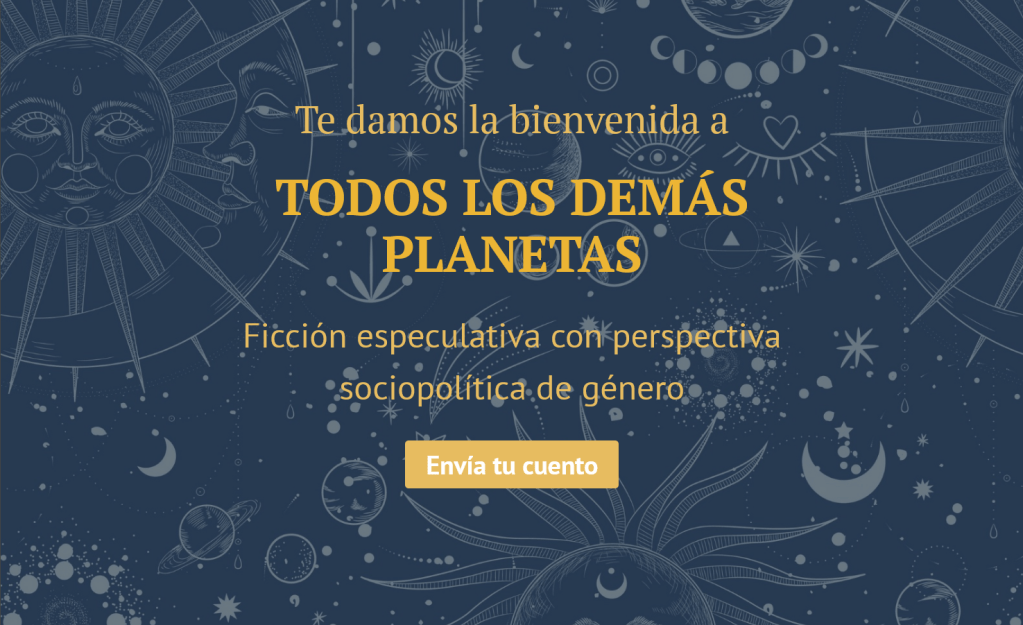
Convocatoria: “Todos los demás planetas”

Se abre el plazo para la convocatoria “Todos los demás planetas” desde el 12:00 a.m. del 30 de septiembre a las 11:59 p.m. del 31 de octubre de 2021, (hora de España).

Las escritoras españolas Sofía Rhei y Cristina Jurado y yo buscamos ficción especulativa con perspectiva sociopolítica de género, o sea, relatos que utilicen lenguaje de una manera creativa y no conformista respecto a los roles binarios de género. Se valorarán las formas de lenguaje neutro en todas sus variantes, femeninos genéricos, expresiones lingüísticas de sociedades con más de dos géneros, géneros originales y cualquier otra opción diferente a la normatividad del masculino plural por defecto. Las narraciones que aporten términos reales de culturas nativas en las que los roles de género se entiendan de manera diversa serán extraordinariamente bien recibidas.

Entre los relatos enviados se realizará una selección que será publicada en la revista SuperSonic. Asimismo, se elegirá un relato ganador que será traducido al inglés y enviado a diversas publicaciones internacionales.

Hasta 5.000 palabras, un relato por persona, textos inéditos y escritos en español.

El resultado se anunciará en la web de la convocatoria y en las RRSS de las convocantes el 1 de febrero de 2022.

Toda la información sobre esta iniciativa se puede consultar en la web https://todoslosdemasplanetas.com.

In the zone: What planet am I on?

Artist’s concept of how rocky, potentially habitable worlds might appear elsewhere in our galaxy. Credit: NASA/JPL-Caltech/R. Hurt. https://exoplanets.nasa.gov/what-is-an-exoplanet/planet-types/terrestrial/

You may have heard about “writing in the zone.” It’s a creative state where the writer or artist becomes one with the work, in the flow, totally focused. Athletes can experience this, too.

Having been a writer for a while, I can say that this rarely happens. Most of us work distracted, even if we’re trying not to multitask. The computer advises you about a program update, the dog wants your attention, you’re out of coffee, and what’s that funny smell?

Still, it can happen. I remember one time vividly. Actually, what I remember is when it ended. I’d been working on the novel Interference, which takes place on a distant planet called Pax. I felt like I was there, living in the odd and wonderful sights, the cacophony of sounds, and the scents that carried meaning.

Then I looked up. Where was I? Not on Pax. So what planet was this? A blue sky, an oxygen atmosphere, and lots of clear signs of homo sapiens dominance. Yeah, this was Earth. In fact, pretty soon I recognized the city, the building, and the year, and remembered what I was doing there.

I still had one wisp of a question. Why was I on Earth? Why not somewhere else or some other time? The answer was obvious — but not entirely satisfying. Do I really have to be here?

She thought it was only a dime…

Here’s a bit of my family lore. When my great-grandmother was a young girl, her family fell on hard times, and she had to get a job. They were living in Milwaukee, and Pabst Brewery had recently won a blue ribbon at the 1893 World Columbian Exposition, the Chicago World’s Fair. The brewery was tying blue silk ribbons on every bottle.

That was her new job. (In those days, children could work in factories that made beer.) After her first week, tying countless ribbons, she got her pay envelope. She could tell by feel that it contained only one small coin. A dime! She’d worked so hard and wanted to be so proud of the help she could give her family, but she’d earned only ten cents.

She cried all the way home on the trolley and gave the envelope to her mother, who opened it. The coin was a ten-dollar gold piece.