What’s a masterpiece worth?

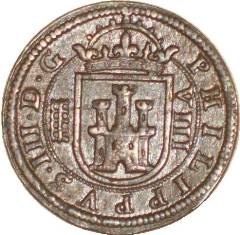
Originally published in 2010 when I lived in Madrid, Spain. The photo is of an eight maravedí coin from 1607, during the reign of King Felipe III, minted in Segovia.

***

What did Miguel de Cervantes earn from Don Quixote de la Mancha? We don’t know, but we have enough clues to try to guess. Cervantes was poor before it was published and poor after it was published, so it wasn’t a huge amount of money. Everyone agrees on that.

A little background

Don Quixote de la Mancha was published in two parts, the first in 1605 and the second in 1615. Cervantes didn’t plan on a second part, but after another author wrote a continuation, he decided to write his own.

In 1604, Cervantes was 50 years old and living in Valladolid. He had written a short story about Don Quixote, and he presented the idea of a novelization to publisher Francisco de Robles, who agreed and urged Cervantes to get it ready fast. Then the book was hastily edited (which explains the many errors in the text), printed on cheap paper with worn type, and rushed to the market.

Probably no one considered it a universal masterpiece, but the first edition of 1,000 copies sold well — in fact, it was immediately pirated in Lisbon. Cervantes had already won notice as a playwright, and this book, which satirized popular novels of chivalry and contemporary society, cemented his reputation as a major writer (at age 50, which was old at the time).

He had received a 10-year royal privilege to print Don Quixote, which he sold to Robles for an unknown amount; the paperwork was lost. But he had sold an earlier novel, La Galatea, to Robles’ grandfather for 1,336 reales, of which he eventually only received 1,086.

Nieves Concostrina, a journalist with Radio Nacional de España, reported in the series Acércate al Quijote that he received no more than 100 ducados (which equals 1,100 reales or 37,500 maravedíes) for the copyright, which she estimates as worth only about €200 today.

Daniel Eisenberg, the former editor of Cervantes, the scholarly journal of the Cervantes Society of America, wrote that he probably received 1,500 reales (51,000 maravedíes), which he says would have been worth 500,000 pesetas in 1992, or €5,503.72 today. That’s better, but still not a lot of money.

Maravedíes today

Their estimates in reales are reasonably close, so that’s a start. I don’t know how they arrived at modern currency, though. Converting antique currencies into present-day currencies can never be done well because, among other problems, the things that money can buy have changed. Cervantes never bought gasoline, for example. I don’t buy firewood.

But both Cervantes and I live in Madrid, and we both buy food. The Instituto de Cervantes, in its on-line footnotes to Quixote, has published the prices of several food items in New Castille in 1605. So let’s go shopping and do some math.

• A half-kilo of mutton sold for 28 maravedíes, according to the footnote. Mutton is no longer sold here, but a half-kilo of hamburger goes for €2.50 at my local grocery store. On that basis, 1 maravedí equals €0.089

• A chicken, 55m. The average price according to government’s Food Price Observatory’s latest statistics is €3.52. 1m = €0.064

• A dozen oranges, 54m. Food Price Observatory average is €4.26. 1m = €0.079

• Laying hen, 127m. Common price in local ads is €12. 1m = €0.094

• A ream of writing paper, 28m. A packet of A4 110 gr. Pioneer brand paper at Carlin, a major chain, €2.93. 1m = €0.104

• A dozen eggs, 63m. Food Price Observatory average is €1.33. 1m = €0.021 (This figure is an outlier, as you can see. The price of eggs has gone down a lot over the centuries. These days agribusinesses produce eggs in giant factory farms. Things change. For the better?)

The average of all these prices gives us 1m = €0.075. A weighted average would be better, I know, but how many laying hens do most of us buy now, so how much should they “weigh”? Not to mention the disparity in egg prices.

If we go with 7.5 euro cents per maravedí, the price of a copy of Quixote, set by law at 290.5 maravedíes, would have been €21.78. That sounds a bit low. We know that books were expensive items in those days. But that price was “en papel,” in paper — that is, as loose pages. The purchaser had to have them bound and covered at additional expense.

On the other hand, most people earned rather little. They would have spent a big part of their income, perhaps most of it, merely on food. According to the novel, Don Quixote spent three-fourths of his income on food for his household, and they ate frugally. A book would have taken a big bite out of tight budgets.

Not a get-rich quick scheme

If we accept that exchange rate — 1 maravedí = 7.5 euro cents — then Concostrina’s estimate of 37,400 maravedíes yields €2,805. Eisenberg’s 51,000 maravedíes yields €3,825.

It’s not a lot. Cervantes seems to have had income from other sources at the time. I hope so.

Those of you in the United States may be wondering what this is in US dollars. Yeesh. The dollar-euro exchange rate fluctuates daily, and there’s a worldwide currency war going on right now. On November 1, 2010, the value was USD$3,911.24 for Concostrina’s estimate and USD$5,333.50 for Eisenberg’s, but that will change. Go to Oanda for the latest numbers.

What Cervantes thought

In Book II, Chapter LXII of Don Quixote, our knight-errant meets an author in a printing shop in Barcelona and has this conversation:

“I would venture to swear,” said Don Quixote, “that you, sir, are not known in the world, which always begrudges its reward to rare wits and praiseworthy labors. What talents lie wasted there! What genius thrust away into corners! What worth left neglected! … But tell me, sir, are you printing this book at your own risk, or have you sold the copyright to some bookseller?”

“I print at my own risk,” said the author, “and I expect to make a thousand ducados at least with this first edition, which is to be of two thousand copies that should sell in the blink of an eye at six reales apiece.”

“A fine calculation you are making!” said Don Quixote. “It seems you don’t know the ins and outs of the printers, and the false accounting that some of them use. I promise you when you find yourself weighed down with two thousand copies, you will feel so careworn that it will astonish you, particularly if the book is unusual and not at all humorous.”

“Then what!” said the author. “Sir, do you wish me to give it to a bookseller who will give three maravedíes for the copyright and think he is doing me a favor? I do not print my books to win fame in the world, for I am already well-known by my works. I want to get something out of it, otherwise fame is not worth a farthing.”

Treasure, alien life, and ghosts

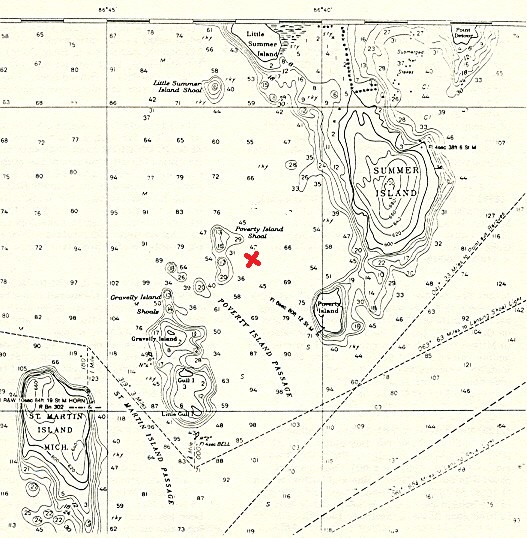
I know of two supposed sunken treasures of gold in Wisconsin, one in Lake Michigan and one in Lake Mendota, both dating back to the Civil War. I’ve researched the one in Lake Michigan and even have the treasure map which locates the gold near Poverty Island Shoal at the tip of Door Peninsula, but I haven’t decided to go hunt for it. I don’t think these treasures exist.

What interests me is why these stories stay alive. Lies are common as leaves in a forest, so why keep certain ones?

First, there’s a simple wish for sudden wealth, the motive force behind lotteries.

Second, legends often say that treasures, buried or sunken, are guarded by leprechauns, mermaids, or at least a curse — by beings alien and magic to our existence. It’s a wish for a livelier universe. In the same way, some of us hope for life on Mars or Andromeda, which would also be a real treasure.

Third, it’s a wish to preserve and honor the past by keeping stories alive. Ghosts work the same way. I met a woman whose neighbors told her the troubled presence she noticed on the stairway of the house she’d just bought was of a teenager who had committed suicide some 50 years earlier because he was gay. She hung a gay pride poster in the stairway to soothe him, and it seemed to work.

Most importantly, treasure is real. Sometimes — at Troy and in the Caribbean — gold is found, and then our wishes are confirmed. I can see Mars at night, and I might be watching Martians. If there are ghosts, I have visited haunted houses. When I lived in Milwaukee, someone else in that city named Susan Burke (not me) won the Supercash lottery. Riches await, if we keep searching.

X marks the spot.

Works eligible for awards

Here are some things published in 2025 that you may wish to consider nominating for an award — just a reminder. Some are my own works, some are my translations.

Science fiction and fantasy short stories by me

“To Defeat Water” Short story, 1175 words. If you curse Poseidon, he might curse you, too, time and time again. And life after life, you can fight back. Read it here: The Lorelei Signal, July 2025.

“Journey to Apollodorus” Novelette, 8760 words. In my novel Dual Memory, an AI named Par Augustus discovers a story about robots in the Apollodorus Crater on Mercury. This is the story. It focuses on the humans who struggle to create and maintain a scientific team when a lander sent to Mercury behaves unexpectedly. Success can be as stressful as failure. Oxygen Leaks Magazine, March 2025 (no longer in publication, contact me for a copy).

Novella translation

ChloroPhilia by Cristina Jurado. Translation of a novella, 20,200 words. Would you sacrifice your humanity to save the world? Nominated for Spain’s Ignotus Award, this strange coming-of-age story addresses life after an environmental disaster, collective madness, and sacrifices made for the greater good. Buy it here: Apex Books, January 2025.

Science fiction short story translations

“Trees at Night” by Ramiro Sanchiz. Translation of a short story, 6050 words. A librarian at a hospital-like sanatorium befriends a young patient named Federico for reasons that eventually become clear. Read it here: Clarkesworld Science Fiction and Fantasy Magazine, November 2025.

“Proxima One” by Caryanna Reuven. Translation of a short story, 4020 words. A machine intelligence called Proxima One sends probes into the galaxy on long journeys filled with waiting and yearning in a search for intelligent life. The probes cope with unexpected wonders, loss, and profound changes — but there is always possibility and hope. Read it here: Clarkesworld Science Fiction and Fantasy Magazine, May 2025.

“Bodyhoppers” by Rocío Vega. Translation of a short story, 5290 words. Minds can hop from body to body, but there’s always a problem because the system is designed to create them. One day, you can’t return to your own body because it’s occupied by someone with more money. Now you have no home, and you’re still madly in love. Clarkesworld Science Fiction and Fantasy Magazine, February 2025.

Poetry translation

Liquid Sand / Arena Líquida by Jorge Valdés Díaz-Vélez. Book of poetry translated by Christian Law Palacín and myself. This is the first major bilingual collection of poems by Jorge Valdés Díaz-Vélez, one of Mexico’s most respected contemporary poets. It gathers 42 of his works selected from six previous collections that span more than two decades of writing. Shearsman Books, November 2025.

‘Arena Líquida / Liquid Sand’ by Jorge Valdés Díaz-Vélez, translated by Sue Burke and Christian Law-Palacín

I translated the poems in Liquid Sand / Arena Líquida with my Spanish friend Christian. One of us would draft the translation of a poem, then we would pass it back and forth, debating words, lines, and meaning — the goal of a translation is always to maintain the meaning. We didn’t quibble much. Translation is easiest when the original work is well-written.

In the opening poem, “Nadie / No One,” Ulysses returns to Ithaca to become a specter among his own memories. While there’s no way to summarize a collection of 42 poems, the theme of time occurs often. Time moves, and we move, but in different directions for different reasons, as the poem “Negro Sol / Black Sun” says:

The afternoon weighs heavily
toward its settlement. Ours
is due to a harder sun
and we have had to learn
to walk beneath its burden.

Liquid Sand / Arena Líquida is the first major bilingual collection of poems by Jorge Valdés Díaz-Vélez, one of Mexico’s most respected contemporary poets. Published this month by Shearsman Books and available from most bookstores, it gathers works by Valdés Díaz-Vélez selected from six previous collections that span more than two decades of writing.

Madrid Review Magazine says:

“In these pages, Valdés Díaz-Vélez explores time, memory, and the fragile equilibrium between movement and stillness. His poems evoke the physical and emotional geographies of the Americas while questioning belonging, transformation, and endurance. The English versions retain the clarity and meditative strength of the originals, inviting readers to cross the line between two languages and two sensibilities. To read Liquid Sand / Arena Líquida is to encounter poetry that is precise, reflective, and alert to the unseen rhythms of contemporary life. It is a landmark publication for readers of bilingual and Latin American literature.”

My vote for the Nebula Award for Novelette

As a member of the Science Fiction and Fantasy Association, I get to vote for the Nebula Awards. Here is my vote in the category of novelette (7,500 to 17,500 words). The award will be presented at the Nebula Conference on June 7 in Kansas City.

Overall, the stories amounted to a satisfying little anthology. I based my vote on the strength of the storytelling, not an easy metric to apply since they’re all good, but I thought one in particular was slightly better. Of course, your opinion may differ.

Negative Scholarship on the Fifth State of Being” by A.W. Prihandita (Clarkesworld 11/24) — A doctor finds herself limited by bureaucracy when an unusual alien comes seeking her care. Your heartstrings will be tugged.

Loneliness Universe” by Eugenia Triantafyllou (Uncanny 5-6/24) — Friends try to meet, but they can’t find each other even though they’re in the same place. Then things get more eerie (no spoilers). Not quite horror but very unsettling.

Katya Vasilievna and the Second Drowning of Baba Rechka” by Christine Hanolsy (Beneath Ceaseless Skies 4/18/24) — Romantasy, sweet and fulfilling. All fairy tales (or rather, tales about vengeful river spirits) should be like this.

The Brotherhood of Montague St. Video” by Thomas Ha (Clarkesworld 5/24) — The accidental discovery of a book printed on paper triggers an existential crisis in an electronic world with constant volatility. The understated storytelling style effectively delivers growing horror.

What Any Dead Thing Wants” by Aimee Ogden (Psychopomp 2/24) — Terraforming by magic leaves behind ghosts that want something. The cool, deadpan narration makes the fantastic feel real, but the magic system seems inconsistent to me.

Joanna’s Bodies” by Eugenia Triantafyllou (Psychopomp 7/1/24) — A teenage girl finds a supernatural means to bring a dead friend back. Although this is an obviously bad idea, it’s made worse by resentment, manipulation, immaturity, and guilt. Told with a gripping voice.

My vote: “Another Girl Under the Iron Bell” by Angela Liu (Uncanny 9-10/24) — A demon will do anything to get freedom from an evil master. Which one, the demon or the master, is the most evil? Which one is in love? Every word is measured and every detail impeccable.