Two bits and pieces of eight

You may know the American English-language expression two bits from the musical/rhythmic riff, “shave and a haircut, two bits” or from the meaning of two-bit as something cheap or trivial. You may even know that in the United States, two bits is twenty-five cents, a quarter-dollar, so you might think that one bit is one-eight of a dollar. You would be right.

How did this linguistic oddity come to pass?

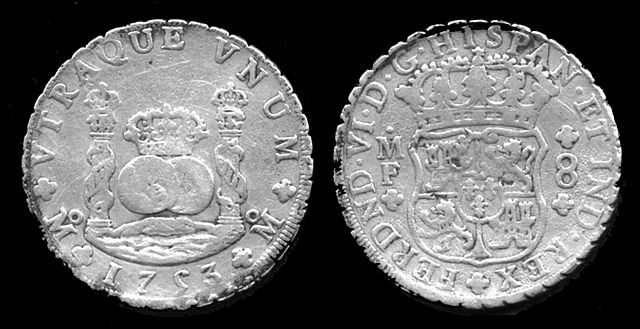
Back when the United States were British colonies, due to a coin shortage, the colonies tended to use a Spanish coin called a dollar, also known as a piece of eight because it was worth eight reales. The real coin had been circulating in Spain since medieval times, and because of the rich silver mines in Spanish colonies in Mexico and South America, during colonial times reales and Spanish dollars became common currency throughout the world. The one-eighth dollar coins became known as “bits” or parts of a dollar.

When the United States became an independent country, it started making its own silver dollars and smaller coins, including quarter-dollars, and the terminology for bits as eighths hung on for a couple of centuries. Language changes slower than currency.

As for Spanish, the only meaning of bit is another meaning for that word in English, a BInary digiT used in computer sciences. Spain stopped using reales in 1868, when it replaced them with the peseta, until that was replaced by the euro in 2002.

In English, a piece of eight remains as part of Caribbean piracy lore. Now you know the booty the pirates were after: silver coins. Yo-ho-ho and a bottle of rum.

The euro was coming!

Spain_20cent_2001We’re living through historic times. Of course, we’re always in the midst of history, but the pandemic reminds us that this time it’s big — and not what we would have chosen.

I lived through a much happier big event almost nineteen years ago. The European Union was switching to the euro. At the time, I was living in Spain, and we were all excited. Rarely do average citizens get to participate directly in such a grand moment as the introduction of a new international currency involving fourteen European countries.

In late December of 2001, I got my first euros, a “starter kit” bag of shiny new coins purchased at a bank with Spanish pesetas, about 12 euros’ worth. I took them home and admired them with a friend: some copper-colored, some gold-colored, and some silver and gold bi-metal. They depicted King Juan Carlos II, Cervantes, and the Cathedral of Santiago.

At an exchange rate of 166.386 pesetas per 1 euro, the math stumped us a little, but lots of businesses were handing out cards with conversion tables. We were going to need the help.

On January 1, 2002, we would begin to use this new, strange money.

No more would we use the peseta, which had served Spain for 133 years. No more peseta prizes would be offered in the El Gordo lottery, held every December 22. At the lottery drawing, the winning numbers and prizes are always sung, and in 2001, the audience began to sing along — singing goodbye to the peseta.

Euro-ready or not, nine days later, midnight struck! People lined up at ATMs on their way to New Year’s parties to withdraw the new cash. The Madrid subway system discovered that its ticket machines were not quite euro-ready and didn’t work with the new currency, so people got to ride free until that was fixed the next day.

Officially, the euro had existed as a non-physical currency starting January 1, 1999, so we’d had a long time to get ready. Despite all the preparations, on January 1 a waiter in France got confused and accepted a 5-denomination Monopoly bill as a 5€ bill: both are grayish, the same size, and have big 5s on them.

In Spain, we officially had until February 28 to shift over to the new currency, but it took only a few days. By law, we could pay in pesetas and get our change in euros, and that’s how we did it: people would buy a 100-peseta cup of coffee with a 10,000 peseta bill.

We all had to do a lot of math with the 166.386 exchange rate. For a long time I saw befuddled elderly people in stores helplessly holding out a handful of euro bills and coins to check-out clerks, who would pick out the right amount. The euro had cents, like dollars, and my husband had to teach our landlord how to write a check with decimals. I knew that the copper coins would tarnish soon like US pennies, but Spaniards were dismayed when they saw the pretty coins turn brown.

Yet even before the euro began circulating, problems had begun to surface. To avoid paying taxes on under-the-table earnings, many Spaniards kept significant savings in cash — suitcases full of bills. How could they exchange those for euros without paying taxes? They couldn’t, so they began spending the pesetas. One December 2001 advertisement for diamonds simply showed jewelry and the tagline: “Honey, the euro is coming and I don’t have a thing to wear.”

More problems with the euro eventually followed, especially after the financial crisis of 2008, a historic event that no one enjoyed living through. I prefer to remember those fun days eighteen years ago when we had bright new money in our purses and the knowledge that one day we would tell children, “I remember when I held my first euro coin.…”

Some day, I hope to bore children with the story of the excitement of getting my Covid-19 vaccination. Meanwhile, we’re all in a historic moment, and we can influence the outcome, at least a little. “Honey, the coronavirus is coming…”
Review: “This Is How You Lose the Time War”

This Is How You Lose the Time WarThis Is How You Lose the Time War by Amal El-Mohtar

My rating: 5 of 5 stars

This story of desperation is told in exhilarating prose. Two agents — enemies fighting in a war to the death across space and time — begin to leave each other letters, and their correspondence grows to matter more to each other than the war. The result is a gem of literary science fiction.

This short novel won a basketful of awards, but the best words about it may have been said by the authors, Max Gladstone and Amal el-Mohtar, in their Hugo Award acceptance speech.

Max: To travel in time you have to understand time. There’s no one history of the world — every telling leaves things and people out. But everything that happens, has happened.

Amal: We’re taught history as if it’s a letter written from the past and addressed to us, but if that’s true it’s a letter from a sybil or a spy, allusive, full of hidden meanings and secret writing. The work of a lifetime is learning to read between its lines — and then, learning to reply.

View all my reviews

“La libertad” quote in this website’s banner

Cervantes quote LibertadYou’ll notice this website’s banner displays some words painted in red on a stone wall. The quote comes from the novel Don Quixote. I took the photo during a visit to Salamanca, Spain, in 2008. (I used to live in Spain.)

It says:
“LA LIBERTAD, SANCHO, ES VNO DE LOS MÁS PRECIOSOS DONES QVE A LOS HOMBRES DIERON LOS CIELOS. CON ELLA NO PVEDEN IGVALARSE LOS TESOROS QVE ENCIERRA LA TIERRA NI EL MAR ENCVBRE”
DON QVIJOTE DE LA MANCHA, II, CAP. 58

[“Freedom, Sancho, is one of the most precious gifts that the heavens give to men. It cannot be equaled by the treasures buried in the earth nor covered by the sea.” Don Quixote de la Mancha, Part II, Ch. 58]

Don Quixote utters those words soon after he and his squire, Sancho, manage to politely flee the castle of a duke and duchess who had welcomed them as guests and then amused themselves by playing cruel tricks on them.

Salamanca has been a university town since the 1200s, and since the 1300s, students who receive a doctorate degree paint a symbol called a Victor on a wall of one of the buildings to celebrate. The paint is bull-blood red because Spain has a thing about bulls. Inscriptions in the style of the Victor symbol are also sometimes put up by the city for commemorations.

The full text of this commemoration reads:
SS. MM. LOS REYES ACOMPAÑADOS POR LOS JEFES DE ESTADO Y DE GOBIERNO IBEROAMERICANOS, DESCVBRIERON ESTA PLACA CON MOTIVO DE LA XV CVMBRE IBEROAMERICANA
IV CENTENARIO DE LA PVBLICACION DE “EL QVIJOTE”
EL AYVNTAMIENTO DE LA CIVDAD. 14 DE OCTVBRE DE 2005

[Their Royal Majesties, accompanied by Iberomerican heads of state and government, revealed this plaque on the occasion of the 15th Iberoamerican Summit.
400th anniversary of the publication of “Don Quixote”
The municipal government of the city. October 14, 2005]

That is, the King and Queen of Spain were part of a ceremony to inaugurate the wall-quote as a festive moment during a big international meeting. The city government created the plaque.

Cervantes may have studied at Salamanca University and lived in the city, and he located a number of his works there. While serving in the Spanish military, he was captured in battle by Ottoman corsairs in 1575 and held as a prisoner for almost five years, so he personally knew the value of the precious gift of freedom.