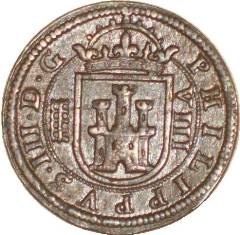
Originally published in 2010 when I lived in Madrid, Spain. The photo is of an eight maravedí coin from 1607, during the reign of King Felipe III, minted in Segovia.
***
What did Miguel de Cervantes earn from Don Quixote de la Mancha? We don’t know, but we have enough clues to try to guess. Cervantes was poor before it was published and poor after it was published, so it wasn’t a huge amount of money. Everyone agrees on that.
A little background
Don Quixote de la Mancha was published in two parts, the first in 1605 and the second in 1615. Cervantes didn’t plan on a second part, but after another author wrote a continuation, he decided to write his own.
In 1604, Cervantes was 50 years old and living in Valladolid. He had written a short story about Don Quixote, and he presented the idea of a novelization to publisher Francisco de Robles, who agreed and urged Cervantes to get it ready fast. Then the book was hastily edited (which explains the many errors in the text), printed on cheap paper with worn type, and rushed to the market.
Probably no one considered it a universal masterpiece, but the first edition of 1,000 copies sold well — in fact, it was immediately pirated in Lisbon. Cervantes had already won notice as a playwright, and this book, which satirized popular novels of chivalry and contemporary society, cemented his reputation as a major writer (at age 50, which was old at the time).
He had received a 10-year royal privilege to print Don Quixote, which he sold to Robles for an unknown amount; the paperwork was lost. But he had sold an earlier novel, La Galatea, to Robles’ grandfather for 1,336 reales, of which he eventually only received 1,086.
Nieves Concostrina, a journalist with Radio Nacional de España, reported in the series Acércate al Quijote that he received no more than 100 ducados (which equals 1,100 reales or 37,500 maravedíes) for the copyright, which she estimates as worth only about €200 today.
Daniel Eisenberg, the former editor of Cervantes, the scholarly journal of the Cervantes Society of America, wrote that he probably received 1,500 reales (51,000 maravedíes), which he says would have been worth 500,000 pesetas in 1992, or €5,503.72 today. That’s better, but still not a lot of money.
Maravedíes today
Their estimates in reales are reasonably close, so that’s a start. I don’t know how they arrived at modern currency, though. Converting antique currencies into present-day currencies can never be done well because, among other problems, the things that money can buy have changed. Cervantes never bought gasoline, for example. I don’t buy firewood.
But both Cervantes and I live in Madrid, and we both buy food. The Instituto de Cervantes, in its on-line footnotes to Quixote, has published the prices of several food items in New Castille in 1605. So let’s go shopping and do some math.
• A half-kilo of mutton sold for 28 maravedíes, according to the footnote. Mutton is no longer sold here, but a half-kilo of hamburger goes for €2.50 at my local grocery store. On that basis, 1 maravedí equals €0.089
• A chicken, 55m. The average price according to government’s Food Price Observatory’s latest statistics is €3.52. 1m = €0.064
• A dozen oranges, 54m. Food Price Observatory average is €4.26. 1m = €0.079
• Laying hen, 127m. Common price in local ads is €12. 1m = €0.094
• A ream of writing paper, 28m. A packet of A4 110 gr. Pioneer brand paper at Carlin, a major chain, €2.93. 1m = €0.104
• A dozen eggs, 63m. Food Price Observatory average is €1.33. 1m = €0.021 (This figure is an outlier, as you can see. The price of eggs has gone down a lot over the centuries. These days agribusinesses produce eggs in giant factory farms. Things change. For the better?)
The average of all these prices gives us 1m = €0.075. A weighted average would be better, I know, but how many laying hens do most of us buy now, so how much should they “weigh”? Not to mention the disparity in egg prices.
If we go with 7.5 euro cents per maravedí, the price of a copy of Quixote, set by law at 290.5 maravedíes, would have been €21.78. That sounds a bit low. We know that books were expensive items in those days. But that price was “en papel,” in paper — that is, as loose pages. The purchaser had to have them bound and covered at additional expense.
On the other hand, most people earned rather little. They would have spent a big part of their income, perhaps most of it, merely on food. According to the novel, Don Quixote spent three-fourths of his income on food for his household, and they ate frugally. A book would have taken a big bite out of tight budgets.
Not a get-rich quick scheme
If we accept that exchange rate — 1 maravedí = 7.5 euro cents — then Concostrina’s estimate of 37,400 maravedíes yields €2,805. Eisenberg’s 51,000 maravedíes yields €3,825.
It’s not a lot. Cervantes seems to have had income from other sources at the time. I hope so.
Those of you in the United States may be wondering what this is in US dollars. Yeesh. The dollar-euro exchange rate fluctuates daily, and there’s a worldwide currency war going on right now. On November 1, 2010, the value was USD$3,911.24 for Concostrina’s estimate and USD$5,333.50 for Eisenberg’s, but that will change. Go to Oanda for the latest numbers.
What Cervantes thought
In Book II, Chapter LXII of Don Quixote, our knight-errant meets an author in a printing shop in Barcelona and has this conversation:
“I would venture to swear,” said Don Quixote, “that you, sir, are not known in the world, which always begrudges its reward to rare wits and praiseworthy labors. What talents lie wasted there! What genius thrust away into corners! What worth left neglected! … But tell me, sir, are you printing this book at your own risk, or have you sold the copyright to some bookseller?”
“I print at my own risk,” said the author, “and I expect to make a thousand ducados at least with this first edition, which is to be of two thousand copies that should sell in the blink of an eye at six reales apiece.”
“A fine calculation you are making!” said Don Quixote. “It seems you don’t know the ins and outs of the printers, and the false accounting that some of them use. I promise you when you find yourself weighed down with two thousand copies, you will feel so careworn that it will astonish you, particularly if the book is unusual and not at all humorous.”
“Then what!” said the author. “Sir, do you wish me to give it to a bookseller who will give three maravedíes for the copyright and think he is doing me a favor? I do not print my books to win fame in the world, for I am already well-known by my works. I want to get something out of it, otherwise fame is not worth a farthing.”