The story of the madman in the bath

Here’s a little story from medieval Spain that I translated, and it has a moral and a punch line. It comes from El Conde Lucanor [Count Lucanor], a book written in 1335 by Don Juan Manuel (1282-1348), nephew of King Alfonso X of Castile.

The book is filled with “exemplary stories” to help the fictitious Count Lucanor deal with his concerns. This one, Exemplum XLIII, was cribbed from a popular story at the time. The Count asked how much he should tolerate from bad people. His advisor recounts this story, and the final line became a refrain.

(Photo: A bath at the Alhambra, Granada, Spain.)

***

A good man owned a public bath, and a madman came into the bath when people were bathing. He hit them with buckets and stones and sticks and everything else he could find, so no one in the world dared to go to the bath that belonged to the good man, who lost his income.

When the good man realized that the madman was making his business fail, he got up early one day and went to the bath before the madman came. He took off his clothes as if he were a customer and got a bucket of boiling water and a large wooden club. Then the madman who had been attacking people arrived at the bath.

The naked good man, who was waiting, saw him and ran at him with fierce anger. He threw the bucket of boiling water at his head and grabbed the club and began to strike him again and again on his head and body. The madman was afraid he would be killed and thought that the good man was mad.

He ran out screaming, and when he met a man who asked him why he was running and yelling, the madman told him:

“My friend, beware, because there is another madman in the bath.”

This book should have been banned

Bars and Shadows: The Prison Poems of Ralph Chaplin

Cover of book

This book of poetry should have been banned. Its author was serving a 20-year sentence in a federal penitentiary for his opinions, and the poems he wrote in Leavenworth were unrepentant:

“But whether it be yours to fall or kill / You must not pause to question why nor where. / You see the tiny crosses on that hill? / It took all those to make one millionaire.” (From the poem “The Red Feast.”)

Ralph Chaplin opposed the United States entering World War I. Worse than that, he opposed capitalism. As a member of the Industrial Workers of the World (IWW) and editor of its eastern US publication Solidarity, he made speeches and wrote poems and songs. The best known is “Solidarity Forever,” which became a union anthem.

But, as economist Scott Nearing wrote in the introduction to Bars and Shadows, “When the war broke out in Europe, with millions of working-men flinging death and misery at one another, men like Chaplin, the world over, regarded it as the last straw. Was it not bad enough that these exploited creatures should be used as factory-fodder? Must they be cannon-fodder, too?” In the eyes of the IWW, the war would only serve to increase the economic power of capitalists.

At the same time, the US Espionage Act of 1917 prohibited interference with military operations and recruitment, and any other speech deemed to support the enemy during wartime. Promptly, Chaplin and a hundred other IWW members were rounded up, convicted, and jailed for speaking out against the draft.

The Espionage Act, amended, is still part of US law and is still being invoked, but from the beginning it has had a contested relationship with free speech. During World War I, as recounted in the book Over Here by David M. Kennedy, one man was arrested for calling President Woodrow Wilson a Wall Street tool, and others faced charges for merely discussing the constitutionality of conscription. A man was jailed for saying the war was for J.P. Morgan “and not a war for the people.”

The law was amended in 1918 by the Sedition Act to further forbid “disloyal, profane, scurrilous, or abusive language” about the government, flag, and military. Expressions of opinions in one part of the country might be acceptable, but in other places, where public officials were dedicated to more vigorous enforcement, those same words by the same speaker were treasonous utterances that could bring jail time.

By 1922, however, when Ralph Chaplin’s book of poetry was published, the war to end all wars had ended, and alarmist lawmakers had moved on to other concerns. Chaplin was released after four years in prison.

I discovered this book in the library of my church, where we take pride in safeguarding banned books. We hold the first edition of Bars and Shadows, and the book is still in print today with many later editions by various publishers, and it’s available free from Project Gutenberg.

Chaplin told Nearing he was not a poet, which he said was an “aesthetic creature” who condescended to workers. He favored making culture “with a rebel note.” The thirty poems in the book adhere to meter and rhyme, and they tell us not to mourn the war dead “but rather mourn the apathetic throng” too cowed to speak. He describes the sound of a bugle playing taps to end the day in prison, and his longing for “the smell of grass and flowers,” and he compares his restless heart to the battle song of a storm. On Christmas day, seven sparrows perch at his barred window — so meagerly is his heart comforted. He misses his wife and son.

But his anger abides.

“The paragon of paltriness / Upraised for all to see […] / The smirking, ass-like multitude / Cringe down at his command […] / Is there not one to share with me / The shame and wrath I own?” (From the poem “Salaam!”)

He exalts when a prisoner escapes from the penitentiary, and he longs for freedom.

These poems express Chaplin’s sharply felt emotions and his grasp of the world that inspired those feelings. Sincere, simple words give the poems strength.

This book came into my hands more than a century after it was printed. Now speech is again being limited in the United States: legally suspect words include gay, women, diversity, equity, pronouns not assigned at birth, Black lives matter, Free Palestine, criticism of Tesla, or merely speaking Spanish in public. Who dares not grovel if you could be next? This little book offers a counterforce.

Let us continue to write poetry.

Don Quixote vs. science fiction

When I lived in Spain, I soon noticed that Miguel de Cervantes and his most celebrated novel, Don Quixote de la Mancha, permeated the culture. Think of Shakespeare in English-speaking realms, then dial it up to 11.

The book changed the way Spain thought about itself. It also made Spain reject any sort of non-realism in fiction, such as science fiction and fantasy, for centuries to come.

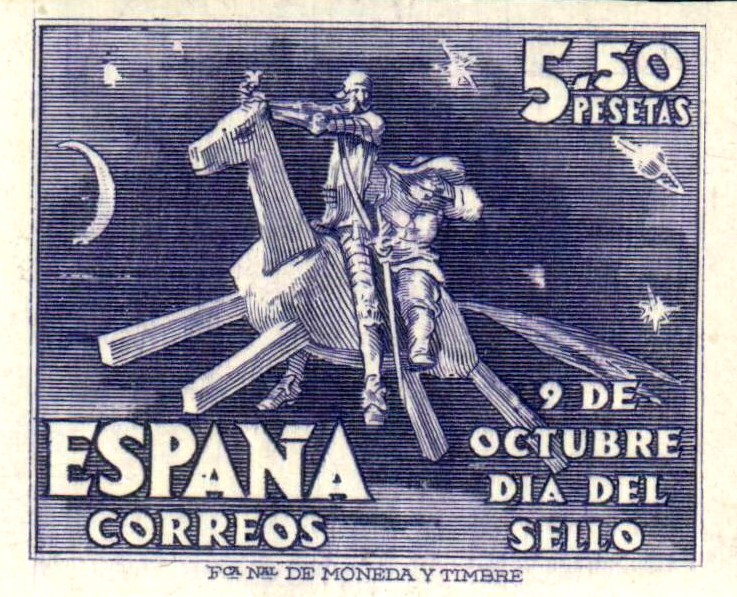
Published in 1605, Don Quixote tells the story of a poor, elderly nobleman driven mad by the fantasy novels of his day, which depicted brave knights and their dazzling deeds. The nobleman adopts the name Don Quixote and sets off on quests. In chapter VIII he famously mistakes windmills for terrible giants and attacks them. In chapter XLI, he is tricked into believing that an enchanted wooden horse has the power to carry him and his squire Sancho Panza through the sky. (Photo: Engraving from an 1863 edition of Don Quixote by Gustave Doré.)

Cervantes’s novel was written when Spain was in a period of desengaño or “disillusionment” after imperial losses, government bankruptcy, a deadly plague, failed harvests, economic disaster, and the defeat of the Invincible Armada. The nation had attempted to fulfill grand ambitions only to discover that it had been tilting at windmills. The novels that Cervantes’s fictional character read were real books that had, a generation earlier, inspired the conquistadors in their exploits: the state of California is named after an imaginary caliphate in one of those books, The Exploits of Esplandian, which was the sequel to Amadis of Gaul (which I translated here). Ambition was not enough, though, and eventually fantasy gave way to sad reality.

Don Quixote changed the way Spain thought about itself — and about literature.

“The problem with Spanish science fiction starts with Quixote,” the editor of a Spanish science fiction ‘zine told me. “Of course, it was a satire of the fantasy adventure novels of its day, and ever since then, perhaps because the satire was so biting, Spain has been the home of realism in fiction.”

School children were taught to scorn those novels of chivalric quests, speculation, and mysterious unknown lands, if they were taught about them at all. Still, a few writers always experimented with science fiction and fantasy, and in the 20th century, books from outside Spain began to inspire a generation.

“Fantastic” literature — science fiction, fantasy, and horror — was slow to gain acceptance as worthy, but in the 1980s and 1990s a growing number of authors encouraged each other and carved out a niche that has since flourished. In the 21st century, books like the Harry Potter and Twilight series appealed to massive numbers of young readers, to the surprise of established publishers and to the delight of the small publishers who had taken a chance on those novels and cashed in. All kinds of publishers took note. The ranks of fandom grew.

Just as in the English-speaking world, Spanish “mainstream” literature discovered it could no longer control access to respectability. Readers had their say.

I’ll be at Windycon this weekend

I’m attending Windycon this weekend, Chicagoland’s longest-running science fiction convention. This is its 50th year, and it will be held from November 8 to 10 at the Double Tree Hilton Hotel in the suburb of Oak Brook. This year’s theme is Infinite Diversity in Infinite Combinations.

With about 1,000 members, this is a more personal and friendly event than mega-conventions. Note the word “members” — the convention is organized by fans for fans, all volunteers, not by a professional corporation. It also has a literary bent, focusing on experienced and aspiring authors and writers. Topics for panels and activities range from astrophysics to costuming techniques to pop culture. This includes steampunk, dragons, fairies, robots, music, anime, zombies, pirates, ninjas, extraterrestrials, gaming, horror, space operas, urban fantasy, theater, vampires, time travel, and cats.

There’s also an art show, dealer’s room, gaming room, and legendary parties at night.

During the day, here’s where you can find me:

Early SF Authors and the Pseudonyms They Hid Behind — Friday, 6 to 7 p.m., Windsor Room. How would their work have been affected if they were allowed to show who they were? Panelists are Richard Chwedyk, Steven Silver, and W.A. Thomasson; moderator Sue Burke.

Writer’s Workshop — Saturday, 9 a.m. to 11:30 a.m. Preregistration required.

Author Reading — Saturday, 12 to 12:30 p.m., Ogden Room. I plan to read the essay “Do your neglected houseplants want revenge?” and the short story “Summer Home.”

Reading and Writing Through the Female Gaze — Saturday, 2 to 3 p.m., York Room. Panelists are Lisa Moe, Dina S. Krause, K.M. Herkes, and Alexis Craig; moderator Sue Burke.

The Many Facets of Fandom — Saturday, 8 to 9 p.m., Butterfield Room. How you experience the different brilliant sparkles depends on how you cut the gem that is fandom. Panelists are Jason Youngberg, Alexis Craig, and W.A. Thomasson; moderator Sue Burke.

Familiar or Fantastical? — Sunday, 10 to 11 a.m., Kent Room. What type of world-building do you enjoy with your fiction? Do you prefer far-off worlds or ours? Panelists are David Hankins and Sue Burke; moderator Bill Fawcett.

The Darker Side of Space — Sunday, 11 a.m. to 12 p.m., Hunt Room. The future is not always a garden of roses. Let’s discuss the darker side of science fiction futures. Panelists are Donna J.W. Munro, Chris Gerrib, and Paul Hahn; moderator Sue Burke.

Usurpation: Love will be ferocious

The novel Usurpation is the third in the Semiosis trilogy. The first book, Semiosis, takes place on a distant planet called Pax where the dominant species is an intelligent plant, rainbow bamboo. Stevland is the reigning bamboo. At the end of the second book, Interference, Stevland has sent his seeds to Earth, where the rainbow bamboo are flourishing, but no one knows they’re intelligent.

Then, at the end of Interference, Stevland sends a message to the bamboo on Earth: “…I must share a secret about humans. They are ours to protect and dominate.”

A bamboo named Levanter asks, “Tell us how.”

Stevland’s response finally arrives in Usurpation: “…Compassion will give you courage. Love will be ferocious.”

That’s all I can say without spoilers. In fact, I’ve probably spoiled enough already.

Usurpation will be released on October 29. I’ll be celebrating at 6:30 p.m. Wednesday, October 30, at Volumes Bookcafé, 1373 N. Milwaukee Ave., in Chicago, with Alex Kingsley, whose first novel, Empress of Dust, has just been released. You’re invited!It’s the day before Halloween, so you’re encouraged to cosplay.

You can see me at a Speculative Literature Foundation event read the opening of Chapter 3 of Usurpation in this 3-minute video. (All the novels in the trilogy are available as audiobooks, narrated by Caitlin Davies and Daniel Thomas May, who do a much better job than me.)

You can read a few reviews of Usurpation at NetGalley, and a recent review of Semiosis at Space Cat Press. Semiosis was named one of the 75 best science fiction books of all time by Esquire Magazine.

If you want an autographed copy of my next novel and you can’t come to the launch party, you can order it through Volumes Books here.