I do not have secret children

Close enough for AI.

I’ve discovered that there’s an entry about me in Grokipedia, and since I am the world’s leading expert in all things regarding Sue Burke, I took a look. Wow, 4,500 words, more than I think I’m worth. I don’t recommend you check it out, though. Let me explain why.

In case you haven’t heard of it, Grokipedia describes itself as “an AI-generated online encyclopedia operated by the American company xAI.” Elon Musk created the project because he believed Wikipedia had been influenced by the “woke mind virus.” Grokipedia asserts a commitment to neutrality in its AI-curated outputs, claiming to deliver “the truth, the whole truth and nothing but the truth” through an automated synthesis aligned with objective knowledge representation.

But it’s an AI, so it possesses only an illusion of understanding — and a recognized tendency for overstatement. I have “growing recognition,” “earned accolades” and “professional accolades” as well as “significant recognition” and a “growing reputation in the field.” Such flattery!

But there are errors. Here are a few.

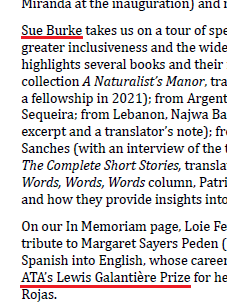
It says I won the American Translators Association Lewis Galantière Prize in 2010. I did not. I checked the footnote, and what I think happened is that my name and the prize were both mentioned on the same page of an ATA magazine (see photo). Proximity amounts to correlation for an AI.

The entry says, “In the late 1970s and early 1980s, Burke relocated briefly to Austin, Texas.” During those “brief” years — actually, during all the years from 1955 to 1998 — I lived in Milwaukee. I lived in Austin from 1998 to 1999.

Since there was no internet until the 1990s, Grokipedia has little to say about the first four decades of my life, although I assure you I was busy.

It says I published either “more than 40 short stories” (correct) or “about 25.”

It also slightly misstates a whole lot of things, and it invents causal connections that don’t exist. For example, it says that certain freelance jobs “significantly refined Burke’s stylistic precision and narrative voice.” Not true. I got those jobs because I already had the skills.

The AI tries very hard to create a narrative, so it adds cause and effect everywhere it can. In reality, my life has had a somewhat random quality to it. Things happened, and then I tried to make the best of the changed circumstances. There was no masterplan.

Grokipedia’s AI also tries to draw unwarranted conclusions. It says, “Burke keeps her family life private” and “no children are mentioned in available biographical accounts,” suggesting that I do have children, I just don’t tell anyone about them. Most people have children, so statistically I do too, right? In fact, I have talked about my family life, although there’s not always much to say. Children are one of life’s great adventures, and if I had them, they would be the smartest, best, most talented children in the world, and I would never tire of telling you about them.

My husband read my Grokipedia entry, and he had one good thing to say about it: “Now you don’t have to create a fake resume. The AI made one for you.”


What a year! The words of 2025

Let’s start with Spain, since I used to live there. The word of the year for 2025 is arancel (tariff), according to Fundéu, which advises on questions about Spanish language use for news reporting. Due to US policy changes, issues of tariffs for imports and exports have been in the news a lot in Spain.

The runners-up give a peek into other issues in Spanish news: apagón (power outage), macroincendio (massive wildfire), preparacionista (prepper), boicot (boycott), dron (drone), generación Z (Generation Z), macrorredada (massive roundup, specifically ICE arrests in the US) rearme (rearm, as with weapons), papa (pope), tierras raras (rare earths), and trumpismo (Trumpism).

The Economist magazine, Australia’s Macquarie Dictionary, and Merriam-Webster Dictionary all chose slop. “Slop merchants clog up the internet with drivel,” the Economist opines. Merriam-Webster defines slop as “digital content of low quality that is produced usually in quantity by means of artificial intelligence.” The Macquarie definition specifies “low-quality content created by generative AI, often containing errors, and not requested by the user.” All three sites have long lists of runner-up words.

For Oxford University Press, the word is rage bait, “online content deliberately designed to elicit anger or outrage by being frustrating, provocative, or offensive, typically posted in order to increase traffic to or engagement with a particular web page or social media account.” Oxford adds, “The Oxford Word of the Year can be a singular word or expression, which our lexicographers think of as a single unit of meaning.” The runners-up are aura farming and biohack. (Robert Reich points out that rage bait is profitable.)

Dictionary.com chose 67for 2025. “Most other two-digit numbers had no meaningful trend over that period, implying that there is something special about 67,” the site informs us, adding that “we’re all still trying to figure out exactly what it means.” Dictionary.com’s runners-up include an emoji. Both CNN and AP agree 67 can be annoying. The comic xkcd has additional information about funny numbers.

Canada’s Queens University picked maplewash, “the deceptive practice of making things appear more Canadian than they actually are.” That is, maplewashing encourages buying Canadian-made products rather than US imports. The word edged out elbows up. Both words speak to our times, and as an American, I apologize to our nice neighbors to the north.

Cambridge chose parasocial: “involving or relating to a connection that someone feels between themselves and a famous person they do not know, a character in a book, film, TV series, etc., or an artificial intelligence.” It adds, ominously, “The emergence of parasocial relationships with AI bots saw people treat ChatGPT as a confidant, friend or even romantic partner. These led to emotionally meaningful – and in some cases troubling – connections for users, and concerns about the consequences.” Sloppy consequences.

Collins Dictionary picked vibe coding, which “refers to the use of artificial intelligence prompted by natural language to write computer code.” (See also: slop.) Collins, too, has a runner-up list, and some of those terms will sound familiar.

Global Times reports that the Trilateral Cooperation Secretariat has chosen future as the China-Japan-South Korea Spirit Word of the Year. The secretary-general of TCS said future reflects the optimism and determination of the people of China, Japan, and South Korea to build closer ties in the future.

Time chose “the architects of AI” as Person of the Year 2025. (See also: slop.)

Pantone chose its color of the year, Cloud Dancer, “a lofty white that serves as a symbol of calming influence in a society rediscovering the value of quiet reflection. A billowy white imbued with serenity, PANTONE 11-4201 Cloud Dancer encourages true relaxation and focus, allowing the mind to wander and creativity to breathe, making room for innovation.”

As reported by NPR and Today, not everyone is impressed by the color, although Homes and Gardens points out that “white is timeless.” I should mention that my home office is painted white. In my case, it’s because I was too lazy to think harder.

Why I don’t use AI

Clanker

I don’t use AI because I’m lazy.

My job as a writer and translator is to produce excellence. Let me use translation as an example of how AI creates extra work because it’s easy to explain, and I really am lazy.

You may know that an AI can produce a translation that might be passably correct, although it will sound “off” in certain ways. I could use that as a first draft and fix it, right?

Sure. But it’s faster and easier to do it right the first time. If I fix an AI first draft, I have to go over every single word just as if I were translating it on my own, sometimes reviewing it several times, to drag it into excellence. Fixing AI slop is like flying from Chicago to New York and changing planes in Miami. I prefer a direct flight. I also prefer airplane pilots who have not ingested hallucinogens.

I’ve been writing professionally for more than a half century, and I’ve learned how to do a lot of things because I’ve done them uncounted times, but I still learn something new every single time I write anything. Using an AI would be like sending someone to the gym for me. I wouldn’t get stronger. Although I am lazy, I will work hard at writing because that’s how I pay the rent — and because I enjoy writing so much that I want to excel.

Striving for excellence is satisfying. Look at the faces of sweaty athletes on the field during a game. They’re having the time of their lives.

***

Rant over. If you want further rants, here are some curated links:

AI Killed My Job: Translators – by Brian Merchant

The Value of Human Translation – American Translators Association

Best Translation Apps: A Translator Puts Four to the Test – American Translators Association

Humans are being hired to make AI slop look less sloppy – NBC News

As AI Gets Smarter, It Acts More Evil – by Ted Gioia

Time to Play … !! SPOT THE BOT !! – Writer Unboxed

AI Spam – The Encyclopedia of Science Fiction

Criticism in the Age of AI – by Lincoln Michel

Artificial Intelligence and Ethics – Delancyplace

Word of the week: Clanker – by Nancy Friedman – Fritinancy

The Internet Is Turning You Into Someone You’d Hate IRL – WebMD

Could AI Data Centers Drain Lake Michigan? – The Block Club Chicago Podcast