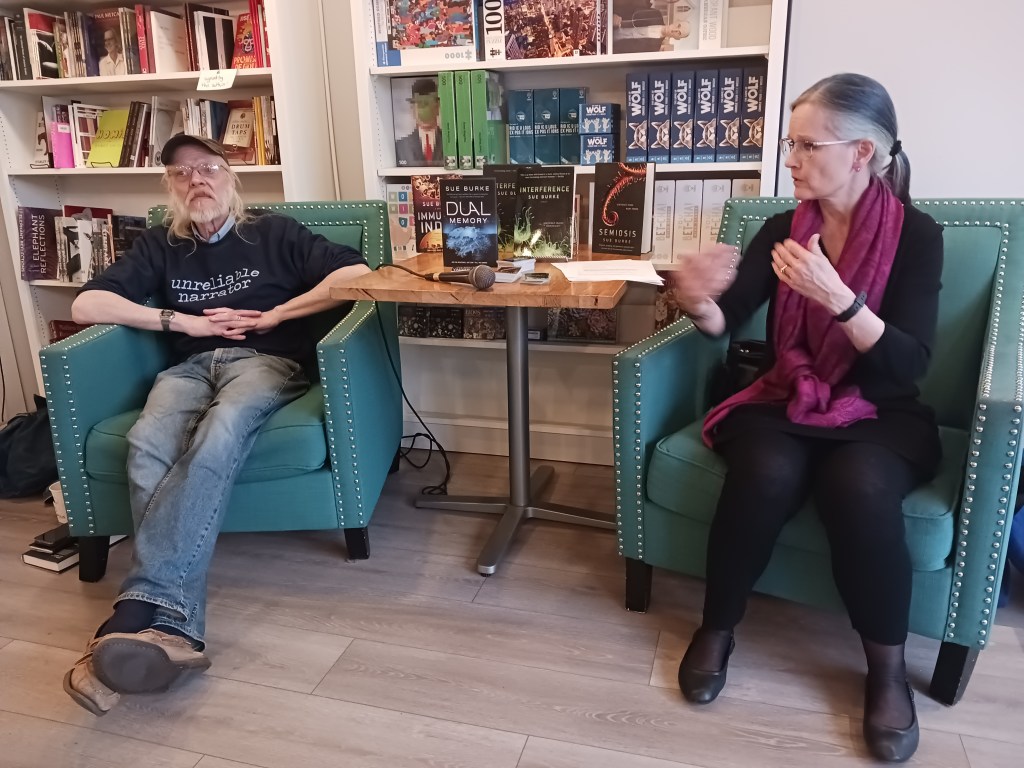
SFF Addicts and I talk and laugh a lot

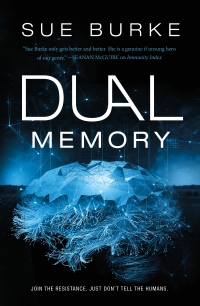
Adrian M. Gibson and M.J. Kuhn, co-hosts of the SFF Addicts Podcast, chat with me in Episode 51 about my next book, Dual Memory. We also discuss plant consciousness, since I’m very fond of plants even though they’re murderous. Then they ask me about book launch jitters, which I’m not at all fond of but I very much have.

Available today, May 2, in audio and video:

http://linktr.ee/SFFAddicts

http://youtube.com/@FanFiAddict

Dual Memory will be released on May 16. If you’re in Chicago, come to the launch party at Volumes Bookcafé, 1373 N. Milwaukee Ave., in the Wicker Park neighborhood, at 6:30 p.m. Tuesday, May 16, and witness my jitters. If you can’t come, you can order the book through Volumes and request an autograph, and I’d be delighted to sign a book to you personally.

My vote for the Nebula Award Best Novelette

For the past 58 years, the Science Fiction and Fantasy Writers Association (SFWA) has presented the Nebula Awards. The finalists for the best works in 2022 in seven categories have been announced, and the awards will be presented in a ceremony on Sunday, May 14, streaming live from Anaheim, CA, as part of the 2023 Nebula Conference Online. Winners are determined by the vote of SFWA members.

I’m a member of SFWA, and I’ve read all the works in the novelette category, which is 7,500 to 17,500 words. Every nominee in this category could reasonably win the Nebula.

They vary so widely that they could also serve as a quick survey of the breadth of current science fiction and fantasy in style as well as subject. Past, present, and future. Here, there, and nowhere. Love, courage, and honesty. Heart-warming, heart-breaking, and heart-stopping. Here are my impressions and my vote. If you can, read them for yourself.

Two Hands, Wrapped in Gold” by S.B. Divya (Uncanny 5–6/22) – Everything a boy touches turns to gold, which is a curse, not a blessing, and as an adult, he tries to use it to do something good and loving. Two cultures and two histories clash in the story — no spoilers, but it will become obvious in a satisfying way.

“A Dream of Electric Mothers” by Wole Talabi (Africa Risen anthology) – Technology manages to make tradition come true: ancestors can be consulted. But should their messages be trusted? Time and place, character and theme mesh to bring the answer.

The Prince of Salt and the Ocean’s Bargain” by Natalia Theodoridou (Uncanny 9/22) – Salt in the sea wishes to live and becomes a man, or so the story is told. Living turns out to be complicated. A twist at the end fulfills the story, which manages to be timeless and placeless and yet convey a universal meaning.

Murder by Pixel: Crime and Responsibility in the Digital Darkness” by S.L. Huang (Clarkesworld 12/22) – Can an AI unintentionally become a killer? Using the format of a magazine article, this story has the creepy feel of our present-day reality more than science fiction. It even has footnotes.

We Built This City” by Marie Vibbert (Clarkesworld 6/22) – Workers maintaining the dome over a city on Venus fight for their right to do their job in reasonable working conditions. Science fiction is always about the present.

My vote: “If You Find Yourself Speaking to God, Address God with the Informal You” by John Chu (Uncanny 7–8/22) – Can you be friends with a superhero? Can a superhero solve one of today’s ugliest problems? John Chu explores these questions with a tender, breakable heart, and emotional honesty suffuses every sentence.

My vote for the Nebula Award Best Short Story

For the past 58 years, the Science Fiction and Fantasy Writers Association (SFWA) has presented the Nebula Awards. The finalists for the best works in 2022 in seven categories have been announced. The awards will be presented on Sunday, May 14, streaming live from Anaheim, CA, as part of the 2023 Nebula Conference Online. Winners are determined by the vote of SFWA members.

I’m a member of SFWA, and I’ve read all the works in the short story category. Congratulations to the finalists! Every one of them is worth reading. There’s a bit more horror than in some years, and a bit of romance.

Here are my thoughts and my choice, with links to the stories available online. My criteria: Which story takes the most risk?

Dick Pig” by Ian Muneshwar (Nightmare 1/22) – The heir to a house, possibly haunted, struggles against family conflicts, told with unsettling honesty. Haunted houses are commonplace, but the visceral, coarse intensity of the narrator pushes this story into risky territory.

D.I.Y” by John Wiswell (Tor.com 8/24/22) – Two young self-taught magicians try to end a drought and wind up facing corporate greed. As usual with John Wiswell, there’s kindness, hope, humor, and a touch of sharp-eyed irony and cynicism. The two young magicians slowly dare to show their vulnerability toward each other: the story is about taking risks.

Douen” by Suzan Palumbo (The Dark 3/22) – A dead girl becomes a kind of ghost, struggling with the pain and loneliness of death. The story is set in Trinidad and Tobago culture and told in Creole. It shouldn’t be a risk to assert that non-White-centric culture has value and interest, should it?

Destiny Delayed” by Oghenechovwe Donald Ekpeki (Asimov’s 5–6/22) – Destiny can be taken from people, literally, and like anything of value, it becomes a commodity subject to corruption. The ending shows us what exactly is delayed. At risk is the reader’s hope.

“Give Me English” by Ai Jiang (F&SF 5–6/22) – Words are currency, and somehow, the exchange rate is always unfavorable to the poor. An immigrant to the New York from China loses her native Chinese and her English word by word while others acquire words she could never afford. Jiang explores a new idea, always a risk, and the result is effective and c____.

My choice: “Rabbit Test” by Samantha Mills (Uncanny 11–12/22) – The entire history of abortion is told as dystopia — which it is (I’ve been living it my whole life). This story made me angry, but not at the author. The story-telling style takes risks, braiding in different characters from different historical times, staying true to history while creating rich characters.

Here’s me reading Chapter 3 of ‘Dual Memory’

“Something woke up. Independent machine intelligence appeared rarely, spontaneously, and scientists didn’t understand the process. Some said an independent intelligence created itself slowly as bits of programming accumulated, and eventually it would ignite into consciousness — much the same way that a pile of manure would spontaneously combust…”

On March 16, I took part in the Speculative Literature Foundation’s Deep Dish reading at Volumes Bookcafé here in Chicago, and I read Chapter 3 of my next novel, Dual Memory. You can watch a video of that reading at YouTube. It’s a short chapter, 5 minutes, and it’s funny until it isn’t.

You can see the other readers — and they were great — at the Deep Dish YouTube channel, and learn more about them at the Speculative Literature Foundation’s website post.

Dual Memory comes out on May 16. I’ll have a launch party that evening at Volumes Bookcafé in the Wicker Park neighborhood of Chicago. If you can’t come but you want an autographed copy, you can order it through Volumes and we’ll be delighted to get it to you.

You can read the first chapter of Dual Memory and get links to more booksellers at the Tor Forge Blog.

And if you’re wondering what the book is about, here’s the review by Publisher’s Weekly:

Burke explores art and artificial intelligence in this clever near-future adventure. The dual narrators, one human and one computer, meet on the small arctic island of Thule, run by altruistic doctors. Antonio Moro is a Bronzewing mercenary defending the island from the Leviathon League raiders bent on enslaving its civilians when he is blasted from a rusty garbage barge. Injured, he’s left to recover ashore, and secretly ordered by Bronzewing Captain Soliana to root out raider infiltrators. He’s also linked to a personal assistant program, Par Augustus (or “Venerable Companion”), one of only four extant independent intelligent machines. Illiterate Antonio, a self-taught artist who is invariably polite to machines, and Par, a prickly manipulator capable of well-meant deceit, make an unlikely duo, but together they just might be able to save Thule from the Leviathon League. Burke loads the story with fascinating characters as she probes how humanity’s artistic capacity to inspire might interact with AI’s flexible intelligence. This playful glimpse of nonthreatening human-machine interaction is sure to charm.