What I saw wasn’t real and no one else could see it, and it was gorgeous.
I recently had a cataract-clouded lens in my eye removed and replaced with an artificial lens. I can see much better now.
But there’s something I can no longer see. My cataracts were the type that made halos around bright light, and these halos were like rainbows or glories. Walking down a street at night was a spectacle. The photo might give you an idea of what it was like.
I won’t miss the cataracts and the problems they caused, but I will miss the beautiful illusion of rainbows.
When I lived in Spain, I soon noticed that Miguel de Cervantes and his most celebrated novel, Don Quixote de la Mancha, permeated the culture. Think of Shakespeare in English-speaking realms, then dial it up to 11.
The book changed the way Spain thought about itself. It also made Spain reject any sort of non-realism in fiction, such as science fiction and fantasy, for centuries to come.
Published in 1605, Don Quixote tells the story of a poor, elderly nobleman driven mad by the fantasy novels of his day, which depicted brave knights and their dazzling deeds. The nobleman adopts the name Don Quixote and sets off on quests. In chapter VIII he famously mistakes windmills for terrible giants and attacks them. In chapter XLI, he is tricked into believing that an enchanted wooden horse has the power to carry him and his squire Sancho Panza through the sky. (Photo: Engraving from an 1863 edition of Don Quixote by Gustave Doré.)
Cervantes’s novel was written when Spain was in a period of desengaño or “disillusionment” after imperial losses, government bankruptcy, a deadly plague, failed harvests, economic disaster, and the defeat of the Invincible Armada. The nation had attempted to fulfill grand ambitions only to discover that it had been tilting at windmills. The novels that Cervantes’s fictional character read were real books that had, a generation earlier, inspired the conquistadors in their exploits: the state of California is named after an imaginary caliphate in one of those books, The Exploits of Esplandian, which was the sequel to Amadis of Gaul (which I translated here). Ambition was not enough, though, and eventually fantasy gave way to sad reality.
Don Quixote changed the way Spain thought about itself — and about literature.
“The problem with Spanish science fiction starts with Quixote,” the editor of a Spanish science fiction ‘zine told me. “Of course, it was a satire of the fantasy adventure novels of its day, and ever since then, perhaps because the satire was so biting, Spain has been the home of realism in fiction.”
School children were taught to scorn those novels of chivalric quests, speculation, and mysterious unknown lands, if they were taught about them at all. Still, a few writers always experimented with science fiction and fantasy, and in the 20th century, books from outside Spain began to inspire a generation.
“Fantastic” literature — science fiction, fantasy, and horror — was slow to gain acceptance as worthy, but in the 1980s and 1990s a growing number of authors encouraged each other and carved out a niche that has since flourished. In the 21st century, books like the Harry Potter and Twilight series appealed to massive numbers of young readers, to the surprise of established publishers and to the delight of the small publishers who had taken a chance on those novels and cashed in. All kinds of publishers took note. The ranks of fandom grew.
Just as in the English-speaking world, Spanish “mainstream” literature discovered it could no longer control access to respectability. Readers had their say.
I’m attending Windycon this weekend, Chicagoland’s longest-running science fiction convention. This is its 50th year, and it will be held from November 8 to 10 at the Double Tree Hilton Hotel in the suburb of Oak Brook. This year’s theme is Infinite Diversity in Infinite Combinations.
With about 1,000 members, this is a more personal and friendly event than mega-conventions. Note the word “members” — the convention is organized by fans for fans, all volunteers, not by a professional corporation. It also has a literary bent, focusing on experienced and aspiring authors and writers. Topics for panels and activities range from astrophysics to costuming techniques to pop culture. This includes steampunk, dragons, fairies, robots, music, anime, zombies, pirates, ninjas, extraterrestrials, gaming, horror, space operas, urban fantasy, theater, vampires, time travel, and cats.
There’s also an art show, dealer’s room, gaming room, and legendary parties at night.
During the day, here’s where you can find me:
Early SF Authors and the Pseudonyms They Hid Behind — Friday, 6 to 7 p.m., Windsor Room. How would their work have been affected if they were allowed to show who they were? Panelists are Richard Chwedyk, Steven Silver, and W.A. Thomasson; moderator Sue Burke.
Reading and Writing Through the Female Gaze — Saturday, 2 to 3 p.m., York Room. Panelists are Lisa Moe, Dina S. Krause, K.M. Herkes, and Alexis Craig; moderator Sue Burke.
The Many Facets of Fandom — Saturday, 8 to 9 p.m., Butterfield Room. How you experience the different brilliant sparkles depends on how you cut the gem that is fandom. Panelists are Jason Youngberg, Alexis Craig, and W.A. Thomasson; moderator Sue Burke.
Familiar or Fantastical? — Sunday, 10 to 11 a.m., Kent Room. What type of world-building do you enjoy with your fiction? Do you prefer far-off worlds or ours? Panelists are David Hankins and Sue Burke; moderator Bill Fawcett.
The Darker Side of Space — Sunday, 11 a.m. to 12 p.m., Hunt Room. The future is not always a garden of roses. Let’s discuss the darker side of science fiction futures. Panelists are Donna J.W. Munro, Chris Gerrib, and Paul Hahn; moderator Sue Burke.
Can an AI write a good short story? No. But some people are submitting AI-produced stories for publication anyway, hoping for a quick buck. For science fiction magazines, this is costing them time, money, and morale.
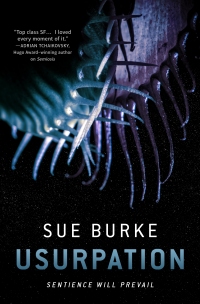
Today the novel Usurpation goes on sale! You can buy it wherever fine books are sold, available as hardcover, ebook, and audiobook. Find out why carnivory isn’t the worst thing a plant can do.
It’s the third book in the Semiosis trilogy, and here’s an incisive review of the series at Ancillary Review of Books by Alex Kingsley called “Imagining Radical Mutualism.”
If you’re in Chicago, please come to the book launch tomorrow, Wednesday, October 29, at 6:30 p.m. at Volumes Bookcafé, 1373 N. Milwaukee Ave. Since it’s the day before Halloween, feel free to wear a costume! (Don’t worry, you won’t be the only one.) If you’re not in Chicago and you want an autographed copy, you can order it through Volumes.