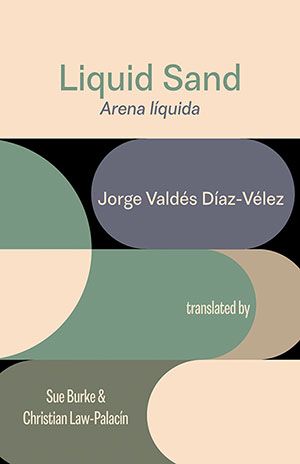
‘Arena Líquida / Liquid Sand’ by Jorge Valdés Díaz-Vélez, translated by Sue Burke and Christian Law-Palacín

I translated the poems in Liquid Sand / Arena Líquida with my Spanish friend Christian. One of us would draft the translation of a poem, then we would pass it back and forth, debating words, lines, and meaning — the goal of a translation is always to maintain the meaning. We didn’t quibble much. Translation is easiest when the original work is well-written.

In the opening poem, “Nadie / No One,” Ulysses returns to Ithaca to become a specter among his own memories. While there’s no way to summarize a collection of 42 poems, the theme of time occurs often. Time moves, and we move, but in different directions for different reasons, as the poem “Negro Sol / Black Sun” says:

The afternoon weighs heavily
toward its settlement. Ours
is due to a harder sun
and we have had to learn
to walk beneath its burden.

Liquid Sand / Arena Líquida is the first major bilingual collection of poems by Jorge Valdés Díaz-Vélez, one of Mexico’s most respected contemporary poets. Published this month by Shearsman Books and available from most bookstores, it gathers works by Valdés Díaz-Vélez selected from six previous collections that span more than two decades of writing.

Madrid Review Magazine says:

“In these pages, Valdés Díaz-Vélez explores time, memory, and the fragile equilibrium between movement and stillness. His poems evoke the physical and emotional geographies of the Americas while questioning belonging, transformation, and endurance. The English versions retain the clarity and meditative strength of the originals, inviting readers to cross the line between two languages and two sensibilities. To read Liquid Sand / Arena Líquida is to encounter poetry that is precise, reflective, and alert to the unseen rhythms of contemporary life. It is a landmark publication for readers of bilingual and Latin American literature.”

“En Paz” — two translations

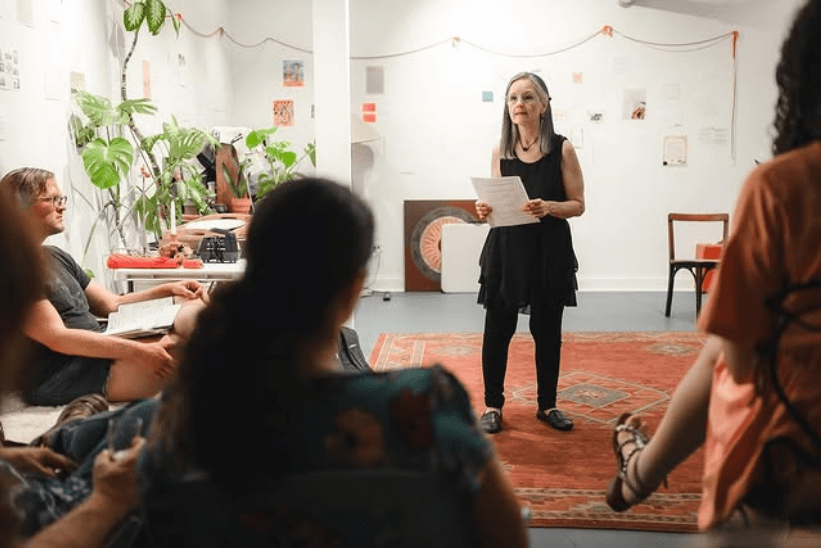
Because “En Paz” is my husband’s favorite poem, I read it at a recent open mic here in Chicago, along with my two translations. The poem is by Amado Nervo, a Mexican poet, and it’s one of his most beloved poems, published in 1916.

My first translation aimed at keeping the meter and rhyme of the original poem. Then I thought it might be a bit sing-song, and I had to force a few meanings to make it rhyme, so I made a second translation that hewed close to the original. At the reading, people had mixed opinions about which one they preferred. How about you?

En paz

Muy cerca de mi ocaso, yo te bendigo, vida,
porque nunca me diste ni esperanza fallida,
ni trabajos injustos, ni pena inmerecida;

porque veo al final de mi rudo camino
que yo fui el arquitecto de mi propio destino;

que si extraje la miel o la hiel de las cosas,
fue porque en ellas puse hiel o mieles sabrosas:
cuando planté rosales, coseché siempre rosas.

…Cierto, a mis lozanías va a seguir el invierno:
¡mas tú no me dijiste que mayo fuese eterno!

Hallé sin duda largas las noches de mis penas;
mas no me prometiste tú sólo noches buenas;
y en cambio tuve algunas santamente serenas...

Amé, fui amado, el sol acarició mi faz.
¡Vida, nada me debes! ¡Vida, estamos en paz!


At Peace

So close now to my sunset, life, I bless you,
you never gave me hopes that were untrue,
nor unjust labor, nor suffering undue;

at the end of my rough road I see
I was architect of my destiny;

Wherever I put ice in things, they froze,
when I wanted honey, its sweets I chose:
my rosebushes always grew me a rose.

…True, winter will follow my endeavor:
but you never said springtime was forever!

Indeed, I spent some long nights lost in woe;
but you never pledged just comfort to bestow;
and yet some nights I thrilled beneath moonglow…

I loved, was loved, in sunshine found release.
Life, you owe me nothing. Life, we are at peace!


At Peace

Very close to my sunset, I bless you, life,
because you never gave me false hope,
nor unjust troubles, nor undeserved blame;

because I see at the end of my hard path
that I was architect of my own destiny;

that if I took honey or ice from things,
it was because I put ice or delicious honey in them:
when I planted rose bushes, I always harvested roses.

…True, my youth will be followed by winter:
but you never told me May would last eternal!

I encountered of course some long nights of sorrows;
but you never promised me only good nights;
and on the other hand, I had some sacredly serene…

I loved, was loved, and the sun caressed my face.
Life, you owe me nothing! Life, we are at peace!

This book should have been banned

Bars and Shadows: The Prison Poems of Ralph Chaplin

Cover of book

This book of poetry should have been banned. Its author was serving a 20-year sentence in a federal penitentiary for his opinions, and the poems he wrote in Leavenworth were unrepentant:

“But whether it be yours to fall or kill / You must not pause to question why nor where. / You see the tiny crosses on that hill? / It took all those to make one millionaire.” (From the poem “The Red Feast.”)

Ralph Chaplin opposed the United States entering World War I. Worse than that, he opposed capitalism. As a member of the Industrial Workers of the World (IWW) and editor of its eastern US publication Solidarity, he made speeches and wrote poems and songs. The best known is “Solidarity Forever,” which became a union anthem.

But, as economist Scott Nearing wrote in the introduction to Bars and Shadows, “When the war broke out in Europe, with millions of working-men flinging death and misery at one another, men like Chaplin, the world over, regarded it as the last straw. Was it not bad enough that these exploited creatures should be used as factory-fodder? Must they be cannon-fodder, too?” In the eyes of the IWW, the war would only serve to increase the economic power of capitalists.

At the same time, the US Espionage Act of 1917 prohibited interference with military operations and recruitment, and any other speech deemed to support the enemy during wartime. Promptly, Chaplin and a hundred other IWW members were rounded up, convicted, and jailed for speaking out against the draft.

The Espionage Act, amended, is still part of US law and is still being invoked, but from the beginning it has had a contested relationship with free speech. During World War I, as recounted in the book Over Here by David M. Kennedy, one man was arrested for calling President Woodrow Wilson a Wall Street tool, and others faced charges for merely discussing the constitutionality of conscription. A man was jailed for saying the war was for J.P. Morgan “and not a war for the people.”

The law was amended in 1918 by the Sedition Act to further forbid “disloyal, profane, scurrilous, or abusive language” about the government, flag, and military. Expressions of opinions in one part of the country might be acceptable, but in other places, where public officials were dedicated to more vigorous enforcement, those same words by the same speaker were treasonous utterances that could bring jail time.

By 1922, however, when Ralph Chaplin’s book of poetry was published, the war to end all wars had ended, and alarmist lawmakers had moved on to other concerns. Chaplin was released after four years in prison.

I discovered this book in the library of my church, where we take pride in safeguarding banned books. We hold the first edition of Bars and Shadows, and the book is still in print today with many later editions by various publishers, and it’s available free from Project Gutenberg.

Chaplin told Nearing he was not a poet, which he said was an “aesthetic creature” who condescended to workers. He favored making culture “with a rebel note.” The thirty poems in the book adhere to meter and rhyme, and they tell us not to mourn the war dead “but rather mourn the apathetic throng” too cowed to speak. He describes the sound of a bugle playing taps to end the day in prison, and his longing for “the smell of grass and flowers,” and he compares his restless heart to the battle song of a storm. On Christmas day, seven sparrows perch at his barred window — so meagerly is his heart comforted. He misses his wife and son.

But his anger abides.

“The paragon of paltriness / Upraised for all to see […] / The smirking, ass-like multitude / Cringe down at his command […] / Is there not one to share with me / The shame and wrath I own?” (From the poem “Salaam!”)

He exalts when a prisoner escapes from the penitentiary, and he longs for freedom.

These poems express Chaplin’s sharply felt emotions and his grasp of the world that inspired those feelings. Sincere, simple words give the poems strength.

This book came into my hands more than a century after it was printed. Now speech is again being limited in the United States: legally suspect words include gay, women, diversity, equity, pronouns not assigned at birth, Black lives matter, Free Palestine, criticism of Tesla, or merely speaking Spanish in public. Who dares not grovel if you could be next? This little book offers a counterforce.

Let us continue to write poetry.