This book should have been banned

Bars and Shadows: The Prison Poems of Ralph Chaplin

Cover of book

This book of poetry should have been banned. Its author was serving a 20-year sentence in a federal penitentiary for his opinions, and the poems he wrote in Leavenworth were unrepentant:

“But whether it be yours to fall or kill / You must not pause to question why nor where. / You see the tiny crosses on that hill? / It took all those to make one millionaire.” (From the poem “The Red Feast.”)

Ralph Chaplin opposed the United States entering World War I. Worse than that, he opposed capitalism. As a member of the Industrial Workers of the World (IWW) and editor of its eastern US publication Solidarity, he made speeches and wrote poems and songs. The best known is “Solidarity Forever,” which became a union anthem.

But, as economist Scott Nearing wrote in the introduction to Bars and Shadows, “When the war broke out in Europe, with millions of working-men flinging death and misery at one another, men like Chaplin, the world over, regarded it as the last straw. Was it not bad enough that these exploited creatures should be used as factory-fodder? Must they be cannon-fodder, too?” In the eyes of the IWW, the war would only serve to increase the economic power of capitalists.

At the same time, the US Espionage Act of 1917 prohibited interference with military operations and recruitment, and any other speech deemed to support the enemy during wartime. Promptly, Chaplin and a hundred other IWW members were rounded up, convicted, and jailed for speaking out against the draft.

The Espionage Act, amended, is still part of US law and is still being invoked, but from the beginning it has had a contested relationship with free speech. During World War I, as recounted in the book Over Here by David M. Kennedy, one man was arrested for calling President Woodrow Wilson a Wall Street tool, and others faced charges for merely discussing the constitutionality of conscription. A man was jailed for saying the war was for J.P. Morgan “and not a war for the people.”

The law was amended in 1918 by the Sedition Act to further forbid “disloyal, profane, scurrilous, or abusive language” about the government, flag, and military. Expressions of opinions in one part of the country might be acceptable, but in other places, where public officials were dedicated to more vigorous enforcement, those same words by the same speaker were treasonous utterances that could bring jail time.

By 1922, however, when Ralph Chaplin’s book of poetry was published, the war to end all wars had ended, and alarmist lawmakers had moved on to other concerns. Chaplin was released after four years in prison.

I discovered this book in the library of my church, where we take pride in safeguarding banned books. We hold the first edition of Bars and Shadows, and the book is still in print today with many later editions by various publishers, and it’s available free from Project Gutenberg.

Chaplin told Nearing he was not a poet, which he said was an “aesthetic creature” who condescended to workers. He favored making culture “with a rebel note.” The thirty poems in the book adhere to meter and rhyme, and they tell us not to mourn the war dead “but rather mourn the apathetic throng” too cowed to speak. He describes the sound of a bugle playing taps to end the day in prison, and his longing for “the smell of grass and flowers,” and he compares his restless heart to the battle song of a storm. On Christmas day, seven sparrows perch at his barred window — so meagerly is his heart comforted. He misses his wife and son.

But his anger abides.

“The paragon of paltriness / Upraised for all to see […] / The smirking, ass-like multitude / Cringe down at his command […] / Is there not one to share with me / The shame and wrath I own?” (From the poem “Salaam!”)

He exalts when a prisoner escapes from the penitentiary, and he longs for freedom.

These poems express Chaplin’s sharply felt emotions and his grasp of the world that inspired those feelings. Sincere, simple words give the poems strength.

This book came into my hands more than a century after it was printed. Now speech is again being limited in the United States: legally suspect words include gay, women, diversity, equity, pronouns not assigned at birth, Black lives matter, Free Palestine, criticism of Tesla, or merely speaking Spanish in public. Who dares not grovel if you could be next? This little book offers a counterforce.

Let us continue to write poetry.
Don Quixote vs. science fiction

When I lived in Spain, I soon noticed that Miguel de Cervantes and his most celebrated novel, Don Quixote de la Mancha, permeated the culture. Think of Shakespeare in English-speaking realms, then dial it up to 11.

The book changed the way Spain thought about itself. It also made Spain reject any sort of non-realism in fiction, such as science fiction and fantasy, for centuries to come.

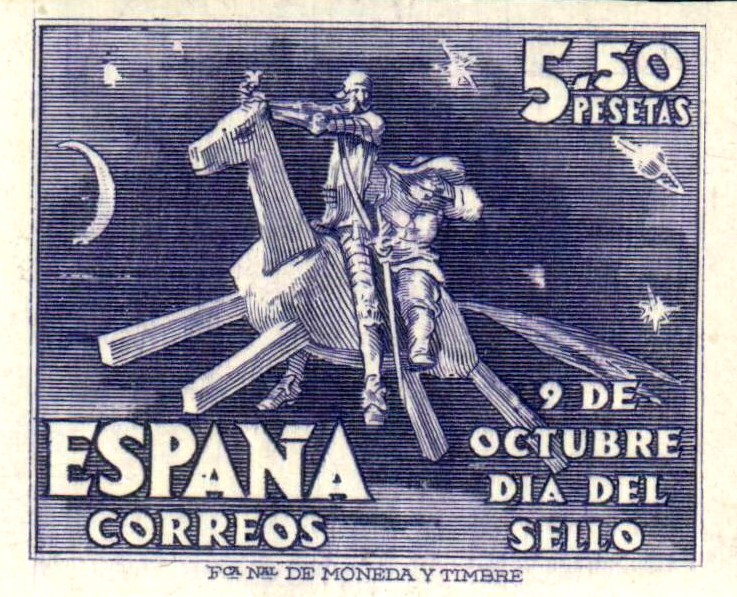
Published in 1605, Don Quixote tells the story of a poor, elderly nobleman driven mad by the fantasy novels of his day, which depicted brave knights and their dazzling deeds. The nobleman adopts the name Don Quixote and sets off on quests. In chapter VIII he famously mistakes windmills for terrible giants and attacks them. In chapter XLI, he is tricked into believing that an enchanted wooden horse has the power to carry him and his squire Sancho Panza through the sky. (Photo: Engraving from an 1863 edition of Don Quixote by Gustave Doré.)

Cervantes’s novel was written when Spain was in a period of desengaño or “disillusionment” after imperial losses, government bankruptcy, a deadly plague, failed harvests, economic disaster, and the defeat of the Invincible Armada. The nation had attempted to fulfill grand ambitions only to discover that it had been tilting at windmills. The novels that Cervantes’s fictional character read were real books that had, a generation earlier, inspired the conquistadors in their exploits: the state of California is named after an imaginary caliphate in one of those books, The Exploits of Esplandian, which was the sequel to Amadis of Gaul (which I translated here). Ambition was not enough, though, and eventually fantasy gave way to sad reality.

Don Quixote changed the way Spain thought about itself — and about literature.

“The problem with Spanish science fiction starts with Quixote,” the editor of a Spanish science fiction ‘zine told me. “Of course, it was a satire of the fantasy adventure novels of its day, and ever since then, perhaps because the satire was so biting, Spain has been the home of realism in fiction.”

School children were taught to scorn those novels of chivalric quests, speculation, and mysterious unknown lands, if they were taught about them at all. Still, a few writers always experimented with science fiction and fantasy, and in the 20th century, books from outside Spain began to inspire a generation.

“Fantastic” literature — science fiction, fantasy, and horror — was slow to gain acceptance as worthy, but in the 1980s and 1990s a growing number of authors encouraged each other and carved out a niche that has since flourished. In the 21st century, books like the Harry Potter and Twilight series appealed to massive numbers of young readers, to the surprise of established publishers and to the delight of the small publishers who had taken a chance on those novels and cashed in. All kinds of publishers took note. The ranks of fandom grew.

Just as in the English-speaking world, Spanish “mainstream” literature discovered it could no longer control access to respectability. Readers had their say.

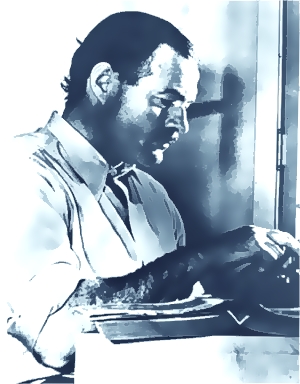
The language of Hemingway

When I lived in Spain, I often heard it said that English is the language of Shakespeare (and Spanish is the language of Cervantes), but I really write in the language of Hemingway. These days, in fact, most people who write in English write like Hemingway, whether they realize it or not and whether they know much about him: a style that is simple, direct, controlled, economic, and if possible, authentic and honest. Perhaps, with luck, even elegant. Nothing like the excesses of the Victorian era. Hemingway was a groundbreaking artist with words.

He was also a legend in his own time, the most famous living writer in the world, a man who wrote about war, hunting, fishing, and bullfighting. The running of the bulls in Pamplona would not be world famous without him. He also was — and still is — a myth, a myth that I think is false, especially about his suicide. The myth says he was macho, adventuresome, active, a drinker, and a womanizer: strong and earthy.

But when I read his works, I doubt he was the man of the myth, which is nothing new. A lot of readers confuse the works with the writer. He wrote about brave, almost savage men, like war heroes and bullfighters — or so the myth says. But in his fiction and even in his news reporting, he was concerned about the feelings of his characters and their struggles to save their souls and hearts. That is not macho.

Hemingway said over and over he was not brave. He wrote that when he first went to Pamplona in 1923, it was a mistake to take his wife to a bullfight because she could see that the bullfighter was truly brave and that her husband was not.

His advice for other writers was excellent. His humor was wise and truly funny.

And he killed himself in 1961. The myths say his bad habits left him incapable of writing. They say he was depressed, that his father and grandfather also committed suicide and he had a character flaw, that his philosophy for life had failed, that he had looked for death during his whole life and finally he found it.

But he had never looked for death: he said that in 1954 when many people thought he had died in an airplane accident in Africa. He did suffer serious injuries in the accident. He lost the use of his kidneys. He had to take blood pressure medication that caused terrible depression, and to counteract the depression the doctors gave him shock therapy, which left him incapable of recalling his own name.

Because of that, he couldn’t write. He begged his wife on his knees not to make him get more treatments. And if that were not enough, he was going blind.

Today, no doubt, he could get better medical treatment. But in 1961, he was a very sick man with no future, and he decided to end his suffering. Perhaps it was an act of a strong man who took responsibility for all the aspects of his life, including the final moment. Perhaps he was an ordinary man who couldn’t stand it any more — that’s what I think. He was just a man, not a myth. Many people couldn’t withstand a physical nightmare like his.

The characters in his works were people who were physically and emotionally hurt, not heroes at all but ordinary people in situations that revealed their strengths and weaknesses and fear and courage.

I think the myth about Hemingway tries to balance the value of his life with the tragedy of his death, something understandable, but I think it is a mistake. Myths seek a just and sensible world. Works of fiction have meaning, which is their charm. Real life is not fair and does not need to make sense.

But, as Hemingway said and wrote again and again, life is worth living. He tried to show that in his works. That’s why he’s still worth reading.

A HEMINGWAY READER

from The Flight of Refugees, April 3, 1938, Barcelona

[A news report from the Spanish Civil War.]

Somewhere up ahead, the bridge across the Ebro was being held against the enemy, but it was impossible to get closer, so we turned the car back again toward Tarragona and Barcelona and passed the refugees again. The woman with the baby born yesterday had it wrapped in a shawl as she swung with the walking gate of the mule. Her husband led the mule, but he looked at the road now and did not answer when we waved. People still looked up at the sky as they retreated, but they were very weary now. The planes carrying the bombs had not come, but there was still time for them and they were overdue.

from The Christmas Gift, 1954

[After an airplane accident in Africa, rumors claimed that he had died.]

In all the obituaries, or almost all, it was emphasized that I had sought death all my life. Can one imagine that if a man sought death all his life he would not have found her before the age of 54? It is one thing to be in the proximity of death, to know more or less what she is, and it is quite another thing to seek her. She is the most easy thing to find that I know of. You can find her through a minor carelessness on a road with heavy traffic, you could find her in a full bottle of Seconal, you could find her with any type of razor blade; you could find her in your own bathtub or you could find her by not being battlewise. There are so many ways of finding her that it is stupid to enumerate them.

If you have spent your life avoiding death as cagily as possible but, on the other hand taking no backchat from her and studying her as you would a beautiful harlot who could put you soundly to sleep forever with no problems and no necessity to work, you could be said to have studied her but not sought her. Because you know among one or two other things that if you sought her you would possess her and from her reputation you know that she would present you with an incurable disease. So much for the constant pursuit of death.

Nobel Prize Acceptance Speech, 1954, read by John C. Cabot, United States Ambassador

[Hemingway was not well enough to accept the prize in person.]

Having no facility for speech-making and no command of oratory nor any domination of rhetoric, I wish to thank the administrators of the generosity of Alfred Nobel for this Prize.

No writer who knows the great writers who did not receive the Prize can accept it other than with humility. There is no need to list these writers. Everyone here may make his own list according to his knowledge and his conscience.

It would be impossible for me to ask the Ambassador of my country to read a speech in which a writer said all of the things which are in his heart. Things may not be immediately discernible in what a man writes, and in this sometimes he is fortunate; but eventually they are quite clear and by these and the degree of alchemy that he possesses he will endure or be forgotten.

Writing, at its best, is a lonely life. Organizations for writers palliate the writer’s loneliness but I doubt if they improve his writing. He grows in public stature as he sheds his loneliness and often his work deteriorates. For he does his work alone and if he is a good enough writer he must face eternity, or the lack of it, each day.

For a true writer each book should be a new beginning where he tries again for something that is beyond attainment. He should always try for something that has never been done or that others have tried and failed. Then sometimes, with great luck, he will succeed.

How simple the writing of literature would be if it were only necessary to write in another way what has been well written. It is because we have had such great writers in the past that a writer is driven far out past where he can go, out to where no one can help him.

I have spoken too long for a writer. A writer should write what he has to say and not speak it. Again I thank you.

***

The trade paperback edition of my novel Dual Memory comes out on April 16 and is available for pre-order from your favorite bookseller. Hardcover, ebook, and audiobook editions are also available.

The third book in the Semiosis trilogy, Usurpation, will be published in October this year, and you can pre-order it with links to your favorite bookseller here, in hardcover and ebook.