Treasure, alien life, and ghosts

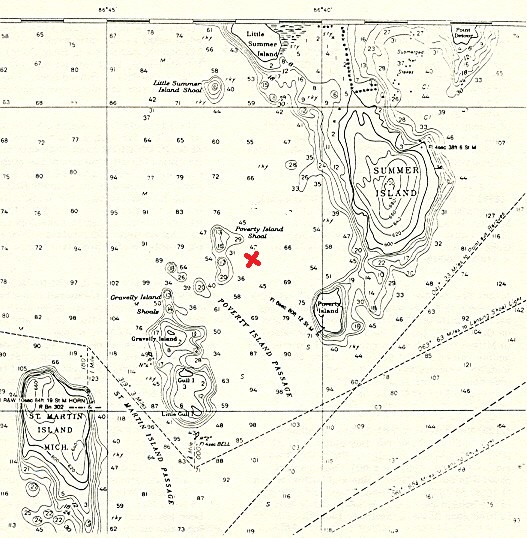
I know of two supposed sunken treasures of gold in Wisconsin, one in Lake Michigan and one in Lake Mendota, both dating back to the Civil War. I’ve researched the one in Lake Michigan and even have the treasure map which locates the gold near Poverty Island Shoal at the tip of Door Peninsula, but I haven’t decided to go hunt for it. I don’t think these treasures exist.

What interests me is why these stories stay alive. Lies are common as leaves in a forest, so why keep certain ones?

First, there’s a simple wish for sudden wealth, the motive force behind lotteries.

Second, legends often say that treasures, buried or sunken, are guarded by leprechauns, mermaids, or at least a curse — by beings alien and magic to our existence. It’s a wish for a livelier universe. In the same way, some of us hope for life on Mars or Andromeda, which would also be a real treasure.

Third, it’s a wish to preserve and honor the past by keeping stories alive. Ghosts work the same way. I met a woman whose neighbors told her the troubled presence she noticed on the stairway of the house she’d just bought was of a teenager who had committed suicide some 50 years earlier because he was gay. She hung a gay pride poster in the stairway to soothe him, and it seemed to work.

Most importantly, treasure is real. Sometimes — at Troy and in the Caribbean — gold is found, and then our wishes are confirmed. I can see Mars at night, and I might be watching Martians. If there are ghosts, I have visited haunted houses. When I lived in Milwaukee, someone else in that city named Susan Burke (not me) won the Supercash lottery. Riches await, if we keep searching.

X marks the spot.

Intricate Stardust

(I wrote this at a workshop for imagining science last spring at the Chicago Botanic Garden. It came as the result of a writing prompt, and I thought about something I’d seen that morning in one of the gardens.)

***

The rabbit was twitching and bleeding. The edge of the universe was far away — in scientific terms, fully 1027 centimeters. Less than one centimeter away were the talons of a hawk, and soon, the rabbit would be still.

You watched this drama unfold on that spring morning, knowing that you lived on a planet tilted in its orbit toward the sun, which created the seasons. Above, unseen in daytime skies, countless stars swirled within galaxies and super-clusters of galaxies. The thought made you shiver. What did this vast universe want?

The rabbit knew. It wanted to live, but as you understood, only sentient things felt real wants, and the universe, with its great distances, existed impersonally.

So you moved on, sure that the universe had no hidden intent, but you had too much at stake in the cosmos to stop wondering.

Long ago, when the universe was young, it had been populated by huge blue stars that burned hot, collapsed, and exploded. New stars gathered from their dust, burned, collapsed, and exploded, each time creating more complex matter. Some of the stardust had accumulated into a planet — your home — orbiting a stable star, so in this particular place, the universe had grown exceptionally complex. Stardust had reached sentience.

You were sentient and full of doubt on that sunny spring morning, near a bleeding rabbit, and like the rabbit, you wanted to live. Then, you found your real question: Why was life so brief? But what did brevity mean in an expanding universe? Across vast time and deep space, the universe continued to form and re-form with wants and doubts generated by intricate stardust. When you looked at the rabbit, you saw yourself.

The rabbit must have had doubts, too, however brief and small. Did stars ever doubt in one sense or another? Because at this time and this space, the universe was twitching and self-aware, and through you, it would continue to move on.