I’ll be at Windycon this weekend

I’m attending Windycon this weekend, Chicagoland’s longest-running science fiction convention. This is its 50th year, and it will be held from November 8 to 10 at the Double Tree Hilton Hotel in the suburb of Oak Brook. This year’s theme is Infinite Diversity in Infinite Combinations.

With about 1,000 members, this is a more personal and friendly event than mega-conventions. Note the word “members” — the convention is organized by fans for fans, all volunteers, not by a professional corporation. It also has a literary bent, focusing on experienced and aspiring authors and writers. Topics for panels and activities range from astrophysics to costuming techniques to pop culture. This includes steampunk, dragons, fairies, robots, music, anime, zombies, pirates, ninjas, extraterrestrials, gaming, horror, space operas, urban fantasy, theater, vampires, time travel, and cats.

There’s also an art show, dealer’s room, gaming room, and legendary parties at night.

During the day, here’s where you can find me:

Early SF Authors and the Pseudonyms They Hid Behind — Friday, 6 to 7 p.m., Windsor Room. How would their work have been affected if they were allowed to show who they were? Panelists are Richard Chwedyk, Steven Silver, and W.A. Thomasson; moderator Sue Burke.

Writer’s Workshop — Saturday, 9 a.m. to 11:30 a.m. Preregistration required.

Author Reading — Saturday, 12 to 12:30 p.m., Ogden Room. I plan to read the essay “Do your neglected houseplants want revenge?” and the short story “Summer Home.”

Reading and Writing Through the Female Gaze — Saturday, 2 to 3 p.m., York Room. Panelists are Lisa Moe, Dina S. Krause, K.M. Herkes, and Alexis Craig; moderator Sue Burke.

The Many Facets of Fandom — Saturday, 8 to 9 p.m., Butterfield Room. How you experience the different brilliant sparkles depends on how you cut the gem that is fandom. Panelists are Jason Youngberg, Alexis Craig, and W.A. Thomasson; moderator Sue Burke.

Familiar or Fantastical? — Sunday, 10 to 11 a.m., Kent Room. What type of world-building do you enjoy with your fiction? Do you prefer far-off worlds or ours? Panelists are David Hankins and Sue Burke; moderator Bill Fawcett.

The Darker Side of Space — Sunday, 11 a.m. to 12 p.m., Hunt Room. The future is not always a garden of roses. Let’s discuss the darker side of science fiction futures. Panelists are Donna J.W. Munro, Chris Gerrib, and Paul Hahn; moderator Sue Burke.

Usurpation: Love will be ferocious

The novel Usurpation is the third in the Semiosis trilogy. The first book, Semiosis, takes place on a distant planet called Pax where the dominant species is an intelligent plant, rainbow bamboo. Stevland is the reigning bamboo. At the end of the second book, Interference, Stevland has sent his seeds to Earth, where the rainbow bamboo are flourishing, but no one knows they’re intelligent.

Then, at the end of Interference, Stevland sends a message to the bamboo on Earth: “…I must share a secret about humans. They are ours to protect and dominate.”

A bamboo named Levanter asks, “Tell us how.”

Stevland’s response finally arrives in Usurpation: “…Compassion will give you courage. Love will be ferocious.”

That’s all I can say without spoilers. In fact, I’ve probably spoiled enough already.

Usurpation will be released on October 29. I’ll be celebrating at 6:30 p.m. Wednesday, October 30, at Volumes Bookcafé, 1373 N. Milwaukee Ave., in Chicago, with Alex Kingsley, whose first novel, Empress of Dust, has just been released. You’re invited!It’s the day before Halloween, so you’re encouraged to cosplay.

You can see me at a Speculative Literature Foundation event read the opening of Chapter 3 of Usurpation in this 3-minute video. (All the novels in the trilogy are available as audiobooks, narrated by Caitlin Davies and Daniel Thomas May, who do a much better job than me.)

You can read a few reviews of Usurpation at NetGalley, and a recent review of Semiosis at Space Cat Press. Semiosis was named one of the 75 best science fiction books of all time by Esquire Magazine.

If you want an autographed copy of my next novel and you can’t come to the launch party, you can order it through Volumes Books here.

The novel that changed Spanish science fiction

I was thrilled when I learned that Rafael Marín would translate my novel Semiosis into Spanish. I think he’s one of the finest stylists in genre writing in Spain. But he’s more than that. He’s an award-winning novelist, comic book writer, essayist, critic, screenwriter — and a pioneer in the genre.

His first novel, Lágrimas de luz [Tears of Light], is often called the “before and after” novel in Spanish science fiction. Published in 1984 and written when Marín was only 22 years old, it proved that a Spanish author could write an ambitious literary work of science fiction.

This might sound odd. Of course Spanish authors could — but they had to believe that themselves, and they had reason to doubt it. For the previous two centuries, realism and naturalism had reigned supreme in Spanish literature. Despite “futurist” authors like Nilo María Fabra, science fiction (and fantasy and horror) didn’t exist in Spain and wasn’t possible.

In the English-speaking world, science fiction set down its roots in the early 20th century, first as pulp and then as more serious works. Spain had its pulp too, starting in the 1950s, although its authors usually wrote under Anglo-Saxon pseudonyms like Louis G. Milk or George H. White at the behest of publishers, who did not think openly Spanish authors, pulp or serious, would sell. Top English-language authors like Alfred Bester and Roger Zelazny were available in translation, though, and they made their mark.

From 1968 to 1982, a fanzine with a professional attitude, Nueva Dimensión, edited by Domingo Santos, provided budding authors with a chance to grow, and some solid works began to appear. But nothing caught readers’ attention like Lágrimas de luz.

The novel’s plot

The novel is set during the Third Middle Ages. A young man named Hamlet Evans, living in a small town that manufactures food, aspires to more in life than toiling in a factory, numbed by drugs and sex. He wants to be a poet, specifically one of the bards whose songs celebrate the Corporation, which expands the human empire and protects it from its enemies. He is accepted for training at the bards’ monastery and is assigned his first military ship.

Soon he learns that the glorious triumphs of the empire are anything but: Indigenous life forms are cruelly wiped out and the planets’ resources are stripped as the Corporation expands its iron grasp. Disillusioned, Hamlet can no longer compose acceptable epic poems.

He resigns and is set down on the first available planet, which turns out to be under punishment for a rebellion against the Corporation. He barely survives, eventually escaping to join a small theater group and then a circus. The Corporation, meanwhile, decides that no entertainment that fails to extol its greatness can continue to exist, and sends troops to wipe them out.

Hamlet escapes again, and he decides to continue an outlaw artistic existence to defy the Corporation.

Ambitious and Spanish

Marín himself has called the novel an “ambitious space opera” — which it is, offering careful characterization and thematic development. Hamlet matures as a man and an artist in a fully-imagined universe.

The novel also makes a clean break from pulp. It features a protagonist who is hardly a hero, and its themes include the search for beauty as well as the crisis and alienation of youth. Rather than save the universe, Hamlet can barely save himself, and the universe might not even merit saving: no lightweight escapism here.

The story also draws on Spain’s own medieval past and brings it into the future. The bards’ songs echo works like El Cid that had once been sung throughout the land — a past oral culture updated for the novel’s present. The novel also responds in its own way to Robert Heinlein’s Space Troopers and openly draws on themes from Moby Dick and other classics.

The surprise of Lágrimas de luz didn’t usher in a sudden boom in Spanish science fiction. That came in the 1990s with works by authors like Juan Miguel Aguilera, Elia Barceló, Javier Negrete, and Rodolfo Martínez, among many others, but the door had been opened.

Lágrimas de Luz, by the way, is still in print after all these years and is available from Spain’s Apache Libros.

A chat at SciFiScavenger

Over at SciFiScavenger on YouTube, I spend a half-hour chatting with host Jon Jones about plants, Usurpation, and my other books, and I share some recommendations for books I love.

Here’s the list — by the way, you can find more of my book opinions at Goodreads.

Life Beyond Us, edited by Julie Nováková, Lucas K. Law, and Susan Forest. The European Astrobiology Institute created this anthology of 27 short stories by top authors about first contact with life unlike our own. Each story is matched with an essay by a scientist. Exciting and educational.

Children of Time, by Adrian Tchaikovsky. If you liked Semiosis, you’ll like this. Similar theme, lots of spiders, and a transcendent ending.

Meet Me in Another Life, by Catriona Silvey. If you like romance novels, this is the science fiction novel for you. Two people keep meeting, but why? I wept like a baby at the ending.

Langue[dot]doc 1305, by Gillian Polack. If you like historical fiction, this is the science fiction novel for you. Scientists travel back in time to France in 1305, and they underestimate the people who live there. Worse, they don’t listen to the historian traveling with them.

Babel, by R.F. Kuang. As a translator, I found the magic system fascinating and meticulously constructed. Better yet, the story is solidly anchored in historical fact.

17776: What football will look like in the future, by Jon Bois and Graham MacAree. This is a daring multimedia SF experiment, and not really about football. I’ll never forget the tragic death of the heroic light bulb. Find it here: https://www.sbnation.com/a/17776-football

The Marlen of Prague: Christopher Marlowe and the City of Gold, by Angeli Primlani. Magic is the only thing that might save Europe from the Thirty Years’ War. The author clearly understands Prague and the theater.

In Defense of Plants, by Matt Candeias, PhD. How can you resist a book with an entire chapter about “The Wild World of Plant Sex”?

The Great Believers, by Rebecca Makkai. Not SFF at all, sorry, but I live in Chicago, and this novel accurately reconstructs the disaster of AIDS in the gay community in the 1980s. You might consider it historical fiction.

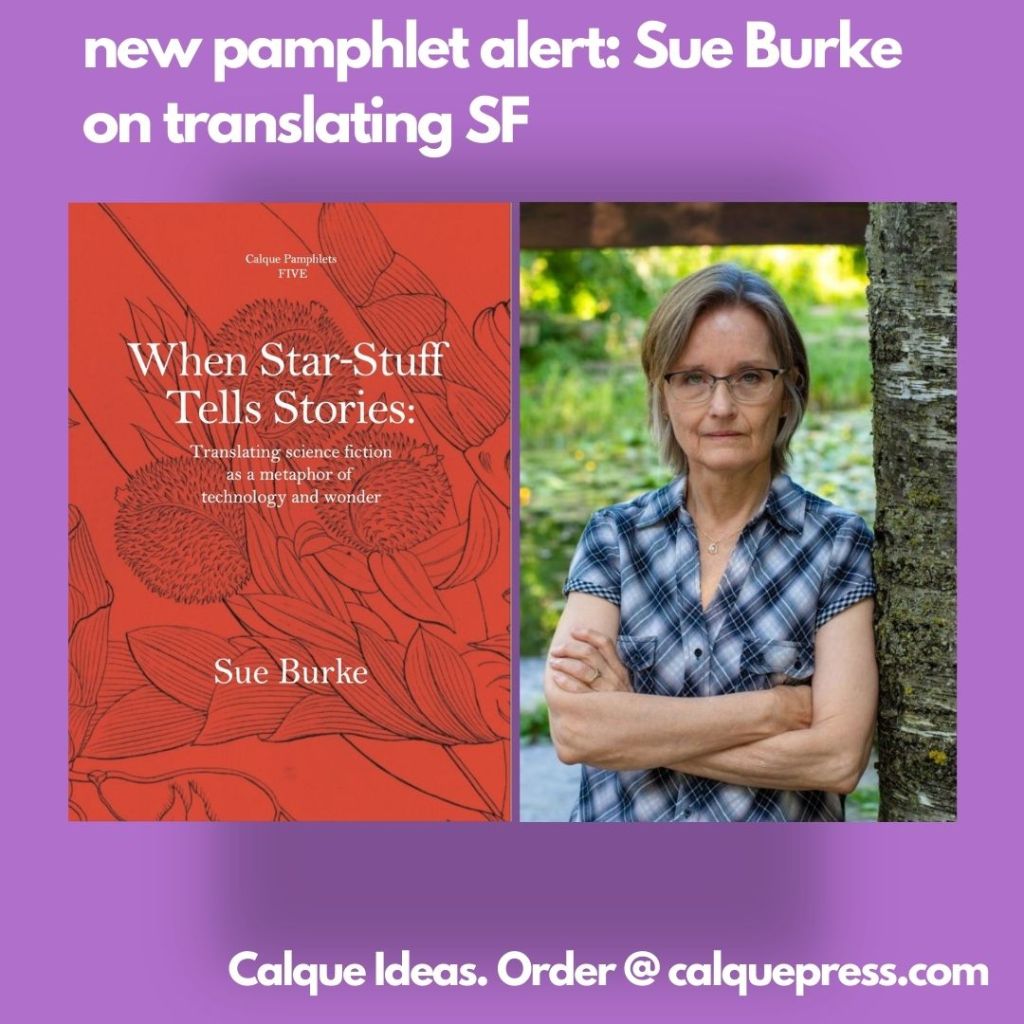
“When Star-Stuff Tells Stories” – now on sale

“If and when aliens make first contact, who should answer? Maybe humankind should turn to people like me, translators of science fiction. We’ve already thought through this kind of problem.”

That’s the opening sentences of my essay When Star-Stuff Tells Stories: Translating science fiction as a metaphor of technology and wonder. Calque Press has just published a limited edition of it as a 24-page pamphlet, and you can learn more and buy it here.

It’s one of a series of essays and other short works published by Calque. They’re meant to provide an opportunity for writers to think aloud about their own experiences and knowledge — and they are beautifully printed on high-quality paper. The publisher is fussy about the look and feel.

Here’s Calque’s description of When Star-Stuff Tells Stories:

Starting from the very earliest forms of human communication, the ways in which language developed into languages, and created the role of the translator, Sue Burke offers an invaluable guide to the importance and difficulties of translation on Earth, and gives us fascinating speculation about what might happen if we ever do come into contact with extraterrestrial intelligence. This pamphlet addresses questions of what communication is, and how the translator is uniquely positioned to work at escaping the bounds of the medium and bringing pure meaning into an intelligible form.