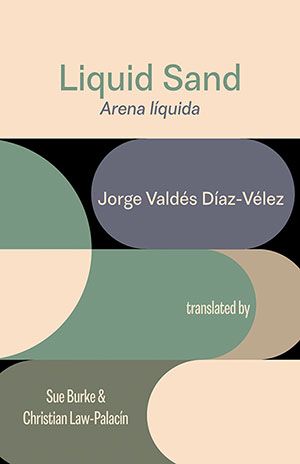
‘Arena Líquida / Liquid Sand’ by Jorge Valdés Díaz-Vélez, translated by Sue Burke and Christian Law-Palacín

I translated the poems in Liquid Sand / Arena Líquida with my Spanish friend Christian. One of us would draft the translation of a poem, then we would pass it back and forth, debating words, lines, and meaning — the goal of a translation is always to maintain the meaning. We didn’t quibble much. Translation is easiest when the original work is well-written.

In the opening poem, “Nadie / No One,” Ulysses returns to Ithaca to become a specter among his own memories. While there’s no way to summarize a collection of 42 poems, the theme of time occurs often. Time moves, and we move, but in different directions for different reasons, as the poem “Negro Sol / Black Sun” says:

The afternoon weighs heavily
toward its settlement. Ours
is due to a harder sun
and we have had to learn
to walk beneath its burden.

Liquid Sand / Arena Líquida is the first major bilingual collection of poems by Jorge Valdés Díaz-Vélez, one of Mexico’s most respected contemporary poets. Published this month by Shearsman Books and available from most bookstores, it gathers works by Valdés Díaz-Vélez selected from six previous collections that span more than two decades of writing.

Madrid Review Magazine says:

“In these pages, Valdés Díaz-Vélez explores time, memory, and the fragile equilibrium between movement and stillness. His poems evoke the physical and emotional geographies of the Americas while questioning belonging, transformation, and endurance. The English versions retain the clarity and meditative strength of the originals, inviting readers to cross the line between two languages and two sensibilities. To read Liquid Sand / Arena Líquida is to encounter poetry that is precise, reflective, and alert to the unseen rhythms of contemporary life. It is a landmark publication for readers of bilingual and Latin American literature.”

My vote for the Nebula Award for Novelette

As a member of the Science Fiction and Fantasy Association, I get to vote for the Nebula Awards. Here is my vote in the category of novelette (7,500 to 17,500 words). The award will be presented at the Nebula Conference on June 7 in Kansas City.

Overall, the stories amounted to a satisfying little anthology. I based my vote on the strength of the storytelling, not an easy metric to apply since they’re all good, but I thought one in particular was slightly better. Of course, your opinion may differ.

Negative Scholarship on the Fifth State of Being” by A.W. Prihandita (Clarkesworld 11/24) — A doctor finds herself limited by bureaucracy when an unusual alien comes seeking her care. Your heartstrings will be tugged.

Loneliness Universe” by Eugenia Triantafyllou (Uncanny 5-6/24) — Friends try to meet, but they can’t find each other even though they’re in the same place. Then things get more eerie (no spoilers). Not quite horror but very unsettling.

Katya Vasilievna and the Second Drowning of Baba Rechka” by Christine Hanolsy (Beneath Ceaseless Skies 4/18/24) — Romantasy, sweet and fulfilling. All fairy tales (or rather, tales about vengeful river spirits) should be like this.

The Brotherhood of Montague St. Video” by Thomas Ha (Clarkesworld 5/24) — The accidental discovery of a book printed on paper triggers an existential crisis in an electronic world with constant volatility. The understated storytelling style effectively delivers growing horror.

What Any Dead Thing Wants” by Aimee Ogden (Psychopomp 2/24) — Terraforming by magic leaves behind ghosts that want something. The cool, deadpan narration makes the fantastic feel real, but the magic system seems inconsistent to me.

Joanna’s Bodies” by Eugenia Triantafyllou (Psychopomp 7/1/24) — A teenage girl finds a supernatural means to bring a dead friend back. Although this is an obviously bad idea, it’s made worse by resentment, manipulation, immaturity, and guilt. Told with a gripping voice.

My vote: “Another Girl Under the Iron Bell” by Angela Liu (Uncanny 9-10/24) — A demon will do anything to get freedom from an evil master. Which one, the demon or the master, is the most evil? Which one is in love? Every word is measured and every detail impeccable.

My vote for the Nebula Award for Short Story

Each year, the members of the Science Fiction and Fantasy Writers Association choose the winners of the Nebula Awards in seven categories, including short story (fewer than 7500 words). As a member, I can vote for the one I consider most deserving. Voting is closed, and the awards will be presented on June 7.

All these short stories are high quality and worthy of nomination, so your choice may very reasonably differ from mine:

The Witch Trap” by Jennifer Hudak (Lady Churchill’s Rosebud Wristlet 9/24) — An old charm against witches inspires a reconsideration of the way that the fear of witches creates witches. Reconsideration, the story makes clear, might not be a bad thing.

Five Views of the Planet Tartarus” by Rachael K. Jones (Lightspeed 1/24) — Flash fiction about horrors faced by those found guilty of treason, with an ennobling, subversive twist.

Evan: A Remainder” by Jordan Kurella (Reactor 1/31/24) — A man who recently transitioned slowly comes to terms with his new identity. This involves coughing up a new skeleton (this is not a spoiler). Although it is tender, beautiful, and heartfelt, I think it’s literary fiction because the “magic” is wholly symbolic, not science fiction or fantasy — you may reasonably disagree, of course. While the lines between genres are always permeable and debatable, I think the Nebulas ought to stick to actual SFF. Literary writing has its own awards.

The V*mpire” by PH Lee (Reactor 10/23/24) — A vulnerable adolescent on Tumbler gets bullied into letting monsters into his home. This story may be more metaphor than actual fantasy, but it’s brilliantly written, and the toxic manipulation involved is heartbreaking to witness.

We Will Teach You How to Read | We Will Teach You How to Read” by Caroline M. Yoachim (Lightspeed 5/24) — A message is sent apparently to humans from a very different, brief-lived species: a simple message that holds entire lives. The story is told in a successfully experimental format, and it left me with a lot to think about.

My vote: “Why Don’t We Just Kill the Kid in the Omelas Hole” by Isabel J. Kim (Clarkesworld 2/24) — I nominated this for the strength of the storytelling voice, and after reading all the finalists I still like it best: “… tell me there is a better solution than putting one single kid in the hole, and letting that one single kid have a miserable life, in return for the good lives of all of our children?” Moral certainty is so messy, but at least the kid in the hole can be ethically sourced.

My Goodreads review of ‘Speculative Whiteness: Science Fiction and the Alt-Right’

Speculative Whiteness: Science Fiction and the Alt-Right

Speculative Whiteness: Science Fiction and the Alt-Right by Jordan S. Carroll
My rating: 4 of 5 stars

I read this short book before it became a finalist for a Hugo Award for Best Related Work, and it’s a timely choice that deserves the attention the nomination brings.

The author, Jordon S. Carroll, discusses the ways that alt-right/fascist/White nationalists have long used popular culture to promote their ideas, including science fiction, fantasy kingdoms, and superheroes. Alt-right readers, he says, are willing to convince themselves that the future in science fiction is a blueprint for their hopes. This explains their objections to Lt. Uhuru in Star Trek. Black people don’t belong in their future.

Speculative Whiteness shows how these ideas really belong to the past, and how alt-right expectations are self-contradictory in any case. The book includes copious footnotes and ends on a hopeful note: “the alt-right promises a bold new future in space but it never achieves escape velocity from white supremacy’s perpetual present.”

However, the book was published in October 2024, and a lot has happened since then. The alt-right won the US presidential election and many other political offices, and our present seems to be slouching toward a future that only the alt-right wanted.

Here are some articles that extend the focus of the book into the present:

Interview with Jordan S. Carroll – Exploration Log 7: Science Fiction and Other Suspect Ruminations
https://sciencefictionruminations.com…

China Miéville says we shouldn’t blame science fiction for its bad readers – TechCrunch
https://techcrunch.com/2025/03/30/aut…

We’re sorry we created the Torment Nexus – Charlie Stross’s Diary
https://www.antipope.org/charlie/blog…

How Trump and Musk Are Ruining Sci-Fi – Daniel W. Drezner on Substack
https://danieldrezner.substack.com/p/…

The big idea: will sci-fi end up destroying the world? – The Guardian
https://www.theguardian.com/books/202…

View all my reviews

Stories and Matters of Size

You might have an idea for writing a work of fiction, but is it flash fiction, a short story, a novel, or an epic trilogy? It can be frustrating to begin what you hope will be a short story, but soon it’s grown too long, and you don’t have time for a novel right now. Or, you might start a novel and run out of steam because there isn’t enough of an idea to fill all those pages.

Here are a few ways to help you evaluate your idea before you start.

• How many scenes can you imagine? A novel might have 80 scenes of 1,000 words each, and a short story just a few scenes.

• How many plot points can you imagine for a three-act outline, Hero’s Journey, or other novel plotting tool? A shorter piece may have only one or two pieces of the plot.

• Can you imagine the story as a picture? The artist El Greco will help illustrate this concept.

A simple picture can be a short-short story. Boy Lighting a Candle, by El Greco, 1571.

This story might be:

“The little glowing fairy was fragile and needed help to stay alive.”

Add a few more characters, and you have a longer short story. An Allegory with a Boy Lighting a Candle in the Company of an Ape and a Fool, by El Greco, 1577.

This story might be:

“The little glowing fairy was fragile, but it attracted too much attention, and the boy didn’t think he could keep it safe.”

With more characters and more conflict, you might have a novel. The Miracle of Christ Healing the Blind, by El Greco, ca. 1570.

This story might be:

“The protagonist’s unusual but successful medical techniques often got him into trouble, and eventually he faced a death sentence.”

A big canvas with a lot happening could well be a trilogy. Burial of the Count of Orgaz, by El Greco, 1586. The painting is 15 feet / 4.5 meters tall.

This story might be:

“The Count’s death unleashed an epic conflict between men and God.”

(Notice the lack of women at the Count’s funeral. That could become an important plot point in the story.)

Exercise

Think of an idea you’ve been playing around with. Try to imagine it as a work of art. Would it fit nicely on a postage stamp? It might be flash fiction. Would it fill a wall-sized mural? You might have an epic. The goal is to avoid unpleasant surprises when you finally start to write. If you need an idea, here are a few:

• A medical team must decide if it can ethically flee a deadly situation.

• A technology company begins to operate in increasingly illegal activities, but the change is so slow and the money is so good that one of the engineers, who becomes deeply troubled, can’t afford to quit.

• A family living in a haunted house refuses to believe in ghosts.

• Two individuals initiate a series of gift exchanges, and the gifts tell more about the givers than they realize.

• Friends witness the breakup of a family from different perspectives and have different opinions.