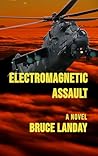
Goodreads review: ‘Electromagnetic Assault’ by Bruce Landay

Electromagnetic AssaultElectromagnetic Assault by Bruce Landay
My rating: 5 of 5 stars

If you like futuristic military techno-thrillers, you’ll probably like this book.
Do I need to say more? Let’s consider the many varieties of book reviews including consumer, preview, sponsored, literary, professional, and academic.
In this case I’m a reader (or consumer, if you prefer that term, which I don’t). This is a preview because the book will be released April 7 (although you can pre-order it). It’s almost sponsored because I know Bruce and critiqued earlier versions of the opening chapters, and he sent me a free copy of the final book, but I’m writing this review because I want to give my honest opinion.
Tips on how to write a review usually recommend writing a summary of the book. To my thinking, this habit largely results from an unexamined hangover from middle school book reports when you had to summarize a book to prove to the teacher that you actually read it, no matter how tedious your summary was (and is). We’re adults now, and we have all the tedium we need. You can just read the book blurb, which is blissfully brief.
A critical assessment is also recommended for a review. In this Electromagnetic Assault, bullets fly around and things blow up a lot. For this reason, I found the battle that takes place in my old neighborhood in Milwaukee especially entertaining. There are endless plot twists, as befits a book of this type. To say more would spoil your fun. So much for my summary and assessment.
The reviewer is also advised to mention relevant information about the author. Bruce is a former Air Force officer. You will notice the expertise.
More broadly, I think there three types of book reviews:
• The first is for readers who haven’t read the book but wonder if they want to. That’s what we’re doing here.
• The second is for readers who aren’t going to read the book but want a useful, thoughtful summary from a professional so they can feel like they’ve read the book. The review provides a lengthy non-tedious analysis. You can often read these in upscale magazines and academic settings, which is not where we are now.
• The third kind of review subjects the novel to literary criticism regarding its writing style and thematic development. I think the very short chapters add to the velocity of the book, which is an appropriate attribute for a thriller. To discuss its literary merits further, we would both need to have read the book, and so far only one of us has.
To conclude, I believe Electromagnetic Assault is a worthy addition to its sub-genre. Enough said.


View all my reviews

The novel that changed Spanish science fiction

I was thrilled when I learned that Rafael Marín would translate my novel Semiosis into Spanish. I think he’s one of the finest stylists in genre writing in Spain. But he’s more than that. He’s an award-winning novelist, comic book writer, essayist, critic, screenwriter — and a pioneer in the genre.

His first novel, Lágrimas de luz [Tears of Light], is often called the “before and after” novel in Spanish science fiction. Published in 1984 and written when Marín was only 22 years old, it proved that a Spanish author could write an ambitious literary work of science fiction.

This might sound odd. Of course Spanish authors could — but they had to believe that themselves, and they had reason to doubt it. For the previous two centuries, realism and naturalism had reigned supreme in Spanish literature. Despite “futurist” authors like Nilo María Fabra, science fiction (and fantasy and horror) didn’t exist in Spain and wasn’t possible.

In the English-speaking world, science fiction set down its roots in the early 20th century, first as pulp and then as more serious works. Spain had its pulp too, starting in the 1950s, although its authors usually wrote under Anglo-Saxon pseudonyms like Louis G. Milk or George H. White at the behest of publishers, who did not think openly Spanish authors, pulp or serious, would sell. Top English-language authors like Alfred Bester and Roger Zelazny were available in translation, though, and they made their mark.

From 1968 to 1982, a fanzine with a professional attitude, Nueva Dimensión, edited by Domingo Santos, provided budding authors with a chance to grow, and some solid works began to appear. But nothing caught readers’ attention like Lágrimas de luz.

The novel’s plot

The novel is set during the Third Middle Ages. A young man named Hamlet Evans, living in a small town that manufactures food, aspires to more in life than toiling in a factory, numbed by drugs and sex. He wants to be a poet, specifically one of the bards whose songs celebrate the Corporation, which expands the human empire and protects it from its enemies. He is accepted for training at the bards’ monastery and is assigned his first military ship.

Soon he learns that the glorious triumphs of the empire are anything but: Indigenous life forms are cruelly wiped out and the planets’ resources are stripped as the Corporation expands its iron grasp. Disillusioned, Hamlet can no longer compose acceptable epic poems.

He resigns and is set down on the first available planet, which turns out to be under punishment for a rebellion against the Corporation. He barely survives, eventually escaping to join a small theater group and then a circus. The Corporation, meanwhile, decides that no entertainment that fails to extol its greatness can continue to exist, and sends troops to wipe them out.

Hamlet escapes again, and he decides to continue an outlaw artistic existence to defy the Corporation.

Ambitious and Spanish

Marín himself has called the novel an “ambitious space opera” — which it is, offering careful characterization and thematic development. Hamlet matures as a man and an artist in a fully-imagined universe.

The novel also makes a clean break from pulp. It features a protagonist who is hardly a hero, and its themes include the search for beauty as well as the crisis and alienation of youth. Rather than save the universe, Hamlet can barely save himself, and the universe might not even merit saving: no lightweight escapism here.

The story also draws on Spain’s own medieval past and brings it into the future. The bards’ songs echo works like El Cid that had once been sung throughout the land — a past oral culture updated for the novel’s present. The novel also responds in its own way to Robert Heinlein’s Space Troopers and openly draws on themes from Moby Dick and other classics.

The surprise of Lágrimas de luz didn’t usher in a sudden boom in Spanish science fiction. That came in the 1990s with works by authors like Juan Miguel Aguilera, Elia Barceló, Javier Negrete, and Rodolfo Martínez, among many others, but the door had been opened.

Lágrimas de Luz, by the way, is still in print after all these years and is available from Spain’s Apache Libros.