Cultural appropriation: a cautionary tale

The term cultural appropriation has a few definitions, but all contain the idea of members of one culture using elements of another culture, particularly the exploitation and distortion of those elements. Among the ways to misappropriate a culture, you might err because you don’t fully understand that culture, even if you’re sure you do.

Here’s an example. When I was living in Spain, I belonged to an English-language writers critique group, and members came from a variety of countries. For some of them, the United States was a far-off, exotic land, and occasionally they tried to write stories and poems set there. Sometimes they failed spectacularly.

A little background: I was born and grew up in the United States. My father, shown in the photo, played on Marquette University’s football team. Wherever you’re from, you probably know that the sport called “football” in most of the world and “soccer” in the United States is very different from the sport we call “football” in the United States, even though they share historic roots. I’m a casual fan of American-style gridiron football, and I know a few things about it.

One day, an Irish author in our critique group submitted the start of a novel with this conflict: a young man in Chicago wants to play college football, but his father disapproves of anything that would detract from his studies for medical school, so the young man hides his participation in the Northwestern University football team.

The author was a big fan of soccer, and he assumed that American gridiron football would be similar. Wrong, wrong, wrong.

To start with, the author did not understand how hard, how treasured, and how public a spot on Northwestern’s team is. In fact, it’s a Big Ten team, the stuff of legend. Player recruitment involves years of preparation, the whole family, scholarships, sometimes lawyers and agents, and very often intense media attention.

After one game in which the young man in the novel makes a key play, he’s worried his father might find out about his deception, but, he reasons, no one pays much attention to college sports; apparently college sports don’t get much attention in Ireland. In fact, Northwestern games are televised live and covered by the news media in excruciating detail.

In one scene, the player talks to the coach, an underpaid, unimportant man who works out of a grim, tiny office in a basement corner of the school gym. In fact, the Northwestern football program is located in a fieldhouse that could be described as palatial. The current coach, Pat Fitzgerald, reportedly earns $5 million per year and could be described as fairly well known.

The coach orders the young man to “get kitted up and go out on the pitch.” In fact, American football is played in what we call uniforms and on what we call a field.

In one game, the play is described as moving fluidly up and down the pitch, now advancing, now protecting the goal. In fact, American football has been described as controlled violence interrupted by frequent committee meetings (huddles), very stop-and-start, and there are separate offensive and defensive teams as well as special teams.

Clearly, our author had never seen an American football game, but it’s a lot like soccer, right?

I tried to be gentle as I advised the author to abandon his novel. He would never be able to do enough research from his home in Spain to get the details right.

Cultures are complex. It’s easy to blunder. If you want to write about something from another culture, perhaps you can successfully, but the first step is understanding the other culture and yourself. American football is tough enough to withstand a lot of misappropriation. The elements of some other cultures might be fragile and should be approached with care and respect. In fact, you might even discover that you aren’t the right author for that story.

Even though I live in Chicago now and I’ve known some real-life American football players, I’m not qualified to write a novel about a member of the Northwestern University football team. I know more than enough about American football and Northwestern to understand how very little I actually know.
I’ve been birdwatching

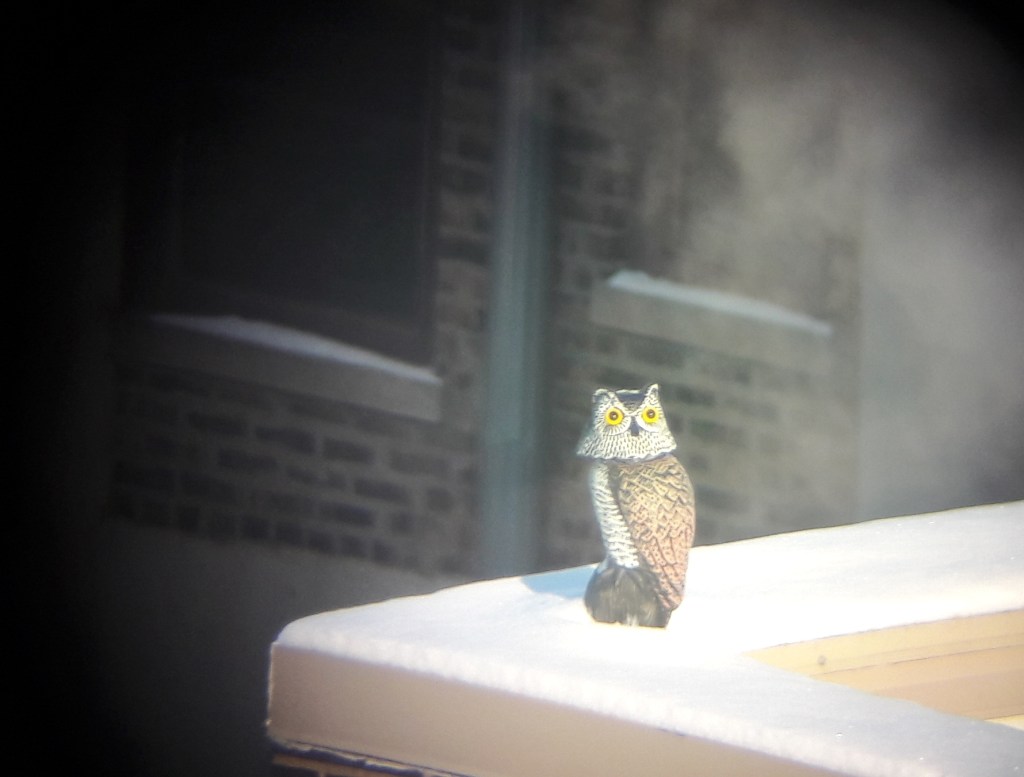
One of my hobbies is birdwatching, and I’ve been making careful observations of a bird perched on the corner of a building about a half-block from my apartment. I’ve identified it as the Common Bobblehead Owl, Caput nutans imitator bubonis.

It’s a faux horned owl; generic brown, white, and buff plumage; glaring yellow eyes; plastic. Height: 14.5 inches plus base; wingspan unknown. Voice: silent. Habits: stationary; head rotates in wind. Prey: gardeners and property owners. Does not reproduce; must be replaced. Worldwide distribution; origin China; migration aided by Walmart and by vendors on Amazon.

I first noticed the bobblehead roosting on the ledge late last year after some maintenance work on the building’s roof. So far, the faux owl has caused no change to the habits of the neighborhood birds, who didn’t frequent that roof anyway, although I recently observed pigeons landing nearby on the ledge to stare inquisitively. Bobblehead observers in Australia have noticed similar effects.

For me, the little sculpture adds a philosophic note to the daily view from my window of the traffic, trees, roofs, and sky. I see pugnacious crows, soaring hawks and falcons, migrating geese, busy songbirds, and flocks of idle pigeons. The bobblehead owl was meant to serve a purpose that wasn’t needed and isn’t being fulfilled. Vanity of vanities.

***

Note: Yes, caput nutans means “bobblehead” in Latin. I looked it up.

Photo: I don’t own a real camera with a zoom lens. Instead, I have a little telescope, and I took the photos by holding my mobile phone to the eyepiece. Turned out pretty good, I think.

Rules for beauty, Spanish vs. English

Last week I mentioned the challenge of translating the novel Prodigies by Angélica Gorodischer for Small Beer Press. She deliberately chose to write the book in a formal style of Spanish that strives for beauty.

However, standards of beauty for Spanish and English share little in common due to the different histories of each language as well as the different possibilities and limits of their grammar and vocabularies. Beauty had to be transformed.

Spanish emerged from a local dialect of Latin. King Alfonso X “the Wise,” who reigned from 1252 to 1284, made Spanish (Castilian, to be precise) the preferred language for scholarship in his realm, replacing Latin. To cement that change, he funded scholars in Toledo and elsewhere to translate literature from other languages into Spanish and to write new books. He himself wrote some important works, knowing that a language must have literature.

Fine writing style in Spanish still echoes its scholarly roots: formal and elaborated. Above all, good style rejects repetition. Vocabulary and syntax should be richly varied. Spanish grammar permits long, ornate sentences, because the verbs are fully conjugated and the nouns and adjectives are gendered, so subordinate clauses can be easily looped together like tatted lace.

English, on the other hand, has suffered a more checkered history. After the Norman invasion in 1066, Norman French became the dominant language in Britain, and English was shattered into regional dialects. As Modern English eventually began to emerge, it was shaped by two formidable literary landmarks: Shakespeare and the King James Bible.

The Bard of Avon began writing plays in about 1592, adding lively new words and expressions that we still use today. We all speak “the language of Shakespeare” — which is how Spaniards often refer to English (to avoid repeating the word English).

But even more important in the development of English, the King James Bible was published in 1611. Its constant use as the single major work of literature readily available to ordinary people made it the standard and model for their language. For us, it’s hard to imagine how central this book was, even to illiterate people, but we can hear still its influence.

Its translators had produced majestic but direct, unornamented prose meant for ordinary people, not scholars, and they stuck close to the syntax of the original languages, notably Hebrew in the Old Testament.

Many of those Bible verses were poetry, and Hebrew poetry does not rhyme; instead, it uses parallel, balanced structures of phrases or ideas, and of words or rhythms. The second half of a parallel may paraphrase its first half; it may give a consequence; it may contradict the first half; or it may add stronger clauses or sentences that lead to an apex. Rhythm can make the prose musical.

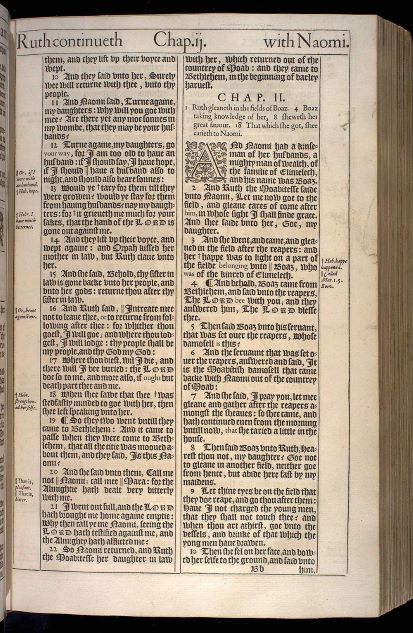
We can hear this in the Book of Ruth: “whither thou goest, I will go; and where thou lodgest, I will lodge: thy people shall be my people, and thy God my God.”

Because of the echo of Hebrew poetry in Modern English, careful repetition and parallel structure strike our ears as beautiful. The two most famous speeches of the 20th century, “I Have a Dream” by Martin Luther King Jr., and “Blood, Sweat, and Tears” by Winston Churchill, demonstrate the power and melody of repetition.

With that in mind, I sought to preserve the beauty in Gorodischer’s novel and her dense, very Spanish prose. Here’s an example from Chapter 15:

“…en algunas casas se cerraron púdicas las cortinas no fuera que ese sol desmesurado y lejos de lugar y medida, como despanzurrando sobre los parquets y los tapices, fuera a desteñir los tapizados y peor, a dar que pensar aguijondeando la piel de los antebrazos y detrás de los lóbulos de las orejas a las niñas vigiladas y obedientes que cambiaban, también en esa época como el sol…”

“The sun came out over a grayish world in a resentful winter, and nothing could be done about it: in some houses the curtains were chastely closed because this sun, excessive and out of place and propriety, might burst on parquet floors and tapestries, might fade the fabric, and worse, might strike the skin on the forearms and behind the earlobes of protected and obedient girls, inciting their thoughts, girls who also transformed in that season like the sun…”

Using a little repetition, I sought to set the words to a different tune and make them sing as sweetly. There were alternatives, of course.

One problem — or possibility, depending on how you look at it — involves the translation of the word fuera, which is the past tense third person singular subjunctive form of “to be.” Spanish subjunctive can be translated in many ways, often with difficulty because the use of subjunctive in English is much more limited than in Spanish. Of the various ways to render it, each requires additional changes in the syntax. One possible way, and a more literal translation, is:

“…in some houses the chaste curtains were closed to prevent this sun, excessive and out of place and propriety, as it was bursting on parquets and tapestries, from fading fabric and worse, inciting thoughts as it was striking skin on the forearms and behind the earlobes of the protected and obedient girls who also changed in this season like the sun.”

Although this is perfectly acceptable, to my ear it sounds ordinary, unlike the original prose, which sounds extraordinary. I hear too many present participles (-ing words), and while repetition of grammatical forms is good, these do not all fulfill the exact same grammatical role: they’re not parallel.

Instead, in my final version, I tried to find a way to unite as many verbs as I could under the modal might. Its use to express weak probability at times can convey the sense imparted by Spanish subjunctive. I chose might burst, might fade, might strike, and deliberately repeated might to make sure the reader understood the relationship among the verbs.

The passage also focuses on the girls of the households, who must be kept chaste and unchanged. So rather than say who toward the end of the sentence, I found a way to repeat girls and thus place a bit more emphasis on them.

In the process, I did not follow the original word for word. Instead, I followed it idea for idea within the artistic intent of the author. I hope that for the reader, I recreated the beauty of the text of the novel and its extraordinary characters and magical setting.

Angélica Gorodischer’s “difficult book”

Sad news: Angélica Gorodischer, a prolific and award-winning Argentinian author, died on February 5 at age 93. Three of her books are available in English: Kalpa Imperial, translated by Ursula K. LeGuin in 2003; Trafalgar, translated by Amalia Gladhard in 2013; and Prodigies, translated by me in 2015.

After I finished my translation of Prodigies — an enchanted and enchanting novel — she and I exchanged a few emails. She told me she wrote the book almost as a dare. Here’s a translation of a portion of one of those emails:

Prodigies is a difficult book. It was hard to write. It began as an argument with a colleague. She maintained that it isn’t possible to write a novel contrary to one’s own tastes, one’s own inclinations; against the grain, so to speak. I said that yes, not only could it be done, but from time to time it must be done, or at least it’s healthy to go against one’s own self and write as pure craft. No you can’t, yes you can, it’s impossible, don’t try to kid me, of course it’s possible, and that’s where it stood.

“But I was left on edge and decided that at some point I was going to write a novel, a full and complete novel, to prove what I had argued in that conversation. And sooner rather than later I set about writing Prodigies. And as I told you: it was difficult. It was difficult, but I liked it.”

She added, “I write in order to write, and that makes me happy.” As for me, “I hope that you’re well, you’re happy, and the goddesses are propitious to you.”

May those goddesses carry her gently to her rest.

***

All three of her books translated into English were published by Small Beer Press. At her passing, Gavin Grant, the publisher, wrote about meeting and working with Angélica Gorodisher.

***

Was Prodigies difficult for me to translate? Yes and no. The prose was lush, complex, and beautiful, and I focused on bringing those qualities into English. Each language operates under different “rules” for beauty, and I needed to translate with those differences in mind — difficult, but I liked it, too.

These are the opening words to Prodigies:

            On the day Madame Nashiru arrived at the boarding house on Scheller Street, a brief tremor passed through the house, unnoticed by everyone except Katja. The foundations of the world did not shudder, plagues did not break out, first-born did not die, there were no catastrophes, the waters of the Genil River did not inundate a dozen towns, black death did not arrive at Addis Ababa, the sorcerers of Yauyuos did not dream about dogs with human heads, the walls of Nerja Cave did not crack, ships did not sink in the inlets of Baffin, volcanoes did not erupt, islands did not disappear, orchards did not suffer drought, the lintels of old cathedrals did not become besooted, cemetery guards did not worry needlessly, nor did police officers or transportation inspectors or sergeants or jailors or tax collectors or judges or executioners; but the house shook, and Katja, who was in the courtyard bending over a tin-plate pan, looked at the water and told herself that there are beings with wings and yet they hide them. She did not know what she meant by that, but she was used to those sudden obscure thoughts, so she was not frightened…

Autobiography of memory foam

Soft and springy: I was born that way, as polyurethane foam should be, a comfort to all, forgiving to those in need of a cushion. I had a noble purpose.

At least, I thought I had a purpose. I thought I knew who I was.

Soon I came under pressure. At first, I sprang back. I could handle it. I was a service to others, and I was proud.

But I had a hidden side, hidden even to myself, a built-in internal stickiness, a limit to my abilities. I could not spring back forever … or even for very long.

Pressure defeated me, left me flat, unyielding, useless. I lost my purpose in the world … and too soon, I will crumble into dust.

Now I can only remember soft days and soothing nights. Apparently, that’s what my name means. Memory foam is merely the memory of foam.