Off to a bad start

Like every writer I know, I’ve started too many stories that petered out and sit on my hard drive tucked out of sight so they don’t depress me. I know what went wrong for some of them. Here’s an analogy:

I’ve got a great starting idea for dinner today: I should use that lovely bag of baby spinach. But how? The too-many possibilities leave me indecisive. I can’t start cooking until I have a goal in mind, a finished dish.

For that reason, menus list dishes rather than random, tasty ingredients. The cooking show MasterChef uses the mystery box ingredient challenge to torture its contestants because the odds are against them cooking up something delectable. It’s fun to watch them fail.

Yet writers commonly start stories “to see where they’ll go.” Stephen King champions this technique. I think his story “Obits,” nominated for a 2016 Hugo, shows how it can fail. In the story, a man discovers he has an extraordinary skill. And then … he runs away and never does that thing again. The consequences of his skill, good or ill, are never explored. I suspect King didn’t know what to do with the idea. He didn’t win a 2016 Hugo.

By contrast, consider “Eutopia” (warning: spoilers in link) by Poul Anderson in the 1967 Harlan Ellison anthology Dangerous Visions. In that story, a time traveler must flee for something horrible he did, although he seems like a good man. The very last word of the story tells you what happened, and its impact helped Dangerous Visions redefine science fiction. The story’s structural success was no accident. Anderson started the story knowing precisely how it would end — and every word from the beginning pointed toward that end.

If I start a story or novel without knowing the ending, I might get blocked and, in panic, grab at the first ending that comes to mind, although it could be hackneyed or weak or miss the mark. Or I might not finish the story at all. If I start with a strong ending in mind, success is not guaranteed, but my odds are good.

I’ve learned that my ending idea need not be too specific: “He wins, although it means betraying some of his core values so he can uphold other values,” or “She kills her rival and takes over,” or “He lures the ghosts to a morgue and leaves them there, trapped.”

I still hope to achieve Anderson’s genius at endings — which means I have a goal (an ending) for the story of my writing career.

These days, if I’m working on a writing prompt, I try to write the ending of a story. I might draw on one of those half-baked ideas rattling around my brain, or I might come up with something new. I get a story that I know how to finish. Much more needs to be done to start the idea, of course, but the end is in sight.

Tonight, by the way, I’ll make a chicken-pasta-vegetable toss for dinner. The fresh baby spinach should be a delicious final touch. Bon appétit!

Goodreads review of ‘Way Station’

Way Station

Way Station by Clifford D. Simak
My rating: 5 of 5 stars

The strength of this novel, which won the 1963 Hugo Award, is in its main character, Enoch Wallace. He observes carefully and thinks deeply, and the novel is often quiet and reflective.

One hundred years ago, his home in the secluded countryside of Wisconsin next to the Mississippi River became a secret way station for aliens traveling through the galaxy. He has stopped aging. What does his strange new life mean?

“For he remembered now how he had been sitting on the steps thinking how he was alone and about a new beginning, knowing that he could not escape a new beginning, and that he must start from scratch and build his life anew. And here, suddenly, was that new beginning — more wondrous and fearsome than anything he could have dreamed in an insane moment.”

For most of the novel, it’s a simple story without much action, but slowly, small mistakes and the dangers of Earth’s 1960s and atomic war brinksmanship build into existential peril.

“Somewhere, he thought, on the long backtrack of history, the human race had accepted an insanity for a principle and had persisted in it until today that insanity-turned-principle stood ready to wipe out, if not the race itself, at least all of those things, both material and immaterial, that had been fashioned as symbols of humanity through many hard-won centuries.”

The point of the novel is what this means to Enoch, to humanity, and beyond. “And that was the secret of the universe, Enoch told himself — a thing that went on caring.”

View all my reviews

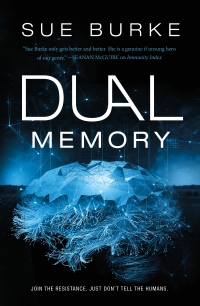
‘Dual Memory’ has been launched

My new novel, Dual Memory, has now spent two weeks out in the wild world! Thank you to Volumes Bookcafé for hosting the launch, to Richard Chwedyk for leading a conversation with me at the launch, and to my husband, Jerry Finn, for all his support. And thanks to everyone who has bought it, and especially those who have reviewed it. Reader reviews at places like Amazon, Goodreads, and LibraryThing, and word of mouth, are the only sure way to sell books.

Paul Semel interviewed me for his site about Dual Memory, and among his other questions: What inspired the novel? How did Par Augustus get its name? Would the story make a good game? (As a game, I think it would ruin friendships.)

During the discussion at Volumes, I remembered that one of the novel’s characters, so to speak, the Marathon Building, was inspired by an incident that stuck with me from another science fiction work, 17776: What Football Will Look Like in the Future. This is a serialized multimedia narrative by Jon Bois. In Chapter 19, the machines in the story share a eulogy for “our dearest ancestor.” But read the entire story! It’s free online. 17776 is a daring experiment in storytelling, and you don’t need to like football to enjoy its wild inventiveness.

***

By the way, if you’re at Goodreads and you haven’t read Semiosis yet, here’s your chance to get the book for free. Five copies are up for grabs. Giveaway closes June 6. Limited to United States. Sign up here.

A secret seventh-grade history lesson

My junior high school had a scandalous “secret” that older students would melodramatically point out to incoming seventh-graders. The hallway floors in one of the buildings was edged with decorative glazed tiles in bright colors. On the first floor near the office, amid tiles depicting anchors, lions, birds, shields, and other motifs, there was a swastika!

Oh, no! Why?

The answer involved a history lesson. The swastika symbol was old, older than Nazis and World War II. Nazis didn’t invent it, they only used it. Our building was older than the Nazis, so when it was built, the ancient symbol had seemed innocent, just like the lions and anchors.

We learned a lot in those buildings. In my case, classes included Spanish, algebra, geometry, civics, literature, art, home economics, and gym. But in the hallways, thanks to that scandalous tile, we also learned a lesson about the world:

The meanings of things change over time, and the past holds surprises.

We also wondered why we were attending school in such old, decrepit buildings. This wasn’t just us kids whining, since teachers and parents had the same question. These buildings were genuine fire traps. At some point — I can’t find out exactly when — the buildings were torn down and replaced by a new middle school elsewhere in the city.

My old junior high school was so unloved that I cannot find a single photo of the buildings on the internet. All I could find were tiles (see photo) in the Men’s Gymnasium, built in 1917, at Indiana University. They seem to have come from the same set of patterns as the ones at my junior high school.

The tiled floor at my old school with the swastika has disappeared. It has become history, a memory with a lesson about history itself.

And the world keeps changing.