The Science in Fiction podcast: Sue Burke on Intelligent Plants

Marty Kurylowicz and Holly Carson invited me to join them on their podcast, The Science in Fiction — and it’s now available for your listening pleasure.

We talked about the science of botany in my science fiction novel Semiosis and its sequel Interference. Plants have a lot of surprising behaviors, and the hosts learned things they didn’t know about tulips, apples, osage oranges, and giant ground sloths.

We also discussed my novels Immunity Index about a coronavirus pandemic — which I wrote before the covid-19 pandemic — and Dual Memory, which has recently arrived on bookstore shelves. I’ve just turned in the manuscript for the third installation of the Semiosis trilogy, Usurpation, due to be published in October 2024.

The Science in Fiction podcast will follow up this episode with an interview next week with Paco Calvo, professor of the philosophy of science and principal investigator at the University of Murcia’s Minimal Intelligence Lab in Spain, and author of Planta Sapiens.

Here are all the places you can listen to Ep 12: Sue Burke on Intelligent Plants in Semiosis.

Buzzsprout

Apple Podcasts

Spotify

Audible.ca

Amazon Music

Video from the Deep Dish reading

As you may recall, back on September 14 I read a short story called “The Virgin Who Rescues Dragons” at an event here in Chicago, the Deep Dish reading series, organized by the Speculative Literature Foundation. I was one of eight readers that evening.

If you couldn’t attend, you can watch videos of us. Here’s the link to the YouTube playlist.

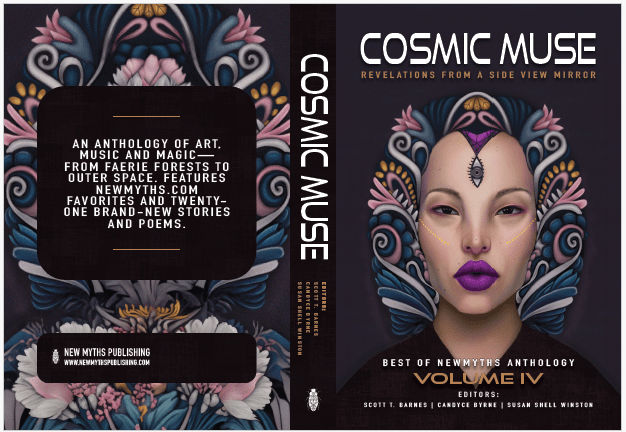
The piece I read will be published this fall inThe Best of NewMyths Anthology Volume 4: The Cosmic Muse. Due to time constraints, the version I performed of “The Virgin Who Rescues Dragons” is abridged. The full version has a lot more jokes, so buy the book!

Watch my video here.

My votes for the 2023 Hugo Best Short Story

This year the Worldcon will be held in Chengdu, China, and the 2023 Hugo Awards, the Lodestar Award, and the Astounding Award will be presented on Saturday evening, October 21, at a formal ceremony at the Chengdu Worldcon.

Although I won’t be attending in person, I am a Worldcon member and get to vote for the awards. Members also make the nominations, and the works or individuals with the most nominations become the finalists.

Because the convention is in China, a number of Chinese works are on the ballot, including three in the short story category. I was looking forward to reading them, and I wasn’t disappointed. The voting is by ranked choice, and here’s my ranking:

6. “On the Razor’s Edge” by Jiang Bo (Science Fiction World, January 2022) – Chinese astronauts learn that American astronauts must be rescued from their space station — but there’s a lot of animosity between the two governments. Will they be rescued? Can they? This is a straight-up adventure story.

5. “D.I.Y.”, by John Wiswell (Tor.com, August 2022) – Two young self-taught magicians try to end a drought and wind up facing corporate greed. As usual with John Wiswell, there’s kindness, hope, humor, and a touch of sharp-eyed irony and cynicism. The two young magicians slowly dare to show their vulnerability toward each other.

4. “The White Cliff” by Lu Ban (Science Fiction World, May 2022) – An experiment comes to a thoughtful and heartwarming end. It’s hard to say more without spoilers.

3. “Rabbit Test” by Samantha Mills (Uncanny Magazine, November-December 2022) – The entire history of abortion is told as dystopia — which it is (I’ve been living it my whole life). This story made me angry, but not at the author. It was my choice for the Nebula Award, and it won, along with the Theodore Sturgeon Memorial Award, and I won’t complain if it or any of the stories on the ballot wins the Hugo, but I decided to lean toward works from the host country in my top votes because translated works don’t get on the ballot often.

2. “Zhurong on Mars” by Regina Kanyu Wang (Frontiers, September 2022) – Humans have abandoned Mars to machines, specifically a machine named Zhurong after the Chinese god of fire, and soon Zhurong discovers secrets. The story combines Chinese creation myths and the trajectory of the development of life on Earth in a way that feels satisfying.

1. “Resurrection” by Ren Qing, translated by Blake Stone-Banks (Future Fiction/Science Fiction World, December 2022) – A soldier is resurrected after death on the battlefield and sent home to visit his mother in their countryside village. Emotional depth and sharp characterization make this story stand out for me.

Maps as a tool in fiction

When I began writing Dual Memory, I knew I wanted it to take place on an island in the north Atlantic Ocean. Then I had to figure out the particulars. Luckily, I discovered a real island that had some of the necessary characteristics: Grímsey, the northernmost inhabited location of Iceland.

It’s about the right size, on the Arctic Circle, and has lots of puffins. Unlike the island in my story, its population is only about 70 people, but I imagined it could hold 20,000 with enough apartment buildings. I got a map from an Iceland tourist site and from Google and used them to help me keep the details right: the docks were here, a park was there, and the hospital was in the middle.

The novel Immunity Index takes place in real places, and maps of those places, as well as visits, let me try to recreate a setting that felt “real.”

For the novel Semiosis, I made my own maps. Again, they helped keep me oriented. As characters moved around, if they looked in a certain direction, what would they see? If they went from point A to point B, what would they pass along the way? (Readers will notice if you’re inconsistent.)

These are just some of the things maps can do for an author. They don’t have to be good enough to include in the final publication. They can be incomplete, simply showing the relative locations of important things in the story.

If the characters are going to make a journey, the author might benefit from a map, but it might not be the same map that the characters use. If the story involves a treasure map, having an accurate map to refer to, however crudely drawn, will help the author guide the characters through the countryside — and allow the characters to complain about how misleading their map is. Only the author knows how cruelly lost they are.

Much like maps, another tool for the author can be the plan of a building, space ship, or other physical setting, such as the circles of hell, if the characters have the ill fortune to find themselves there.

The act of drawing a map can be a prompt for the author, discovering details and relationships that inspire new depth to the storytelling. What has to exist in that kind of location? What cool things might be there? Where is a character’s favorite place? Where are things that a character would avoid, and why? Is there a good spot for birdwatching, and what does that say about the local ecology?

Two poets: José Martí and Antonio Machado

Two poets, one from Cuba, one from Spain, wrote at different times and in different styles, yet they are linked by history and the Spanish language. José Martí fought and died in the war for Cuban independence from Spain. Spain’s defeat in that war led to soul-searching among writers in Spain, and Antonio Machado emerged as one of its leading voices; he died during the Spanish Civil War.

Here are my translations of some of their works.

***

José Martí (Cuba, 1853 -1895) may be best-known, if unrecognized, for the words to the song “Guantanamera.” They come from Versos sencillos (Simple Verses), his last book of poetry, published in 1891. The first of the thirty-eight sets of verses begins: “Yo soy un hombre sincero…” (I am a sincere man…) The song was popularized by folk singers in the United States in the 1960s.

In the prologue of that book, he speaks of the “horror” of the domination of the Spanish Empire over Cuba. He had long been active in the nationalist cause. In 1882 he founded the Cuban Revolutionary Party while in exile in New York. The war of Cuban independence began on February 24, 1895, and Martí returned to Cuba in April. He was killed in the Battle of Dos Rios on May 19, 1895, and is now honored in Cuba as a hero.

He said: “Poetry must be rooted in the land and based on real events.” His Versos sencillos echo the style of popular songs and foresee the struggle of his beloved homeland. I have tried to translate them into lyrics that could be set to music.

José Martí, from Versos Sencillos (Simple Verses), 1891

XXIII

Yo quiero salir del mundo

Por la puerta natural:

En un carro de hojas verdes

A morir me han de llevar.

No me pongan en lo oscuro

A morir como un traidor;

Yo soy bueno, y como bueno

Moriré de cara al Sol!

I want to leave this world

By the gate into nature:

In a cart of green leaves

They must carry me home.

May they not let me die

As a traitor in darkness;

I am good, I am right

To die facing the Sun!

XXVII

El enemigo brutal

Nos pone fuego a la casa;

El sable la calle arrasa,

A la luna tropical.

The enemy brutes

Set our home ablaze;

In the street their swords raze,

Under tropical moon.

Pocos salieron ileso

Del sable del español;

La calle, al salir el sol,

Era un reguero de sesos.

To escape was in vain

From Spaniard and sword;

At sunrise the street poured

With shed blood and slashed brains

Pasa, entre balas, un coche:

Entran, llorando, a una muerta;

Llama una mano a la puerta

En lo negro de la noche.

A car evades bullets:

They strike as death wails;

A hand knocks at the doorway

In dark night as a threat.

No hay bala que no taladre

El portón; y la mujer

Que llama, me ha dado el ser;

Me viene a buscar mi madre.

Every bullet hits home;

The woman at that door

Gave me my life and more;

My mother to me comes.

A la boca de la muerte,

Los valientes habaneros

Se quitaron los sombreros

Ante la matrona fuerte.

At the call of the grave,

Havana’s valiant men

Remove their hats and bend

Before the matron most brave.

Y después que nos besamos

Como dos locos, me dijo:

“Vamos pronto, vamos, hijo;

La luna está sola: vamos.”

And after we greet

Both mad with love, she said:

“Let us go, son, ahead,

And the lonely moon meet.”

***

Antonio Machado (Spain, 1875 -1939) is the great poet of Spain’s “Generation of ’98.” Spain was defeated and humiliated in the Spanish-American War in 1898. A disparate group of writers rebelled against the moral, political, and social crisis by creating an intellectual regeneration and a modernization in literature.

Machado synthesized popular wisdom, essential questions of life, and philosophic contemplation in his poetry. His life was often marked with personal tragedy and frustration. He enthusiastically supported the Second Spanish Republic in 1931, but he was forced into exile when its government fell to Fascists in the Spanish Civil War. As he fled, his health deteriorated. He died just over the border in France in 1939. He is still an oft-quoted poet in Spain.

Antonio Machado, from Proverbios y cantares (Proverbs and Songs), 1917

Hoy es siempre todavía.

Today is ever forever.

¿Siglo nuevo? ¿Todavía

llamea la misma fragua?

¿Corre todavía el agua

por el cauce que tenía?

A new century? Does

the same forge still burn?

Does the water still churn

through its old riverbed?

¿Sabes, cuando el agua suena,

si es agua de cumbre o valle,

de plaza, jardín o huerta?

When you hear rain fall, do you know,

is it water from summit or valley,

plaza, garden or orchard?

Buena es el agua y la sed;

buena es la sombra y el sol;

la miel de flor de romero,

la miel de campo sin flor.

Good is water and thirst;

good is shade and sun;

honey from rosemary flower,

honey from flowerless fields.

¿Para qué llamar caminos

a los surcos del azar?…

Todo el camina anda

como Jesús, sobre el mar.

Why call roads

the paths made by destiny?…

All travelers go

like Jesus, over the sea.