I see several competing themes in the 2023 Word of the Year choices.
Authentic is Merriam-Webster’s Word of the Year. “A high-volume lookup most years,” the dictionary says at its website, “authentic saw a substantial increase in 2023, driven by stories and conversations about AI, celebrity culture, identity, and social media.”
Authentic cuisine. Authentic voice. Authentic self. Authenticity as artifice. Most of all, authentic meaning made by a human, not an AI. We want to keep it real.
Runners-up include rizz, deepfake, coronation, dystopian, EGOT, X, implode, doppelgänger, covenant, indict, elemental, kibbutz, and deadname. What a year it was.
Rizz, meaning “style, charm, or attractiveness; the ability to attract a romantic or sexual partner,” has been crowned Word of the Year at Oxford University Press. Online voters chose it from a shortlist.
Oxford justifies the choice this way: “It speaks to how younger generations create spaces — online or in person — where they own and define the language they use. From activism to dating and wider culture, as Gen Z comes to have more impact on society, differences in perspectives and lifestyle play out in language, too.” No condescension here.
The word apparently comes from “charisma.” I don’t know if rizz carries the implication that the person doing the rizzing-up is displaying authentic feelings.
Also short-listed by Oxford are Swiftie, de-influencing, beige flag, heat dome, prompt, parasocial, and situationship.
Hallucinate has been chosen by Dictionary.com in the sense involving artificial intelligence: “to produce false information contrary to the intent of the user and present it as if true and factual.”
“We added this sense of hallucinate to our dictionary just this year,” the dictionary’s executives explain. “If this is the first time you’re learning about it, be prepared to start encountering the word — and what it refers to — with increasing frequency. Like AI itself, the word hallucinate is on an upward trajectory.”
On the shortlist are strike, rizz, wokeism, indicted, and wildfire. The Vibe of the Year (yes, Dictionary.com has one) is eras.
AI is the Collins Dictionary Word of the Year — meaning Artificial Intelligence, of course. Collins describes its choice this way:
“The revolutionary AI-powered language model burst into the public consciousness in late 2022, wowing us with its ability to mimic natural human speech. […] And while people were understandably fascinated, they also started to get a bit anxious. If computers were suddenly experts in that most human of domains, language, what next? Cue an explosion of debate, scrutiny, and prediction.”
Runners-up include some choices that reflect Collins’ British outlook: de-influencing, nepo baby, canon event, ultra-processed, semaglutide, ULEZ, greedflation, debanking, and Bazball.
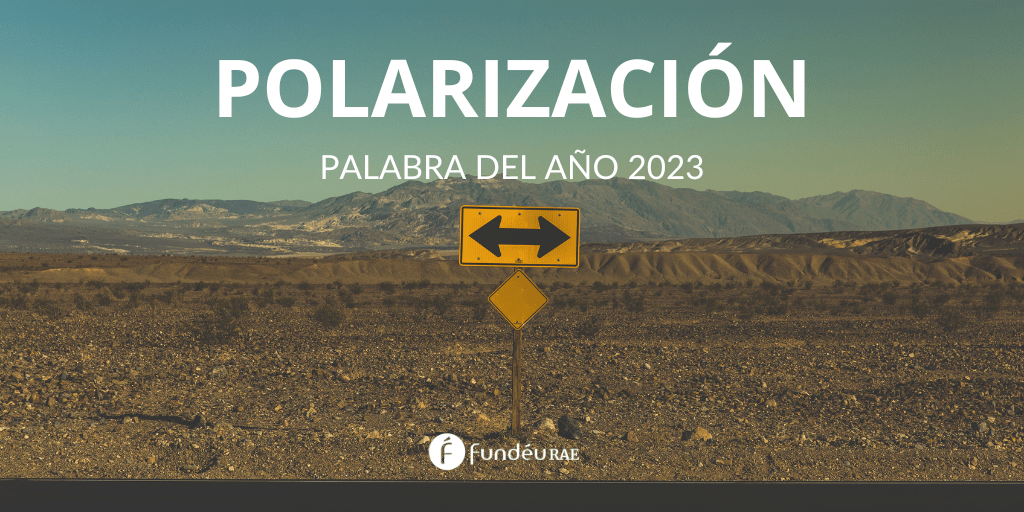
Polarización(polarization) wins palabra del año honors from the Royal Spanish Academy’s foundation in Spain, Fundéu del Español Urgente, which works with the news agency EFE. “It’s common to find examples in the media worldwide referring to many kinds of polarization: in society, politics, public opinion, social networks, etc.”
It was chosen from a dozen words that were in the news in Spain and had “linguistic interest”: amnistía (amnesty), ecosilencio (greenhushing), euríbor (euro interbank offered rate), FANI (unidentified anomalous phenomenon, formerly called UFO), fediverso (fediverse), fentanilo (fentanyl), guerra (war), humanitario (humanitarian), macroincendio (macrofire), seísmo (earthquake), and ultrafalso (deepfake).
Tourismo (tourism) is palabra del año for the Spanish Royal Academy’s foundation in the Dominican Republic, chosen because tourism kept the country’s economy afloat in 2023. Of linguistic interest, the word tourismo is originally derived from English.
***
If that isn’t enough ephemera for you, Wikipedia’s most popular article in 2023 is ChatGPT — followed by Deaths in 2023, 2023 Cricket World Cup, Indian Premier League, and Oppenheimer (film).
Time’s Person of the Year for 2023 is Taylor Swift. “To discuss her movements felt like discussing politics or the weather — a language spoken so widely it needed no context. She became the main character of the world,” the Time article says.
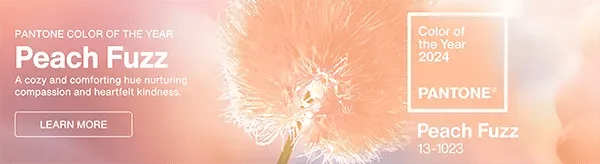
Finally, for this year, 2024, Pantone’s Color of the Year is Peach Fuzz: “PANTONE 13-1023 Peach Fuzz captures our desire to nurture ourselves and others. It’s a velvety gentle peach tone whose all-embracing spirit enriches mind, body, and soul.”
The right color can do so much, and 2024 will need all the help it can get.



 Sue Burke