Plants make the best gifts

I live in a big condominium in Chicago — a skyscraper, really — and a group of us plant-lovers organized a houseplant exchange last weekend. Dozens of plants changed hands. A building like ours is a vertical greenhouse, and we want to keep it green.

It’s hard to love houseplants without having lots of cuttings, plantlets, offshoots, and other extras to give away. I came home with two baby Ficus benjamina variegata, and I’m excited to have them.

***

More news:

Last week I had a conversation in a podcast with “an extremely online pilgrim” named Tasshin. He reviewed my novels Semiosis and Interference, examining ethical themes raised by the books, the world of Pax, and the character of Stevland. You can watch our conversation here on YouTube, where there are also links to an audio version and a transcript. I hope you enjoy our chat as much as we did.

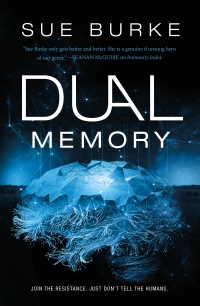
At The Best Books of 2023 by Tor.com reviewers, Matt Keeley calls Dual Memory “a satisfying thriller about art, climate, conspicuous consumption, and artificial intelligence. Burke remains one of our foremost science fiction writers.” Thanks, Matt!

Writing nonhuman points of view

Not every mind is human, which is a challenge for authors. It’s hard enough to write from a different human point of view: we’re a varied species, each one of us with our own experiences and quirks, but at least we can talk to each other. Non-humans … well, they never have long conversations with us, alas.

Yet, if we’re going to write speculative fiction, we can’t let that stop us. For my novel Semiosis, I wanted to write from the point of view of a plant — an alien plant, of course, not an Earthly one. All right, where to start?

Obviously, we know some things about Earth plants, so I began researching them. What is their experience of life? For one thing, they’re under a lot of stress. Growing seasons are short, and weather is uncertain.

Spring ephemerals, such as trilliums and snowdrops, illustrate this anxiety. They grow and flower as early as possible in spring, sometimes right through snow, dangerous though that must be. They catch the sunlight before trees put out leaves and cast shade. They offer nectar to the first bees that wake up after winter, monopolizing their attention. Then these plants go dormant until next spring: that’s the extreme step they must take to get their day in the sun. They leap upward at the first hint of springtime.

Plants compete for sunlight and actively fight over it. A common houseplant called the asparagus fern (Asparagus setaceus) has pretty, lacy leaves – and thorns it can anchor into other plants and climb over them. Its aggression has earned it the status of noxious weed in some parts of Australia. Roses have thorns for the same reason. If they happen to starve other plants by blocking out the sunshine, that’s just survival of the fittest.

Vines climb up trees to get sunshine without the cost of growing a sturdy trunk. Other plants may grow large leaves quickly to cast shadows on their neighbors, or poison the ground to keep out competition.

So, plants lead lives of quiet desperation, in constant combat with a variety of weapons.

The book What a Plant Knows: A Field Guide to the Senses by Daniel Chamovitz documents what his fellow botanists have long known. A plant can see, smell, feel, hear, know where it is, and remember. “Plants are acutely aware of the world around them,” he writes.

Trees, like us humans, have social lives. InThe Hidden Life of Trees: What They Feel, How They Communicate, German forester Peter Wohlleben describes how trees of the same species in forests create communities that help each other, enjoying much longer, healthier lives than isolated city trees. Trees also make decisions, such as when to drop their leaves, which can be a life-or-death gamble on the coming weather.

Plants are alert to their surroundings, and they can recall the past and plan for the future. They’re gregarious, and being isolated hurts them.

As we would expect from highly aware, social creatures, they relate to other species including animals. They grow flowers to attract pollinators, they grow fruit to encourage animals to spread their seeds, and they enter into symbiotic relationships with animals to further their needs. If nutrients are especially scarce, plants turn carnivorous. (The leaves depicted on the cover of Semiosis are of a sundew. The drops are glue to catch insects.)

Through photosynthesis, plants create their own energy. We can’t know how that feels, although we can observe how sap courses up and down stems and through leaves, and how carefully plants arrange their leaves in a “leaf mosaic” to capture light efficiently. Plants that store food for winter know how much food they have because they stop and shed their leaves when they think they have enough: they have body awareness.

Plants differ from us in one essential way: they have no set body type. Humans have two arms, two legs, and a standard-sized brain. A tree has as many branches and roots as it can support. A single tree can be huge, spreading out from its roots to create its own grove, and some can live for centuries, even millennia.

A possible personality for a plant has begun to emerge: anxious, active, aggressive, alert to its surroundings, impatient, reflective, and forward-looking, physically singular, self-aware, long-lived, manipulative of animals, and painfully lonely if it has no companions of its own species. Add intelligence and we have a point of view:

“Growth cells divide and extend, fill with sap, and mature, thus another leaf opens. Hundreds today, young leaves, tender in the Sun. With the burn of light comes glucose to create starch, cellulose, lipids, proteins, anything I want. Any quantity I need. In joy I grow leaves, branches, culms, stems, shoots, and roots of all types. … Intelligence wastes itself on animals and their trammeled, repetitive lives. They mature, reproduce, and die faster than pines, each animal equivalent to its forebearer, never smarter, never different, always reprising their ancestors, never unique.”

Read it now: ‘Poet for Hire’

The first short story I ever got published, back in 1995, “Poet for Hire” is posted here on my website for you to read.

In the story, I imagine Milwaukee’s first free-lance poet, a young woman with curly brown hair. She works out of a storefront in the 2200 block of Kinnickinnic Avenue, down the block from where I used to live. The plants in the Arid Dome of Milwaukee’s Mitchell Park Horticultural Conservatory, one of my favorite places, provide her with vital inspiration. In the end, the power of her pen is mightier than she expects.

Earlier this year, I was contacted by Anja Notanja Sieger. Someone found the story and sent it to her — because she is Milwaukee’s first poet for hire. She’s written poems in the Arid Dome; her husband owns a used bookstore in the exact same storefront in the story; and she has curly brown hair.

Anja invited me to her podcast, The Subtle Forces, where I read the story out loud, and we chatted about its coincidences. “Perhaps you wrote this story,” she said, “and then I happened.”

You can read the short story here.

You can listen to the podcast here.

The story was originally published in The Czarnina Kid and other Weird Tales, available here.

‘Canyonlands: A Quarantine Ballad’ goes on sale today

JB Rodríguez Aguilar has written a lyrical novella about the 2020 pandemic, Canyonlands: A Quarantine Ballad, and María Martínez Moreno and I translated it into English. It goes on sale today at Olympia Publishers and at Amazon.

It tells the story of an American photojournalist on his way home in March 2020 to his family in Chicago. Instead, the Covid-19 pandemic spreads, and he finds himself quarantined in a hotel room in Madrid, Spain. As he watches the statistics of illness and death rise, he retreats into memories of a trip years ago to a North American landscape that was a milestone in his career: Canyonlands National Park in Utah. This leads to a philosophic and personal chronicle of isolation.

JB is a talented photographer, and the book includes a photo essay of Canyonlands, a wilderness carved through layers of stone by the Colorado River and its tributaries.

An excerpt from the first section, in the hotel in Madrid:

What a first draft must do

For me, first drafts come hard. I’ve heard of writers who love them, but that might be an urban legend. I have a hard-learned opinion about first drafts.

First drafts have only one duty to fulfill: They must exist. They don’t need to be good. Mine don’t necessarily achieve coherence. In fact, I like to think of them as “zero drafts,” more of an experiment than an actual draft.

This saves me from the temptation to rewrite as I go, which I advise against. Rewriting can lead to getting stuck rewriting and re-rewriting the beginning, trying to perfect every sentence. Writers who do that may never get all the way to “The End.” But until the end is written, there’s no way to know exactly what the beginning needs. Even the most careful planner and outliner will discover changes in the story as it goes on.

In my first drafts — even as I plan first drafts — sometimes I get stuck. One tool that helps me is my friend Zack Jeffries’ writing prompt book, Break Through to “The End”. He intentionally designed it to use while starting an outline or first draft, writing the draft, or revising it.

What makes these prompts useful, I believe, is that they’re open-ended. Some prompts try to suggest an idea for story: “You’re looking into a bottomless pit. Describe your reactions three days later.” “A mistranslation of ‘weapons’ and ‘equipment’ causes an inappropriate shipment of goods.” (If you want ideas-based prompts, I recommend visiting PostSecret.)

Jeffries assumes you have a ton of ideas. He encourages you, instead, to wonder “What would happen if…” as a means to discover a new aspect of your story. For example, at one point, your character is going to make decisions that will have repercussions. He prompts:

“What would happen in your current scene or next scene if your main or perspective character wondered whether a decision they made was the wrong one? Is this a way to pull up the emotional strings of your reader? Is this a way you can reinforce what’s important to your main character? Can you show the reader what the main characters’ expectations are?”

Character arcs, relationships, plot, world-building, and theme — I can explore as I need in Jeffries’ book. For me, this is one more practical tool to help me get through the struggle of the first draft.

If you’re a writer, what are the tools that get you through the hardest parts?