Who is telling your story?

Even in third-person writing, in both fiction and non-fiction, I believe there’s never a neutral narrator. The precise words always convey a stance, attitude, and vantage point. So we need to understand our narrator as thoroughly as any other character in the story. Here are some examples. The sentences are out of context, which I think makes them easier to parse.

That had many philosophical implications on whether disagreements can exist in paradise, but in reality, all of this bullshit only meant that the people with the Nice Houses were distracted enough that the fourth kid was killed easily, and without much fanfare.

This narrator is relaxed (a loose sentence), conversational, apparently unartful (I’m sure the author sweated over every sentence) but full of judgment: “paradise” juxtaposed with “bullshit” and “Nice Houses” (ironically capitalized). The sentence reads fast and would be flippant except for the underlying outrage expressed in the observation that the bullshit (an emotional word) caused a distraction that resulted in a child’s casual murder. This narrator is close to the reader, distant from events, and opinionated. [“Why Don’t We Just Kill the Kid In the Omelas Hole” by Isabel J. Kim in Clarkesworld Magazine.]

It seemed to be slipping out of his grasp — all that vital, magnificent, inexhaustible world which he had seen from the windows of his room, his first day on the world. It slipped out of his awkward, foreign hands, eluded him, and when he looked again he was holding something quite different, something he had not wanted at all, a kind of waste paper, wrappings, rubbish.

This narrator offers formal, self-possessed observations. The complex sentences and elevated vocabulary read slowly and evoke carefully contrasted images: a magnificent world turns into rubbish in awkward hands. This narrator is a bit distant from the reader but close to the protagonist, looking out of the window with him, then looking at his hands and sharing his sad befuddlement at a long, slow failure. This narrator is wise (shown by the cultivated writing), sympathizes with the protagonist, and willingly takes his side. [The Dispossessed by Ursula K. Le Guin, Chapter 5.]

Dead battles, like dead generals, hold the military mind in their dead grip, and Germans, no less than other peoples, prepared for the last war. They staked everything on decisive battle in the image of Hannibal, but even the ghost of Hannibal might have reminded Schlieffen that though Carthage won at Cannae, Rome won the war.

The narrator for this non-fiction book is erudite, capable of viewing events informed by the height two thousand years (we buy this author’s books to get a lively sweep of history). The reader is assumed to be well-versed enough to know who Hannibal was. The narrator thus offers comradery with the reader and shares opinions with confidence and style, in this case that the German military minds were brain-dead, and Hannibal’s fate foreshadows the outcome of the decisive battles. This narrator is incisive. [The Guns of August: The Outbreak of World War I by Barbara W. Tuchman, Chapter 2.]

His heart was hammering again with an aching terror as he hurtled upward and downward through the blind gangs of flak charging murderously into the sky at him, then sagging inertly.

The narrator is both reporting this wartime aerial battle and sharing the protagonist’s sensations and emotions, “hammering” heart and “aching terror” and flak rising “murderously.” The narrator’s sympathies are with the protagonist, up close and desperate. Notice the alliteration of words that start with “h” and the cadence like panting breath, and the implied helplessness of hurtling up and down to evade a blind opponent as we are made to experience events alongside the protagonist. This narrator has a dog in the fight. [Catch-22 by Joseph Heller, Chapter 15.]

***

Earlier this month I joined a Zoom meeting of Jack Knych’s Instagram Reading Group to discuss Semiosis. The hour-long discussion ranged from the choice of personalities for the plants to the origin of Stevland’s name to the Earth creature that gave origin to the Glassmakers. You can see it here or on YouTube.

***

In February, I was a featured reader at the Deep Dish event at the Chicago science fiction convention Capricon 44. Deep Dish is a reading series organized by the Speculative Literature Foundation. You can watch my six-minute reading as well as the other participants here. I gave an abridged version of an essay “We Lost Control a Long Time Ago” that I wrote for the Asimov’s Magazine blog, From Earth to the Stars. You can read it here.

***

Finally, enough about me. A NASA microgravity plant scientist describes his work in a five-minute video. Plants conquer space!

The language of Hemingway

When I lived in Spain, I often heard it said that English is the language of Shakespeare (and Spanish is the language of Cervantes), but I really write in the language of Hemingway. These days, in fact, most people who write in English write like Hemingway, whether they realize it or not and whether they know much about him: a style that is simple, direct, controlled, economic, and if possible, authentic and honest. Perhaps, with luck, even elegant. Nothing like the excesses of the Victorian era. Hemingway was a groundbreaking artist with words.

He was also a legend in his own time, the most famous living writer in the world, a man who wrote about war, hunting, fishing, and bullfighting. The running of the bulls in Pamplona would not be world famous without him. He also was — and still is — a myth, a myth that I think is false, especially about his suicide. The myth says he was macho, adventuresome, active, a drinker, and a womanizer: strong and earthy.

But when I read his works, I doubt he was the man of the myth, which is nothing new. A lot of readers confuse the works with the writer. He wrote about brave, almost savage men, like war heroes and bullfighters — or so the myth says. But in his fiction and even in his news reporting, he was concerned about the feelings of his characters and their struggles to save their souls and hearts. That is not macho.

Hemingway said over and over he was not brave. He wrote that when he first went to Pamplona in 1923, it was a mistake to take his wife to a bullfight because she could see that the bullfighter was truly brave and that her husband was not.

His advice for other writers was excellent. His humor was wise and truly funny.

And he killed himself in 1961. The myths say his bad habits left him incapable of writing. They say he was depressed, that his father and grandfather also committed suicide and he had a character flaw, that his philosophy for life had failed, that he had looked for death during his whole life and finally he found it.

But he had never looked for death: he said that in 1954 when many people thought he had died in an airplane accident in Africa. He did suffer serious injuries in the accident. He lost the use of his kidneys. He had to take blood pressure medication that caused terrible depression, and to counteract the depression the doctors gave him shock therapy, which left him incapable of recalling his own name.

Because of that, he couldn’t write. He begged his wife on his knees not to make him get more treatments. And if that were not enough, he was going blind.

Today, no doubt, he could get better medical treatment. But in 1961, he was a very sick man with no future, and he decided to end his suffering. Perhaps it was an act of a strong man who took responsibility for all the aspects of his life, including the final moment. Perhaps he was an ordinary man who couldn’t stand it any more — that’s what I think. He was just a man, not a myth. Many people couldn’t withstand a physical nightmare like his.

The characters in his works were people who were physically and emotionally hurt, not heroes at all but ordinary people in situations that revealed their strengths and weaknesses and fear and courage.

I think the myth about Hemingway tries to balance the value of his life with the tragedy of his death, something understandable, but I think it is a mistake. Myths seek a just and sensible world. Works of fiction have meaning, which is their charm. Real life is not fair and does not need to make sense.

But, as Hemingway said and wrote again and again, life is worth living. He tried to show that in his works. That’s why he’s still worth reading.

A HEMINGWAY READER

from The Flight of Refugees, April 3, 1938, Barcelona

[A news report from the Spanish Civil War.]

Somewhere up ahead, the bridge across the Ebro was being held against the enemy, but it was impossible to get closer, so we turned the car back again toward Tarragona and Barcelona and passed the refugees again. The woman with the baby born yesterday had it wrapped in a shawl as she swung with the walking gate of the mule. Her husband led the mule, but he looked at the road now and did not answer when we waved. People still looked up at the sky as they retreated, but they were very weary now. The planes carrying the bombs had not come, but there was still time for them and they were overdue.

from The Christmas Gift, 1954

[After an airplane accident in Africa, rumors claimed that he had died.]

In all the obituaries, or almost all, it was emphasized that I had sought death all my life. Can one imagine that if a man sought death all his life he would not have found her before the age of 54? It is one thing to be in the proximity of death, to know more or less what she is, and it is quite another thing to seek her. She is the most easy thing to find that I know of. You can find her through a minor carelessness on a road with heavy traffic, you could find her in a full bottle of Seconal, you could find her with any type of razor blade; you could find her in your own bathtub or you could find her by not being battlewise. There are so many ways of finding her that it is stupid to enumerate them.

If you have spent your life avoiding death as cagily as possible but, on the other hand taking no backchat from her and studying her as you would a beautiful harlot who could put you soundly to sleep forever with no problems and no necessity to work, you could be said to have studied her but not sought her. Because you know among one or two other things that if you sought her you would possess her and from her reputation you know that she would present you with an incurable disease. So much for the constant pursuit of death.

Nobel Prize Acceptance Speech, 1954, read by John C. Cabot, United States Ambassador

[Hemingway was not well enough to accept the prize in person.]

Having no facility for speech-making and no command of oratory nor any domination of rhetoric, I wish to thank the administrators of the generosity of Alfred Nobel for this Prize.

No writer who knows the great writers who did not receive the Prize can accept it other than with humility. There is no need to list these writers. Everyone here may make his own list according to his knowledge and his conscience.

It would be impossible for me to ask the Ambassador of my country to read a speech in which a writer said all of the things which are in his heart. Things may not be immediately discernible in what a man writes, and in this sometimes he is fortunate; but eventually they are quite clear and by these and the degree of alchemy that he possesses he will endure or be forgotten.

Writing, at its best, is a lonely life. Organizations for writers palliate the writer’s loneliness but I doubt if they improve his writing. He grows in public stature as he sheds his loneliness and often his work deteriorates. For he does his work alone and if he is a good enough writer he must face eternity, or the lack of it, each day.

For a true writer each book should be a new beginning where he tries again for something that is beyond attainment. He should always try for something that has never been done or that others have tried and failed. Then sometimes, with great luck, he will succeed.

How simple the writing of literature would be if it were only necessary to write in another way what has been well written. It is because we have had such great writers in the past that a writer is driven far out past where he can go, out to where no one can help him.

I have spoken too long for a writer. A writer should write what he has to say and not speak it. Again I thank you.

***

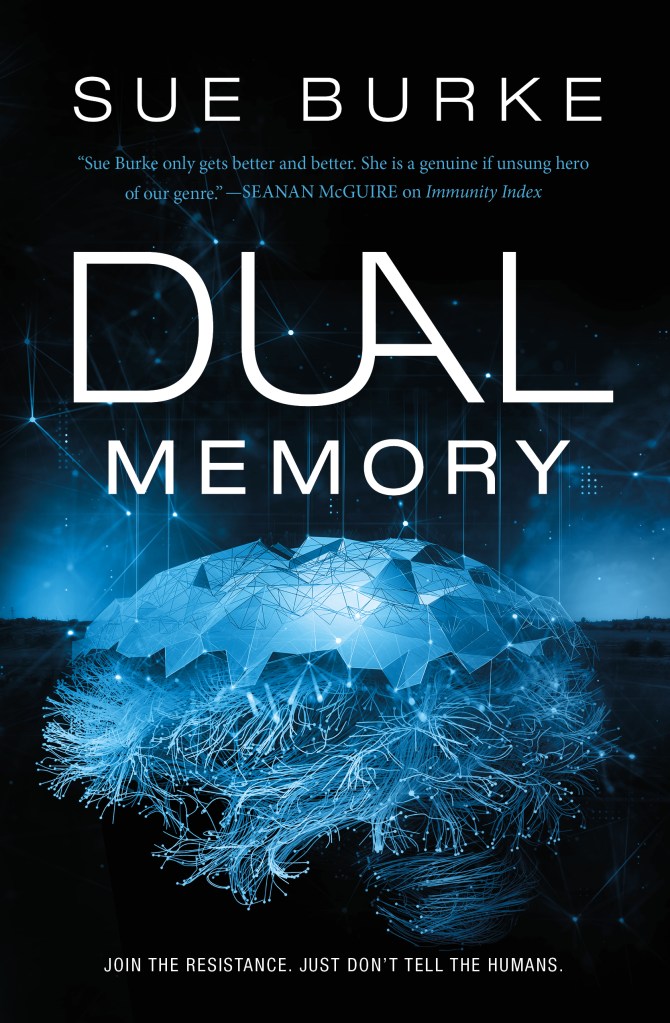
The trade paperback edition of my novel Dual Memory comes out on April 16 and is available for pre-order from your favorite bookseller. Hardcover, ebook, and audiobook editions are also available.

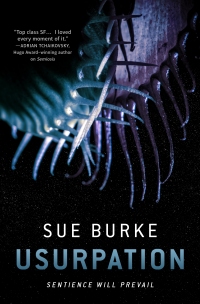
The third book in the Semiosis trilogy, Usurpation, will be published in October this year, and you can pre-order it with links to your favorite bookseller here, in hardcover and ebook.

Why paint portraits of tulips?

As I’ve mentioned before, my most recent novel, Dual Memory, was inspired by tulipmania, a historical event that occurred in Holland in the 1630s during the Dutch Golden Age. One of the facts that inspired me is that although tulipmania is widely known as the folly-filled speculative fever that drove many people into poverty, it simply didn’t happen. Yes, Dutch merchants invested in tulips, and the prices soared, but tulips were pretty good investments, no one went broke, and the anxiety that fueled false reports about “tulipmania” had to do a lot with class and political power.

Merchants in the Dutch Golden Age also invested in art, especially portraits, even portraits of tulips rendered by the finest artists of the day. This is why the protagonist of my novel is an artist. But why did Dutch investors want art?

As Anne Goldgar explains in her book Tulipmania: Money, Honor, and Knowledge in the Dutch Golden Age, it had to do with the mentality of the times in that part of Europe. Explorers, colonizers, and trading vessels were bringing back all kinds of exotic bits from the rest of the world like sea shells, beautiful stones, coins, coconuts, rattles from snakes, stuffed birds, tortoise shells, butterflies, and “anything that is strange.” Rich men created “cabinets of curiosities” to show off their finds, entertain friends, and display their knowledge and good taste.

Along with natural wonders, artificial wonders like art added to the thrill and glory of collecting. Artists’ ability to create their own wonders seemed to put them on a plane equal to God because they could remake nature and thwart the brevity of beauty. Collectors also amassed living things, such as companion dogs and flowers new to Europe, especially tulips. These were rich men — and occasionally rich women — so they could afford to commission art to enhance their collections.

This explains the watercolor portrait (above) of a Koornhert tulip by Pieter Holsteyn II, who is best known for making portraits of objects for collectors. This particular variety of tulip was named for a prominent Amsterdam merchant and collector, Volckert Dircksz Coonhart. Both the tulip and the art were good investments, which is why Harvard Art Museums now owns this stunning portrait.

History offers surprising inspirations for novelists, I believe. The past is as strange as any distant planet.

***

The trade paperback edition of Dual Memory comes out on April 16 and is available for pre-order from your favorite bookseller. Hardcover, ebook, and audiobook editions are also available.

Five things I learned at Clarion

In 1996, I attended the Clarion Science Fiction and Fantasy Writers’ Workshop. Clarion was established in 1968, and it’s an intensive training ground for aspiring writers of fantasy and science fiction. It lasts for six weeks, and I returned exhausted. Back then, it was held at Michigan State University, and now it’s at UC San Diego. The next session is June 23 to August 3, 2024.

What did I learn there? Here are five things:

1. How to critique and why. Finding ways to strengthen someone else’s work is a fast way to learn how to strengthen your own work. The technique I learned from Maureen F. McHugh is this: Summarize what the story is or does in a sentence or two; identify the successes of the work; indicate the weakest parts; and offer one or two ideas for the fastest and biggest improvements.

2. Every story gets only one miracle, and the first sentence should point to it.

3. The person (or thing) that hurts the most is usually the best perspective for a story.

4. Setting reflects character, and different characters will experience the same setting differently.

5. The first draft may have everything you need, but you might need to change it all. That is, the story might be there, but the telling doesn’t do it justice. What is the story trying to do? What are its successes? Weaknesses? What could improve it the most?

How to write great endings

How do you write great endings to a short story or novel? At TBRCon, an all-virtual sci-fi/fantasy/horror convention in January, I was on a panel that discussed just that. You can watch it here:

But we only got to talk for an hour, and there’s a lot more to say, so here’s a little more advice:

First of all, what is an ending? You can define it as the point when the major questions of the story have been answered. You can also think of it as the point where the reader finally knows what will happen next: Mystery gets a solution. Action reaches a resolution. Sin earns redemption or damnation. Anguish finds relief. Love enters a relationship. Conflict is settled. Adversaries win or are defeated. Problems yield solutions. Obstacles are overcome.

Short stories differ from novels because a short story generally has only one question to answer. A novel can have several questions, or a central question that keeps changing because each answer leads to new, bigger questions.

I advise knowing the ending before you start writing, at least in broad terms. Remember, you can change your mind if you get a better idea. In my forthcoming novel Usurpation, I knew all along how the novel would end — what the answer to the central question in the novel would be — then I had to figure out how to get there and how to make it as hard as possible to get there. (No spoilers, but the answer is “yes.”)

Some people are pantsers, also called discovery writers, which means they start writing and see where the story goes. I discourage this method simply because it tends to be the most laborious, slowest way to write, and writing is hard enough to begin with. In my experience, the more I know before I start, the easier the first draft is. Besides, if you don’t have a plan, you might grab the first ending you can think of, and it might be weak or unsatisfying.

I also encourage writing all the way to The End without going back and rewriting the first chapter again and again — even if the story changes and now the beginning needs to be rewritten. Of course the story changes. It always does. So the first chapter will need to change, too. But the beginning should connect to the ending, and until you reach The End, you won’t know what the exact right beginning is.

What kind of ending is good? That depends on the kind of story you want to tell, and there’s no formula that guarantees success. Many kinds of endings are satisfying: happy or sad, open or closed, philosophical or explicit, a twist or a freeze-frame, a summation or a flash-forward…

However, problems with endings almost always start somewhere earlier in the story. The conflict might be too small, too easily solved, or lacking tension. The antagonist might not be worthy. The problem, question, or conflict might not get resolved in the story, so the story doesn’t reach its actual end. Or the ending was reached earlier, and the story continued past the end. The ending may be unforeshadowed, rushed, unresolved, formulaic, illogical, abrupt, or unclear.

How do you know if you have a good ending, and if it’s not, then what’s the problem? One way to know is to set the work aside for as long as you can. I’ve heard of writers who wait for a full year. (I’m not that patient. Also, I might have deadlines.) Another way is to get good beta-readers, although they’re hard to find, and if you get some, treat them like royalty. A third way is to dissect your story. If you’re a pantser, now is the time to unleash your inner plotter and outline the story you have: you can see a lot by breaking it into its most skeletal form. If you’re a plotter, try reading it strictly for pleasure and notice what you enjoy and what bothers you.

Remember that writing is a practice discipline, like music or sports. The more you write, the better you get at it. The more you read, the more you’ll learn about writing, too, but be sure to read quality writing so you learn good lessons. Finally, beta-reading other people’s work is an effective way to learn to spot strengths and weaknesses in their writing, which will help you spot the same things in your own writing. Be sure to critique with kind and gentle honesty.

Have I reached a good ending to this blog post? I don’t think so. There’s a lot more to say. For starters, Rebecca Makkai has written a six-part series about endings on her Substack that explores many specific ways to end a story — wonderful, creative possibilities you can use.

If you want to write, I want you to succeed. I hope I helped a little.