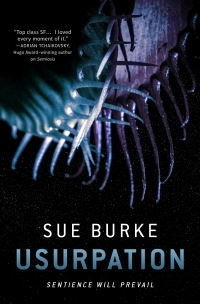
B&N preorder sale – buy the upcoming paperback edition of ‘Usurpation’

Barnes & Noble is holding a promotion for pre-ordered print books from Tuesday, July 8, to Friday, July 11. Prices are 25% off Premium and Rewards members. Use the code PREORDER25

The trade paperback of Usurpation will be released on October 21, 2025. If you haven’t read it yet, this is your chance to get a good price — and to buy more books from your other favorite authors!

What was that hallucination?

When I was 10 years old, before a measles vaccination had been developed, the adults knew an epidemic was coming, and sure enough, I got sick, very sick.

Among my many bad memories of measles was waking up one night in a pool of vomit while hallucinating from a high fever. I remember my mother coming to clean me up, and as she cleaned up the bed, I sat on a bench in the corner of my room.

While I waited, Snagglepuss, a cartoon character I liked, a pink lion, came to sit and talk with me. He was comforting, calming, even a little funny, and he genuinely made me feel better and feel safe.

A few days later, as I thought about it, I appreciated Snagglepuss talking so soothingly to me when I really needed comfort, but the whole thing was obviously a hallucination. (I had other, very unpleasant hallucinations that night, too.) What puzzled me was the way I had imagined his personality, very unlike the TV persona. Normally he was a smart-aleck, even.

Much, much later, I realized that yes, I had been hallucinating, but not the way I thought. Through my mental haze, I hadn’t recognized the kind person providing such gentle, loving care, but in retrospect I could distinctly identify his personality. He had been my father.

Dad in his college days.

A Few Varieties and Secrets of Drafts and Outlines

Fiction writers have an ongoing debate about whether or not to plot: that is, whether to use an outline. But outlines and drafts come in many varieties, which complicates the debate. Here’s everything I know about outlines and drafts condensed into handy bullet points (itself a kind of outline), which I hope will be helpful to you.

Why outline?

• Ideas for novels are too big to hold in your head all at once; you need some sort of notes.

• You might be able to write faster using an outline.

• Outlines can let you write less anxiously because you know what will happen next.

• Outlines are a “big picture” tool to help you revise/re-envision your story for subsequent drafts.

• Leonardo da Vinci used outlines when he painted; this is a respectable artistic tool.

Why avoid outlines?

• Your brain simply doesn’t work that way; you can do just fine without one.

• You lack experience using this tool, so it’s hard to figure out and feels uncomfortable.

A few kinds of outlines

• Three-act structure

• Save the Cat formula

• Romance novel formula

• Scrivener or other software

• 3 x 5 cards or Post-It Notes

• Pictures/scrapbook/artwork/poems

• Spreadsheets/charts/maps

• Hero’s Journey

• Heroine’s Journey

• Fool’s Journey

• Beat Sheets

• Snowflake method

• East Asian four-act kishōtenketsu

• Detailed scene-by-scene

• General chapter-by-chapter

• Character driven

• Theme or narrative focused

• Crisis or paradox centered

• A series of questions

• A series of causes and effects

• Continuous re-evaluation

• Joyous amalgam of all these

Some secrets to using an outline as a writing tool

• You can make an outline at any time: before, during, or after any draft or part of a draft.

• Your outline can be a simple list of beats, plot twists, or key scenes.

• The plot outline is not the manuscript outline, which might not be chronological or logical.

• There is no Platonic ideal story; a story can take different forks in the road along the way.

• You can begin plotting from the end, middle, or beginning of the story.

• Any single step or couple of steps of a standard plot outline can be a short story.

Kinds of drafts

• Zero draft, a wildly experimental initial draft that doesn’t “count” as a first draft.

• Dialog-only draft, with the rest to be filled in during subsequent drafts.

• Disconnected scenes, to be connected in a later draft.

• Fast drafting, writing as quickly as possible without looking back, NaNoWriMo-style.

• Writing each scene as a short story.

• Messy, ugly, crappy early drafts; only the final draft needs to be beautiful.

Exercise: a tiny outline

Summarize your story in three three-word sentences. Such as, for a romance: 1. Girl meets boy. 2. Girl loses boy. 3. Girl wins boy. Or for Hamlet: 1. Hamlet has doubts. 2. Doubts are resolved. 3. Hamlet gets revenge. Does your story have a beginning, middle, and end?

(This post is available as a one-page PDF here.)
My vote for the Nebula Award for Novella

As a member of SFWA, the Science Fiction and Fantasy Association, I get to vote on the Nebula Awards. Here’s my vote for best novella (17,500 to 40,000 words). The awards will be presented at the Nebula Conference on June 7 in Kansas City.

The Butcher of the Forest by Premee Mohamed (Tordotcom) — A woman ventures into a dangerous forest to save two children from a monster. A grim story told with urgency.

The Tusks of Extinction by Ray Nayler (Tordotcom) — Elephants and newly-revived mammoths face extinction from ivory poachers, but they have protectors. The story explores its ideas back and forth in time to dramatize a contest between greed and survival.

Lost Ark Dreaming by Suyi Davies Okungbowa (Tordotcom) — An ancient power arises in a post-apocalypse dystopia, and three very different people in a literally stratified society must try to survive.

Countess by Suzan Palumbo (ECW) — A story inspired by The Count of Monte Cristo, but in space.

The Practice, the Horizon, and the Chain by Sofia Samatar (Tordotcom) — The chain is about an ex-slave, the practice is about the chance to become something better, and the horizon the chance to get it. A lot of social justice, told with the distance of spaceships.

My vote: The Dragonfly Gambit by A.D. Sui (Neon Hemlock) — A former lover, now an enemy, conspires to bring down an empire. I was impressed by the tight storytelling, emotional tension, and frequent reversals.