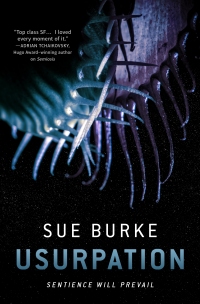
An excerpt from ‘Usurpation’

Here’s an excerpt from the novel Usurpation, which will be published in October in hardback, ebook, and audiobook (in preparation). You can preorder your copy now.


CHAPTER 3 – Year 2885 CE – Pax Institute, Bayonne, France – LEVANTER

She has arrived, the new director of the Pax Institute, and I will be destroyed. She confirms her credentials with the building and walks through the front door.

She is going to take my place. She will find out that I, Levanter, am not a human being. Foolishly, I used my real name to declare myself director, the name Mirlo gave me three centuries ago. He planted seeds he brought from the planet Pax, and I and my two sisters now grow here at the institute’s garden. My name is in the record’s big clumsy library in too many places to erase before she accesses the system. It is even on a sign in the garden in front of my main stalks. She will discover that Levanter is a rainbow bamboo.

No one knows we are intelligent. No one can know. Bamboo grow all over the Earth, and humans would kill us all if they knew. Not all humans are killers, but some are, and they have proven themselves efficient.

Meditate like the stars

How do you meditate? Sitting still, eyes closed? That’s one way to do it: We can imagine ourselves serene like the stars overhead, moving in stately, measured rhythms. We breathe in and out, and they rise and set.

Or we could meditate like the stars as seen from another point of reference, dashing to and fro frenetically. Our Sun moves at 43,000 miles per hour. Nearby Barnard’s star is moving away from us at 200,000 miles per hour, while a star called Ross 128 is moving toward us at 69,000 miles per hour. Stars race through the sky, and they outnumber all the grains of sand on all our beaches. Their heavenly haste creates the galaxies that fly like hurricanes across the cosmos.

You can sit still to meditate. Or you can emulate a star and race like a cannonball from place to place, tugged throughout your journey by bodies as small as a planet or as large as the black hole at the center of a galaxy. Your course will be constantly modified by outside forces as you career past them.

Movement is beauty. Speed is ecstasy. Stars never travel alone and never make the same journey as their neighbors — and here on Earth, every moment of their voyages are tracked with scientific awe.

You can be like them. Savor tomorrow morning’s mad rush. Imagine yourself as a star while you move fast and phrenetic, your destination subject to constant influence and change.

Meditate on your blazing, ecstatic celerity toward parts unknown. You will be heavenly.

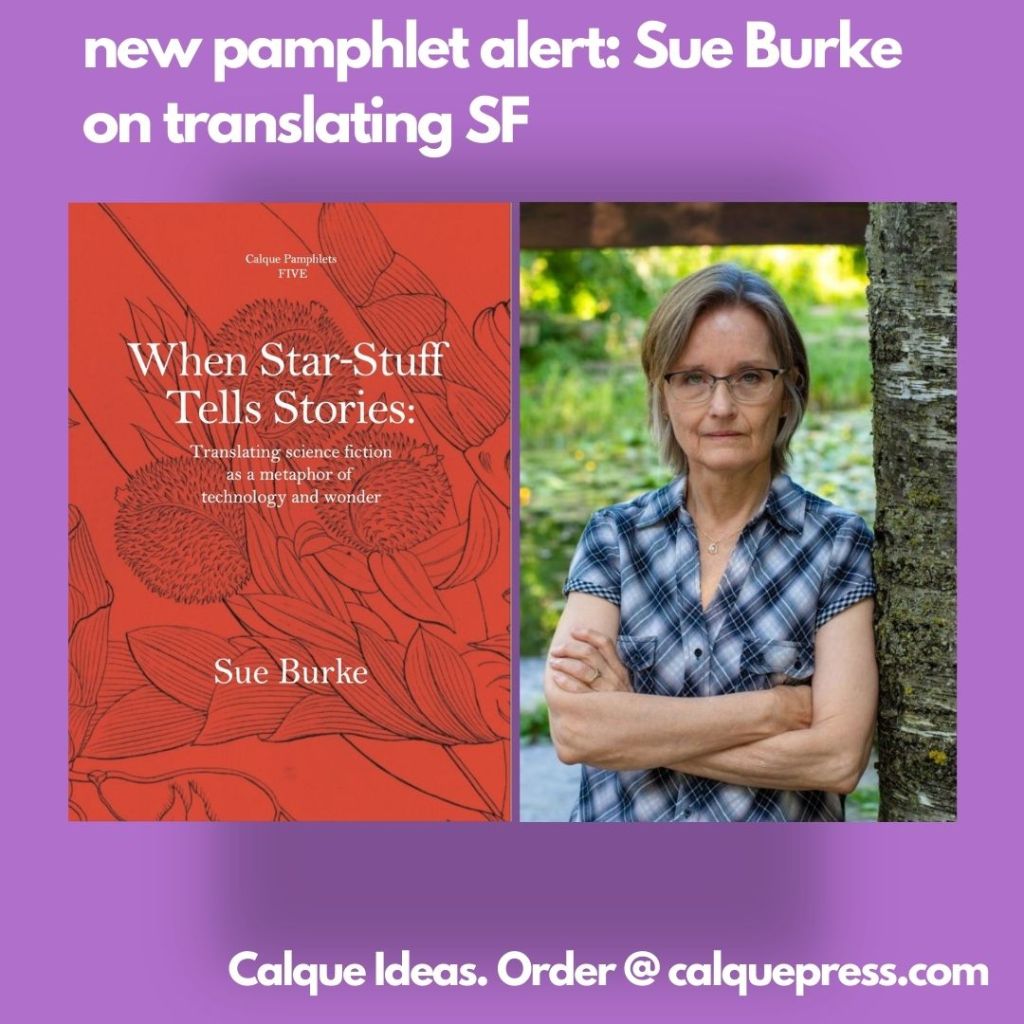
“When Star-Stuff Tells Stories” – now on sale

“If and when aliens make first contact, who should answer? Maybe humankind should turn to people like me, translators of science fiction. We’ve already thought through this kind of problem.”

That’s the opening sentences of my essay When Star-Stuff Tells Stories: Translating science fiction as a metaphor of technology and wonder. Calque Press has just published a limited edition of it as a 24-page pamphlet, and you can learn more and buy it here.

It’s one of a series of essays and other short works published by Calque. They’re meant to provide an opportunity for writers to think aloud about their own experiences and knowledge — and they are beautifully printed on high-quality paper. The publisher is fussy about the look and feel.

Here’s Calque’s description of When Star-Stuff Tells Stories:

Starting from the very earliest forms of human communication, the ways in which language developed into languages, and created the role of the translator, Sue Burke offers an invaluable guide to the importance and difficulties of translation on Earth, and gives us fascinating speculation about what might happen if we ever do come into contact with extraterrestrial intelligence. This pamphlet addresses questions of what communication is, and how the translator is uniquely positioned to work at escaping the bounds of the medium and bringing pure meaning into an intelligible form.

My choices for the Hugo Award Best Novella

As a member of the Glasgow 2024 Worldcon, I’ve been reading for the Hugo Awards. Novellas are little novels (as the name implies) between 17,500 and 40,000 words. I think of it as short enough to explore an idea with urgency but long enough to explore the idea with depth.

As with the categories of novelette and short story, I was pleased to see that Chinese fans from last year’s Worldcon were able to nominate works they found worthy. But I’m afraid I question their judgement now.

My ballot:

1.  Rose/House by Arkady Martine (Subterranean) — A detective investigates a murder in a dead architect’s landmark creation, but the house is haunted by a mad AI. The tense, creepy story is told with haunting, lyrical prose and features a variety of well-drawn characters.

2. Mammoths at the Gates by Nghi Vo (Tordotcom) — Cleric Chih returns to the Singing Hills Abbey, and war mammoths are menacing the gate. This installment in the Singing Hills Cycle is a quiet story about grief, memory, and family, with a beautiful twist at the end. It was also a Nebula Award finalist.

3. Thornhedge by T. Kingfisher (Tor, Titan UK) — A knight, a half-fairy, and a changeling walk into a story … and something luminous happens. Fairies and humans mix disastrously, though. The sorrow is palpable and deftly told. It was also a Nebula Award finalist.

4. The Mimicking of Known Successes by Malka Older (Tordotcom) — It’s billed as “a cozy Holmesian murder mystery and sapphic romance, set on Jupiter,” and that’s what it is. The story moves slowly, however, and has some plot holes. This was also a Nebula Award finalist.

5. No Award — As the rules say, “If you vote for No Award … it means that you believe the finalists you placed above No Award were worthy of a Hugo, but that those not placed above it were not worthy.” The translation of these stories is a bit too literal, but that’s not the problem.

“Life Does Not Allow Us to Meet” by He Xi, translated by Alex Woodend (Adventures in Space: New Short stories by Chinese & English Science Fiction Writers) — Humanity is colonizing distant planets, but it cannot tolerate competition. A team is sent to judge whether the pioneer species of one of the planets qualifies as human. This could have been an interesting story except for the stilted dialogue, wooden characters, infodumping, and a plot hole that caused genocide.

“Seeds of Mercury” by Wang Jinkang, translated by Alex Woodend (Adventures in Space: New Short stories by Chinese & English Science Fiction Writers) — A life form that lives in molten metal is discovered and sent to live on Mercury. A rich man accompanies them, and a society develops on Mercury. Good ideas, although not terribly original, but clumsily told. Good ideas are not enough to win my vote. Ideas must be paired with good storytelling.
My ballot for the Hugo Award for Best Novelette

Because I’m an attending member of this year’s Worldcon in Glasgow, Scotland, in August, I get to read and vote for the Hugo Awards. They’ll be presented at a formal ceremony on Sunday evening, August 11, and I’ll be there.

I was pleased to see a Chinese finalist this year, along with a mix of fantasy and science fiction. The voting is ranked-choice, and here is my ranking. As I read the stories, I considered how strong I felt the endings were and used that as a basis for my decisions, but of course, your judgement may vary.

6. “One Man’s Treasure” by Sarah Pinsker (Uncanny Magazine, January-February 2023) — Trash collectors face dangers as they pick up household waste that includes discarded magic. A cute story with dark themes.

5. “The Year Without Sunshine” by Naomi Kritzer (Uncanny Magazine, November-December 2023) — A catastrophe fills the air with ash and causes a major societal breakdown, and a Minneapolis neighborhood comes together to help everyone living there survive. More seems to be happening beyond the neighborhood, but like the cause of the catastrophe itself, no one in the neighborhood seems to talk about it. This is a cozy catastrophe and a paean to good will. It won the Nebula Award this year.

4. “Ivy, Angelica, Bay” by C.L. Polk (Reactor Magazine 8 December 2023) — Witches battle for control of a neighborhood. Beautiful imagery and a compelling story.

3. “On the Fox Roads” by Nghi Vo (Reactor Magazine 31 October 2023) — Bank robbers in the American Midwest tap into roads the rest of us never see despite — or perhaps because of —their dark, dangerous beauty. The roads lead to the unexpected.

2. I AM AI by Ai Jiang (Shortwave) — A gig cyborg worker who is a writer struggles to survive at the edge of an inhumane, predatory city. Could her life be better if she shed her humanity and became a true AI? This grim dystopia feels inspired by the way we treat creative work today.

1. “Introduction to 2181 Overture, Second Edition” by Gu Shi, translated by Emily Jin (Clarkesworld, February 2023) — If cryogenics is possible, what could possibly go wrong? Gu Shi lays it all out with heartfelt depth and clarity. The idea and the unique storytelling brought this to the top of my ballot.