How I got the idea for the novel “Semiosis”

“Where do you get your ideas?”

If you’re a writer, you may have been asked that. Here’s how I got the idea behind Semiosis and turned it into a novel. Exactly how it happened isn’t typical, but it’s not unusual, either — there are a lot of paths to a novel, and they’re all good — but I think this story illustrates an essential and sometimes overlooked aspect of writing.

The whole thing started with the houseplants on my dining room table in the late 1990s. (The photo is from this decade: different house, different plants, but just as many of them.) One day, I discovered that the little pothos in a mixed planter had wrapped itself around another plant and killed it. At first, I blamed myself for not having noticed earlier and intervened. Then a philodendron on a bookshelf tried to sink roots into another plant. I became suspicious and did some research.

What I learned was disturbing. According to botanist Augustine Pyrame de Candolle, “All plants of a given place are in a state of war with respect to each other.” They compete for light and nutrients, and they use ingenious tactics to abuse and even kill each other. For example, roses have thorns so they can impale their prickles into other plants and climb over them. In the process, they might kill the other plants — but this is war. Roses don’t care as long as they’re victorious.

Even more disturbing, I learned, are the ways that plants use animals for a variety of tasks. They grow flowers to attract pollinators, as we all know, and they’re sometimes very unkind to hard-working insects. Plants also grow fruit so that we’ll eat it and spread their seeds. When a tomato (tomatoes are technically fruit) turns red, the tomato plant is sending you a message: Eat me now! We think we grow crops to feed ourselves, when from the point of view of many plants, they reward us with food to manipulate us into helping them survive. We serve the plants.

I wrote and sold a non-fiction article to a magazine about the viciousness of the vegetable kingdom, and as a science fiction writer, I thought I ought to do something more with the idea. But what was the story?

Then, at a science fiction writing workshop, the instructor posed a writing prompt about a special kind of wall that suddenly appears in a war zone. War? That might work. What if, on a distant planet, a human colony suddenly appeared like a wall between warring plant factions? (Two classmates also got good ideas from that prompt. One wrote a tender steampunk love story, and another an epic fantasy novel.)

Soon enough, my short story was written and published, dramatizing the dangers of setting up a colony between warring plants. A couple of years later, I came back to the story and thought about expanding it into a novel — so I began more research. Even a fairly Earthlike planet needs a carefully designed ecology.

A few unexpected details that I discovered during that research became critical. On Earth, most iron has sunk to the planet’s core, but a lot remains mixed in the crust, so iron is common. However, if a planet happens to have a lot of carbon as it is formed, almost all the iron sinks down to the core, and the crust becomes iron-poor. Plants need iron to create chlorophyll. Your blood is red from hemoglobin, which contains iron. You have what plants want. Stories need conflict. This one could be life-or-death.

I also realized that no matter how I tweaked the plants, they’d respond slowly. They’re simply low-energy beings. I needed to slow down the story but still keep it compelling. I decided to jump in time between chapters by skipping from one generation of the human colonists to the next, a kind of story called a roman-fleuve.

By then, I had finally developed the idea enough to begin writing — after spending a few years researching all the details.

Story ideas come from many sources: sometimes from a conversation, a news report, an old memory, an episode from history, a reaction to another story, a compelling prompt, or a random observation as you’re walking down the street. I believe that ideas are as easy to encounter as snowflakes in winter. What’s hard are stories. Ideas need to be dramatized. It may take time, observation, research — and possibly a little luck — to discover the drama behind the idea.

There’s no right or wrong way to find the drama. I can only offer one piece of advice: Be patient with the process.

***

(This article originally appeared in the Chicago Review of Books in February 2018.)
Books on sale!

If you or someone you know and love hasn’t read the novel Semiosis yet, the ebook will be on sale throughout the month of September for only $2.99 for Kindle. This promotion will include an excerpt from the third book in the Semiosis trilogy, Usurpation, which will be released on October 29.

Besides that, from September 4 to 6, Barnes & Noble is dropping the preorder price for Usurpation, as well as other preorders. B&N Members get 25% off, and Premium members get an additional 10% off. This is good for print, ebook, and audiobook editions.

Meanwhile, I’ll be at Chicago’s Printers Row Lit Fest on Saturday morning, September 7, at the Speculative Literature Foundation table. Come say hi!

Yellow

Every flower is unique. And yet, some small yellow flowers share a common nickname among botanists: DYCs, Damned Yellow Composites. Those are plants of the Asteraceae (daisy, aster, and sunflower) family, which are common worldwide. They’re usually tenacious weeds, and they may be pretty, but they can be so alike that they’re hard to tell apart.

Sometimes botanists don’t even try. It may not matter to the local ecology exactly which species those flowers belong to. Identifying them as DYCs serves well enough except for the most rigorous scientific purposes.

Every small songbird is also unique but far too many look similar to each other. The ones that are hard to distinguish are sometimes called dickybirds by birdwatchers, and often these birds — especially warblers — have a touch of yellow.

There are more galaxies in the sky than grains of sand on Earth’s beaches, so how many stars will be standard M-class yellow stars like our own Sol? Too many to count.

Flowers, birds, stars: yellow abounds. So does ambition.

Flowers, birds, and suns all strive for more, and our universe undergoes constant change as a result. Birds compete with song. Stars create more complex matter at every generation. Imagine what a weed will be like as eternity gives it time to perfect its art. The bouquets will astound us with their sheer ambition.

Yellow means aspiration and change — changes too small and slow for us to see, yet we can enjoy their success so far: a field of flowers, a morning filled with birdsong, and a sunny day. Yellow unites them with beauty.

“Life from the Sky” at Forever Magazine

My novelette “Life from the Sky” is included in the July 2024 issue of Forever magazine. The story tells how this isn’t a good time for an alien life form, no matter how simple and harmless, to land on Earth. The story was originally published in Asimov’s magazine in 2018.

Forever is a monthly science fiction magazine that features previously published stories you might have missed, edited by the Hugo and World Fantasy Award-winning editor of Clarkesworld Magazine, Neil Clarke. The July 2024 issue also includes “The Gods Have Not Died in Vain” by Ken Liu, and “Unauthorized Access” by An Owomoyela. Cover art by Ron Guyatt.

You can by it from Weightless Books: Forever Magazine Issue 114.

(Photo: Me trying to steal Neil Clarke’s Hugo Award at the 2024 Glasgow Worldcon.)

***

If you can read Spanish, you can buy the Spanish-language version of my novelette “Who Won the Battle of Arsia Mons?” [“¿Quién ganó la batalla de Arsia Mons?” translated by Virginia Sáenz] published in the anthology Excelsius 2024. I attended the Celsius 232 literary festival for science fiction, fantasy, and horror in Spain in July, where an anthology of works by writers attending the festival was created as a premium for its Patreon members. It is now on sale to the public, and it includes stories by Angela Slatter, Beatriz Alcaná, Cat Sparks, Charlie Jane Anders, Fulanito Pingüino Escritor, Guillem López, JV Gachs, María Zaragoza, Santiago Eximeno, and Thomas Olde Heuvelt.

“Who Won the Battle of Arsia Mons?” was originally published (in English) at Clarkesworld Magazine in 2017 (available there in print and in audio). It tells the story of the stupidest thing I could think of for robots to do on Mars.

(Photo: Meeting readers at Celsius. The festival was full of people eager to read!)

I’ll be at bookstores in Madrid on Friday and Saturday

If you happen to be in Madrid, Spain, this week, so am I!

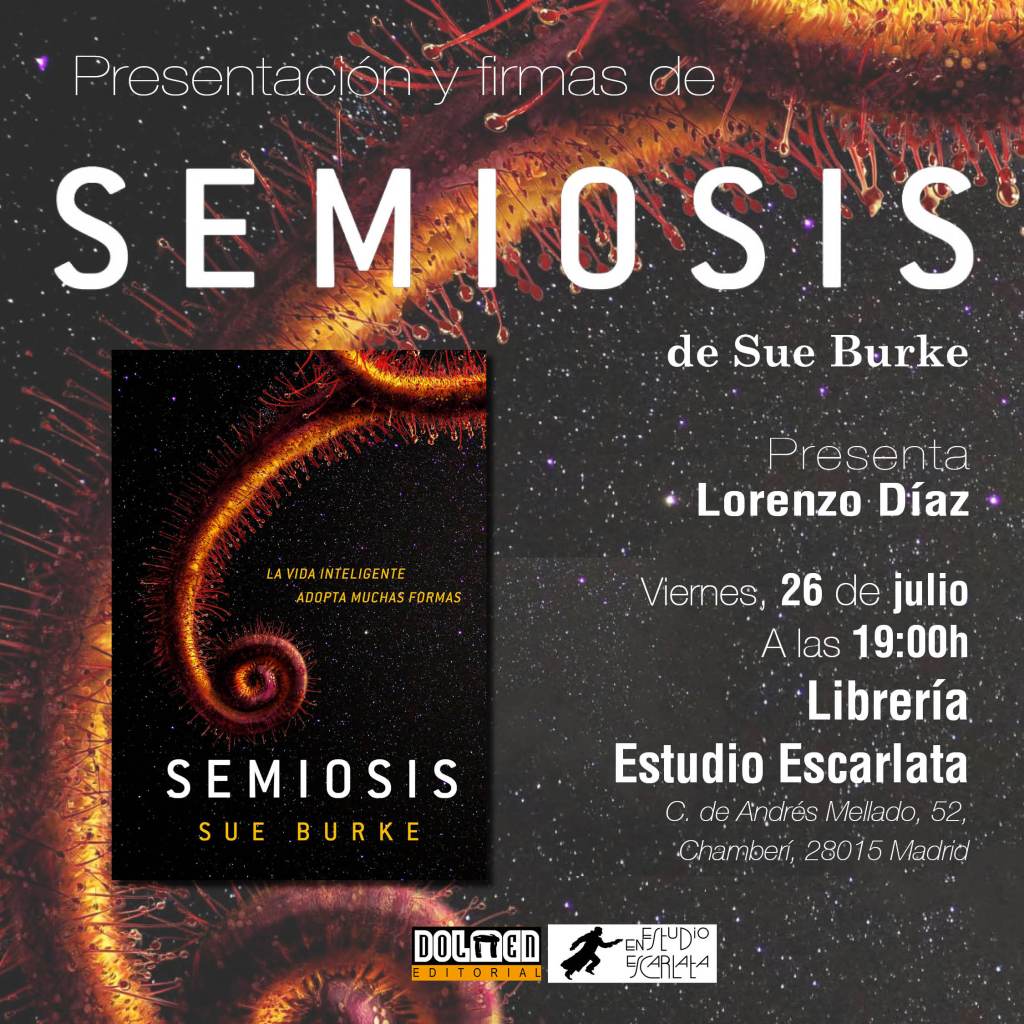
If you speak Spanish, come to Estudio Escarlata at 7 p.m. Friday, July 26, at calle Andrés Mellado 52. As you may know, Semiosis is now available in Spanish — with a wonderful translation by Rafael Marín.

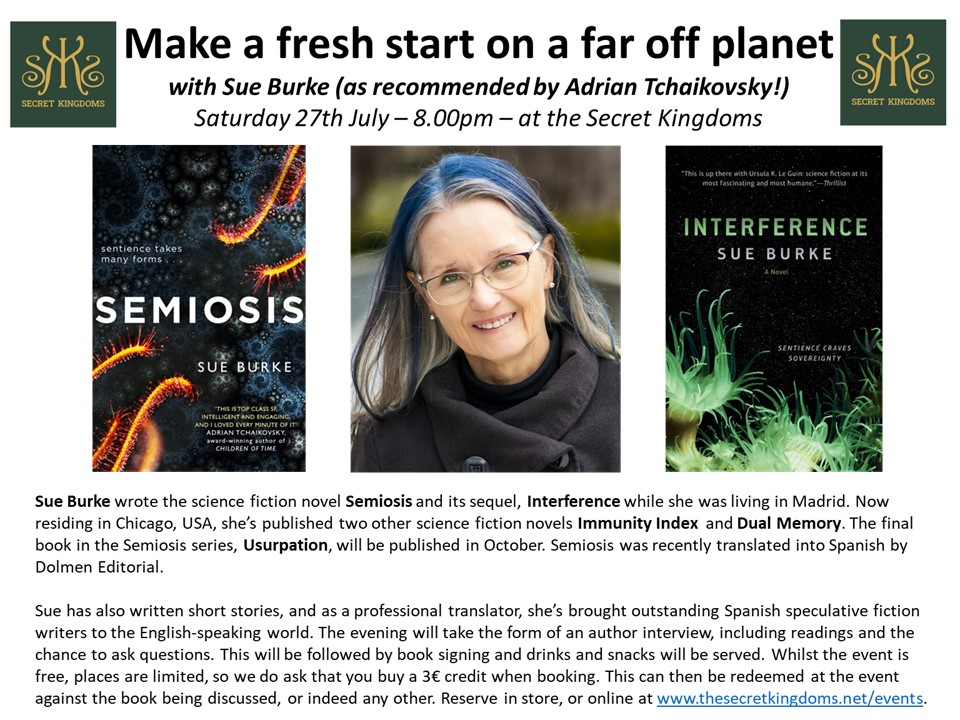
If you prefer English, come to the Secret Kingdoms bookstore at 8 p.m. Saturday, July 27, at calle Moratín 7. I’ll be talking about my books, naturally — followed by drinks and snacks.

As you may know, I lived in Madrid from 2000 to 2016. I’m excited to be back among friends in the city I love!