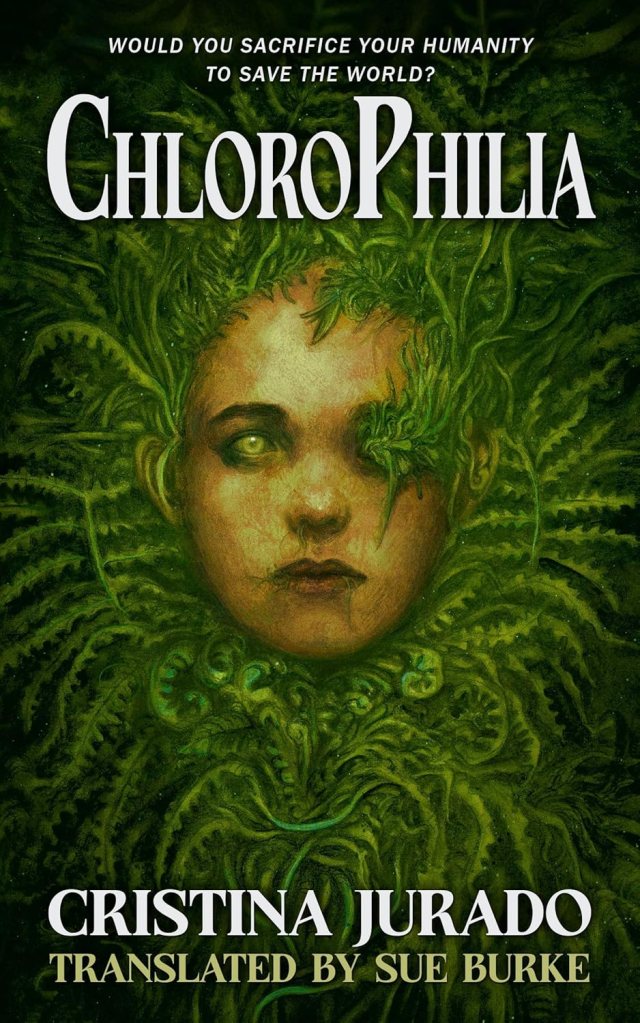
A book I translated, now on sale: ChloroPhilia

Written by award-winning author Cristina Jurado, ChloroPhilia tells the story of Kirmen. He’s different from the other inhabitants of the Cloister, whose walls protect them all from the endless storm ravaging Earth. As a result of the Doctor’s cruel experiments, his physical form is gradually evolving into something better fit for survival in the world outside. This singular coming-of-age story addresses life after an environmental disaster and collective madness, and ends with surprising triumph.

As a translator, I faced a particular challenge with the prologue and the closing section. I’ve translated Cristina before, and she writes beautifully. She poured her talent into prose soaring toward poetry that needed to be equally compelling in English. I did my best:

And behind it all was the roar of the swarm that was its body, millions of shrieks drowning in the fleshy throats of minute beings, a beautiful song made from the spark that lit their lives and that, doused forever, wove the music of the dead.

You can read an interview with the author at The Madrid Review: New Book From The Queen Of Spanish Sci Fi in English.

The novela was reviewed by the Fantasy-Hive as “a remarkable, powerful and disturbing novella that confirms Jurado as a key creative voice in speculative fiction.”

ChloroPhilia is on sale here or at your favorite bookseller.

My works eligible for awards for 2024

If you or someone you know can nominate or vote for writing awards, please consider these works by me that were published last year:

Usurpation: final novel in a trilogy (novel or series) Semiosis. The first novel in the series, Semiosis, is one of the top ten genre books of the first quarter of the millennium, according to Joe Walton.

AI is fueling a science fiction scam: magazine article (related work)

“The Coffee Machine”: translation from Spanish of a work by Celia Corral-Vázquez (short story or translation)

When Star-Stuff Tells Stories: essay about first contact (related work)

Eligible in Spain:

Semiosis: novela extranjera

¿Quién ganó la batalla de Arsia Mons?: novela corta extranjera

Not eligible for a prize, but you might enjoy it:

“Life from the Sky”: republished novelette

Spain’s word of the year, which you weren’t taught in school: dana

Photo of a street filled with cars washed up and destroyed in a flood.

English-language dictionaries and various wordniks have picked their words of 2024, including demure, kakistocracy, enshittification, brat, brain rot, Colesworth, manifest, and polarization.

In Spain, the Fundación del Español Urgente (Foundation for Urgent Spanish) was created by the Spanish Royal Academy and EFE, a news agency, to provide guidance for terminology used in the news media that might pose problems in grammar, meaning, or spelling. It also chooses a word of the year. This year the word is: dana.

Even if you know Spanish, you may have never heard of this word. It’s fairly new, formed by the acronym for depresión aislada in niveles altos (isolated depression at high levels). The World Meteorological Organization explains that it “often occurs during the autumn season because the remaining warm surface heat from summer meets a sudden cold invasion aloft from the polar regions. This leads to what meteorologists used to call ‘a cut-off system’ with low-pressure values that persist over a few days and rotating over the concerned region.” Warm air saturated with moisture meets cold air and becomes an intense, long-lasting storm.

In Valencia at the end of October, the result was devastating rainfall and horrific flash floods. More than 200 people died amid massive damage. There were big political consequences. Dana is Spain’s word of the year because of its importance.

Other candidates for Spain’s word of the year can tell us more about the year that was in that corner of the globe:

Fango (mud or slime): what the victims of the dana had to clean up — and what they hurled at politicians.

Inquiokupa: renters of apartments or homes who stop paying the rent intentionally and refuse to move out. Spain has a housing crisis, too. This, like dana, is a neologism.

Micropiso (micro-apartment): another newish housing-crisis word.

Mena: an acronym for menores extranjeros no acompañados (unaccompanied foreign minors), a newish term because Spain has immigration issues, too.

Narcolancha (narco-speedboat): a newish word invented because Spain has a drug-smuggling problem, too.

Pellet (pellet, also called nurdle in English): a word imported from English to describe the millions of tiny balls of raw-material plastic that washed up on Spain’s west coast in January.

Alucinación (hallucination): errors invented by AIs; as in English, a new meaning has been attached to an existing term.

Gordofobia (fat-fobia): a newish word for a world-wide phenomenon.

Reduflación (shrinkflation): another new word for what happens when the price stays the same but the product becomes smaller, another world-wide phenomenon.

Turistificación (touristification): a problem in many places, including Spain, especially Barcelona.

Woke (woke): another word imported from English, but it’s pronounced with two syllables, WOH-kay.
The best Christmas tree ever

My sister, Beth, died in January 2014 of cancer. Her last Christmas was one of her happiest.

In December, Beth’s son and his wife came to visit, and they set up and decorated the tree. Beth had inherited the Christmas tree ornaments from my parents and grandparents, and although she was too ill to do more than watch them work, she was entranced. It was, my sister said, the best tree ever.

She described it to me over the phone (I had visited at Thanksgiving), and I could see it as she spoke because I knew so many of the ornaments.

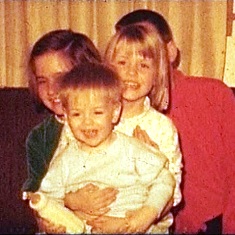
Photo: The four Burke kids on Christmas Eve, captured from one of our grandfather’s home movies. Beth is the blond. I’m wearing green. Lou is the baby. Mike is in back.

My mother had made a canvas-work embroidery angel for the top of the tree. In keeping with family tradition, a little electric candle had been placed in her hands.

Some old, fancy glass ornaments had originally been bought by my grandparents, lovingly cared for by my parents and then by Beth. They were fragile and worn but exceptionally ornate. One had gold stripes edged with glitter and little holiday scenes hand-painted between the stripes.

My sister especially loved the ornament her son had made in grade school, a white paper bird with a long tinsel tail. There was also my ornament from kindergarten, green and red metallic disks glued together around a length of yarn. Other children’s artwork was hung up, too, chronicling a family that grew larger, and boys and girls who grew up. Some ornaments were gifts or careful purchases — each color, each sparkle, each light a story.

“It’s beautiful,” she told me. “I can stare at it for hours.”

It held happy memories from her whole life, as merry as a Christmas tree could be — the best gift, the best tree ever.

The killers will thank you for it

Pragmatics is a branch of linguistics concerned with the relationship of words and sentences to the environment in which they occur. We might also call this context. Machines can’t grasp pragmatics and context — not Google Translate, not ChatGPT, or anything like them. Machines and artificial intelligences don’t interact with the real world. Nothing means anything to them.

I recently made the mistake of reading the text on a sprayer bottle as I was misting a few of my house plants. The text came in English and Spanish. I understand both languages, and I saw errors. Worst of all, this error, which no human would make:

Weed Killers (Deshierbe a Asesinos)

The Spanish version does, in fact, mean “Weed Killers” in the sense of “Go weed the killers” or “You must pull out the weeds on assassins.”

It should say:

Weed Killers (Herbicidas)

As a human being, I can only laugh. Or weep. When the robots take over, they’re going to make so many mistakes…