
My 50-word science fiction short story “Good Boy” has been published by 50 Give or Take.
My 50-word science fiction short story “Good Boy” has been published by 50 Give or Take.
 Electromagnetic Assault by Bruce Landay
My translation of “Bodyhoppers” by Rocío Vega, published at Clarkesworld Magazine, has been nominated in the category of the Best Translated Short Fiction for the British Science Fiction Association Awards. The annual awards are voted on by members of the BSFA and will be presented at this year’s British National Science Fiction Convention, called Eastercon because it takes place over Easter weekend, April 3 to 6.
I’m honored to be listed among such talented translators, and the full BSFA Awards shortlist is a great reading list. Congratulations to all the nominees!

These days, hurtful language is in resurgence, including a particular word, as documented in an article from January in the New York Times, “The ‘R-Word’ Returns, Dismaying Those Who Fought to Oust It.” Even Donald Trump has used it.
The NYT article quotes Katy Neas, the chief executive of the Arc of the United States, a disability rights organization: “It’s language used by bullies to bully.”
I’m posting this excerpt from a newspaper article I wrote 45 years ago. I still remember Dawn’s words. She went to high school in Oak Creek, Wisconsin, where she was a member of the school’s Explorer Post 1841, made up of the school’s special education class.
The students were planning a trip that would include a four‑day cruise on a tall‑masted sailing ship and a day at Disneyworld. They were involved in the decision‑making from start to finish. They raised their own money and arranged to bring a small sailboat into the high school’s pool to practice swimming and sailing techniques. They studied ways to handle long days cooped up on a bus. Their teacher knew they would learn important life skills.
The trip was a success.
I interviewed the class before it left, and this is part of my report. While some of the language has changed over the years, the lesson the students taught me is still fresh.
***
“It stinks!”
That’s what it’s like to be called retarded, according to Karen Gass. “I’m just a slow learner,” she insisted.
But some of her classmates didn’t like being called slow learner, either. Special education students sounded better to them.
Normal was what Dawn Cain wanted to be called.
Karen, Dawn, and about 20 other teenagers are members of an educable mentally retarded class at Oak Creek High School. But calling someone mentally retarded is a strong label, which the students easily understand.
“I’m not retarded. Otherwise I wouldn’t be talking,” Karen said. “Do retarded people make their own jewelry? I don’t think so.”
According to the students, being retarded means being ready for a residential institution like Southern Colony in too many people’s minds. These students are able to handle their own lives. The label overstates the case for them, and they consider retarded an insult.
“We don’t call other people names,” Dawn said. “They shouldn’t have to call us names.”
“I have to take longer to learn something,” Karen added. “But we can do the same things anybody can.”
“We can’t help it we’re slow learners,” Kevin Waterstraat said.
According to the Arc of the United States, 95% of all children and adults with intellectual and developmental disabilities have only mild disabilities. They can be educated in public schools, live independently, hold a job, be self‑supporting, vote, and marry.
Some of these things are in the future for these Oak Creek students, but the pressures of growing up in a world with labels causes immediate problems.
Karen defended her preference for being called simply a slow learner rather than a member of a special class. “I don’t feel that I want to be called special. I feel I’m pretty much normal. It’s just that I learn things slower than others.”
When Kevin talks about his schooling, he talks about his courses and teachers. To him it’s just schoolwork, the same as anyone else’s.
Dawn insists that people who don’t like the fact that they have learning problems aren’t real friends anyway.
It still hurts. For this class, the issue was brought up when a newspaper article last fall told how “a group of educable mentally retarded students will spend four days sailing off the coast of Florida this spring.Y For the last eight years, part of the curriculum for the mentally retarded students has been an adventure trip in the Explorer Scout program.”
The article was factual. The class makes up Boy Scout Explorer Post 1848, and they will be taking a nine‑day trip to Florida that will include time sailing on a ship in the Florida Keys. But the students thought the article was misleading in its use of the term retarded.
For the students, the coming trip is a chance for them to prove how normal they are, as well as a chance for exploring, experimenting, and fun. They are determined to have a successful and educational trip, so they are earning and budgeting their own money and actively planning for potential problems on the trip. They draw on experiences from past trips.
“We argued sometimes about who had to do what,” Keith said.
“Yeah, but we girls did all the work anyway,” he was reminded.
The students are divided into four teams, and each team elects its own leader or has their teacher, Kathy Dermody, choose a leader. The teams will be responsible for different tasks each day, such as cooking.
On their canoe trip last year to Flambeau Flowage, they learned how to handle emergencies. Collapsed tents and wood ticks were easy. Getting lost in the woods was more scary, but each Scout wore a whistle to use to locate the rest of the troop.
But when one member came down with appendicitis, they were all tested. He braved being alone and sick far from home in a strange hospital, while his classmates remained responsible for themselves while their chaperones attended to him.
Students have benefitted from the trip in other ways. Kevin will have a job this summer as a counselor at a camp for handicapped children. “I learned things on the canoe trip I can teach these kids,” he said.
Students have plans for after graduation. One wants to work in day care. Earl Johnson hopes to be a truck driver, and Mrs. Dermody notes ruefully that he may earn more money than she does as a teacher.
The point of the trips for the students is “to see what we can do.” They’ll find out, says Mrs. Dermody, and it’s worth it.
“Some people are good at some things like reading and math,” Karen said, “and some people are good at other things, but everybody’s good at something.” She knows it might take her a little longer or require a little more effort, but she really can do the same things that other people do.
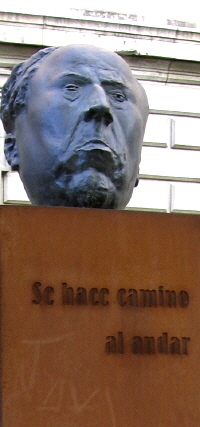
Spanish poet Antonio Machado was born in Seville in 1875 and died in February 1939. His health failed while he was escaping Spain as its government fell to the Fascists at the end of its Civil War.
Spain had long been divided. Although its Civil War began in 1936, Machado named this split “the two Spains” in his book Proverbios y cantares (Proverbs and Songs), Poem LIII, in 1917, and the name stuck.
Roughly speaking, one side of the two Spains was conservative, religious, rural, and traditional; the other progressive, secular, urban, and modernist. There were also differences between regions and between people with privilege and people condemned to poverty. The split ran deep and complex.
As Machado wrote in this poem, twenty years before the brutal war began, one Spain had a death grip on its position, the other was just waking up, and the future did not look good:
Ya hay un español que quiere
vivir y a vivir empieza,
entre una España que muere
y otra España que bosteza.
Españolito que vienes
al mundo te guarde Dios.
Una de las dos Españas
ha de helarte el corazón.
My translation:
There now is a Spaniard who wishes
to live and begins to live,
amid one Spain that is dying
and another Spain that yawns.
Child of Spain, as you come
into the world, may God help you.
One of the two Spains
is going to freeze your heart.
 Sue Burke