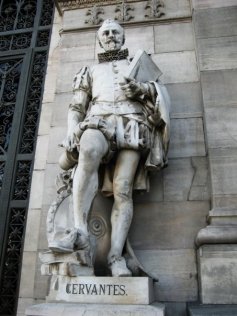
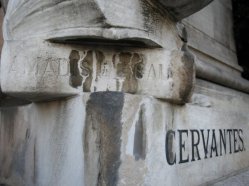
 In front of Spain’s National Library in Madrid, a statue of Miguel de Cervantes stands with one foot resting on a pair of books. One of them is spine-out, and we can read its title: Amadís de Gaula (Amadis of Gaul).
That book tells the story of Amadis, from the fictional kingdom of Gaul, who was the greatest knight in the world. This Spanish novel of chivalry, written by Garci Rodríguez de Montalvo and published in 1508, became Europe’s first best-seller. It was reprinted nineteen times, translated into seven languages, spawned forty-four direct sequels in several languages, and fueled an entire genre that lasted a century. (I also translated it into English.) Most notably, around 1600, it inspired Don Quixote of La Mancha. The second half of Don Quixote was published 400 years ago in 1615.
In many ways, Cervantes satirizes (or pays homage to) that tale, including a characteristic element of novels of chivalry that began with Amadis of Gaul. An earlier version of Amadis had existed since the 1300s in the form of a three-book novel, but Montalvo’s edition was different, as he explains in his prologue:
 “I corrected these three books of Amadis, such as they could be read, due to poor writers or very corrupt and dissolute scribes, and I translated and added a fourth book and a sequel, Exploits of Esplandián, which until now no one has seen. By great good fortune, a manuscript was discovered in a stone tomb beneath a hermitage near Constantinople, and it was brought by a Hungarian merchant to eastern Spain in such ancient script and old parchment that it could only be read with much difficulty by those who knew the language.”
Of course, Montalvo himself wrote the fourth book and Exploits de Esplandián (Sergas de Esplandián). Why lie about it? Because, as he himself put it, the novel “had been considered rank fiction rather than chronicles.” By proclaiming it an ancient story and perhaps even forgotten history rather than fiction, it could obtain the status of works by Homer and Cicero.
He doesn’t seem to have fooled anyone, but he did set a pattern. Supposedly, the manuscript for the sequel Lisuarte de Grecia (Lisuarte of Greece) by Juan Díaz (1514) had been written in Greek in Constantinople and taken to Rhodes when the city fell to the Ottomans. Amadis de Grecia (Amadis of Greece) by Feliciano de Silva (1530) had been found in a wooden box behind a wall in a cave in Spain, hidden during the Moslem invasion in 711. Silves de la Selva (Silves of the Jungle) by Pedro de Luján (1546) was encountered in the magical sepulcher of Amadis himself, written in Arabic.
And so on. Manuscripts were discovered in distant castles and during voyages to far-off lands. Some were written in Hungarian, Latin, Tuscan, German, Chaldean, and “Indian” (Sanskrit, perhaps). A few were even supposedly written by characters from earlier novels.
Among the many jokes in Don Quixote whose punchline we have forgotten today is the one in Chapter IX. It recounts how, in a market in Toledo, a boy was selling some old paper to be reused. Cervantes looked at one of the pieces of paper, a pamphlet, and it turned out to be part of the History of Don Quixote of La Mancha, written in Arabic by Cide Hamete Benengeli. He purchased a translation of the pamphlets for two pecks of raisins and two bushels of wheat. This discovered manuscript, Cervantes claimed, became the basis of the rest of the first part of his novel.
Rather than being found in some exotic place after a search filled with drama, difficulty, and great cost, Don Quixote was rescued from the garbage and translated on the cheap.
Besides that satire in Quixote, there’s another joke based on one of Montalvo’s books that we’ve forgotten to laugh at. An imaginary island described in Exploits of Esplandian overflowed with gold and was ruled by a califa. Spanish conquistadors had read many novels of chivalry and sometimes compared the wonders of the New World to the marvels in those books, but when they sailed up the western coast of what we now call Mexico, they found a place that offered little besides rocks and condors. To entertain themselves, they started calling that barren land after the fabulously rich island in the book: “California.”
***
This article was also published in the Fall 2015 issue (pdf) of The Source, a quarterly publication of the American Translators Association Literary Division.
 I’ll be reading “Who Won the Battle of Arsia Mons” as part of the Writers Aloud series at Prop Theater on Sunday, April 7. The event, from 3 to 5 p.m., will also feature Johanna Drew reading “Ask Me for My Photo (my life in online dating).”
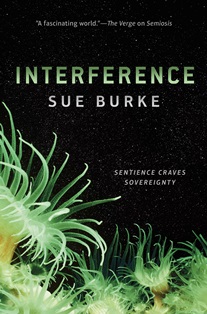 Here’s the cover for Interference, the sequel to Semiosis.

 Sue Burke