Read it now: ‘Poet for Hire’

The first short story I ever got published, back in 1995, “Poet for Hire” is posted here on my website for you to read.

In the story, I imagine Milwaukee’s first free-lance poet, a young woman with curly brown hair. She works out of a storefront in the 2200 block of Kinnickinnic Avenue, down the block from where I used to live. The plants in the Arid Dome of Milwaukee’s Mitchell Park Horticultural Conservatory, one of my favorite places, provide her with vital inspiration. In the end, the power of her pen is mightier than she expects.

Earlier this year, I was contacted by Anja Notanja Sieger. Someone found the story and sent it to her — because she is Milwaukee’s first poet for hire. She’s written poems in the Arid Dome; her husband owns a used bookstore in the exact same storefront in the story; and she has curly brown hair.

Anja invited me to her podcast, The Subtle Forces, where I read the story out loud, and we chatted about its coincidences. “Perhaps you wrote this story,” she said, “and then I happened.”

You can read the short story here.

You can listen to the podcast here.

The story was originally published in The Czarnina Kid and other Weird Tales, available here.

‘Canyonlands: A Quarantine Ballad’ goes on sale today

JB Rodríguez Aguilar has written a lyrical novella about the 2020 pandemic, Canyonlands: A Quarantine Ballad, and María Martínez Moreno and I translated it into English. It goes on sale today at Olympia Publishers and at Amazon.

It tells the story of an American photojournalist on his way home in March 2020 to his family in Chicago. Instead, the Covid-19 pandemic spreads, and he finds himself quarantined in a hotel room in Madrid, Spain. As he watches the statistics of illness and death rise, he retreats into memories of a trip years ago to a North American landscape that was a milestone in his career: Canyonlands National Park in Utah. This leads to a philosophic and personal chronicle of isolation.

JB is a talented photographer, and the book includes a photo essay of Canyonlands, a wilderness carved through layers of stone by the Colorado River and its tributaries.

An excerpt from the first section, in the hotel in Madrid:

What a first draft must do

For me, first drafts come hard. I’ve heard of writers who love them, but that might be an urban legend. I have a hard-learned opinion about first drafts.

First drafts have only one duty to fulfill: They must exist. They don’t need to be good. Mine don’t necessarily achieve coherence. In fact, I like to think of them as “zero drafts,” more of an experiment than an actual draft.

This saves me from the temptation to rewrite as I go, which I advise against. Rewriting can lead to getting stuck rewriting and re-rewriting the beginning, trying to perfect every sentence. Writers who do that may never get all the way to “The End.” But until the end is written, there’s no way to know exactly what the beginning needs. Even the most careful planner and outliner will discover changes in the story as it goes on.

In my first drafts — even as I plan first drafts — sometimes I get stuck. One tool that helps me is my friend Zack Jeffries’ writing prompt book, Break Through to “The End”. He intentionally designed it to use while starting an outline or first draft, writing the draft, or revising it.

What makes these prompts useful, I believe, is that they’re open-ended. Some prompts try to suggest an idea for story: “You’re looking into a bottomless pit. Describe your reactions three days later.” “A mistranslation of ‘weapons’ and ‘equipment’ causes an inappropriate shipment of goods.” (If you want ideas-based prompts, I recommend visiting PostSecret.)

Jeffries assumes you have a ton of ideas. He encourages you, instead, to wonder “What would happen if…” as a means to discover a new aspect of your story. For example, at one point, your character is going to make decisions that will have repercussions. He prompts:

“What would happen in your current scene or next scene if your main or perspective character wondered whether a decision they made was the wrong one? Is this a way to pull up the emotional strings of your reader? Is this a way you can reinforce what’s important to your main character? Can you show the reader what the main characters’ expectations are?”

Character arcs, relationships, plot, world-building, and theme — I can explore as I need in Jeffries’ book. For me, this is one more practical tool to help me get through the struggle of the first draft.

If you’re a writer, what are the tools that get you through the hardest parts?

The real Miss Fanny Kemble was famous

As you may know, many of the characters in the novel Dual Memory are named after tulips because the novel was vaguely inspired by the tulip bubble in Holland in the 1630s.

In my novel, Miss Fanny Kemble is an artist driven out of a shared studio by a jealous rival.

The flower called Miss Fanny Kemble is a “broken” tulip from the early 1830s praised as the finest tulip ever produced in England

The tulip was named after a popular young actress, Fanny Kemble, born into a British theater family in 1809. She toured the United States in the 1830s performing Shakespeare and became so popular that other women copied her hairstyle.

In 1834, she married an American, then discovered that he was an heir to a plantation in Georgia. She was repelled by the slavery there, and the marriage didn’t last long, but she recorded the “simple horror” of what she saw and published a book, Journal of a Residence on a Georgian Plantation in 1838-1839. It helped cement European support for the Union in the Civil War.

Works about her include the biography Fanny Kemble’s Civil Wars by Catherine Clinton, published by Oxford University Press. Photo from public domain.

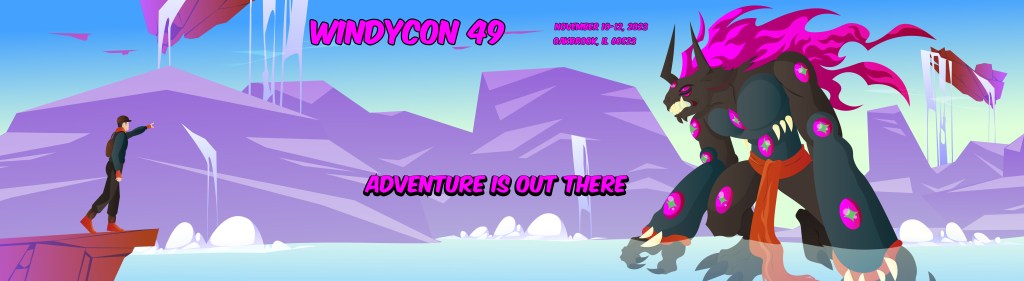
Windycon: Adventure Is Out There

I’ll be at Windycon, Chicagoland’s longest running science fiction convention this weekend, November 10 to 12. Usually about 1,000 members attend. This is an all-volunteer fan-run event, more intimate than mega-conventions, and everyone gets a chance to have fun and conversations with friends and special guests. You can join at the door. It will be held at the DoubleTree Hotel in Oakbrook, Illinois, a suburb of Chicago.

This year’s theme: Adventure Is Out There. We’ll have an art show, charity drive, dealers room, gaming, amateur radio broadcast at W9W, workshops, cosplay, theater, music, concerts, panels, science presentations, snacks, beer, and parties. If you see me, say hi!

Here’s my schedule:

Writer’s Workshop, Saturday, 9:00 a.m. to 12:00 noon. A critique-session workshop, usually with doughnuts (thanks, Rich!), prior registration required.

SETI Protocols, Saturday, 2:00 to 3:00 p.m., York Room. What are the protocols for alien contact? A lot of people and organizations, such as NASA, have put serious thought into this. We’ll discuss their intractable questions and try to come up with reasonable answers. Sue Burke; J. Taylor, moderator.

The Many Types of Fantasy, Saturday, 8:00 to 9:00 p.m. Ogden Room. From high fantasy to low fantasy — and let’s not forget the popular epic fantasy. Who determines the meaning of these distinctions? Are they different? How many kinds of fantasy are there? Let us count the ways… Richard Chwedyk, R. Garfinkle, Z Jeffries, Angeli Primlani; Sue Burke, moderator.

The Obligatory Dr. Who Panel: Good-Bye Rubber Suits, Sunday, 11:00 a.m. to 12:00 noon, Hunt Room. Has it lost its nostalgic charm since the special effects are better? P. Hahn, J. Skwarski; Sue Burke, moderator (but I have opinions!).