2023: Hallucinate authentic AI rizz

I see several competing themes in the 2023 Word of the Year choices.

Authentic is Merriam-Webster’s Word of the Year. “A high-volume lookup most years,” the dictionary says at its website, “authentic saw a substantial increase in 2023, driven by stories and conversations about AI, celebrity culture, identity, and social media.”

Authentic cuisine. Authentic voice. Authentic self. Authenticity as artifice. Most of all, authentic meaning made by a human, not an AI. We want to keep it real.

Runners-up include rizz, deepfake, coronation, dystopian, EGOT, X, implode, doppelgänger, covenant, indict, elemental, kibbutz, and deadname. What a year it was.

Rizz, meaning “style, charm, or attractiveness; the ability to attract a romantic or sexual partner,” has been crowned Word of the Year at Oxford University Press. Online voters chose it from a shortlist.

Oxford justifies the choice this way: “It speaks to how younger generations create spaces — online or in person — where they own and define the language they use. From activism to dating and wider culture, as Gen Z comes to have more impact on society, differences in perspectives and lifestyle play out in language, too.” No condescension here.

The word apparently comes from “charisma.” I don’t know if rizz carries the implication that the person doing the rizzing-up is displaying authentic feelings.

Also short-listed by Oxford are Swiftie, de-influencing, beige flag, heat dome, prompt, parasocial, and situationship.

Hallucinate has been chosen by Dictionary.com in the sense involving artificial intelligence: “to produce false information contrary to the intent of the user and present it as if true and factual.”

“We added this sense of hallucinate to our dictionary just this year,” the dictionary’s executives explain. “If this is the first time you’re learning about it, be prepared to start encountering the word — and what it refers to — with increasing frequency. Like AI itself, the word hallucinate is on an upward trajectory.”

On the shortlist are strike, rizz, wokeism, indicted, and wildfire. The Vibe of the Year (yes, Dictionary.com has one) is eras.

AI is the Collins Dictionary Word of the Year — meaning Artificial Intelligence, of course. Collins describes its choice this way:

“The revolutionary AI-powered language model burst into the public consciousness in late 2022, wowing us with its ability to mimic natural human speech. […] And while people were understandably fascinated, they also started to get a bit anxious. If computers were suddenly experts in that most human of domains, language, what next? Cue an explosion of debate, scrutiny, and prediction.”

Runners-up include some choices that reflect Collins’ British outlook: de-influencing, nepo baby, canon event, ultra-processed, semaglutide, ULEZ, greedflation, debanking, and Bazball.

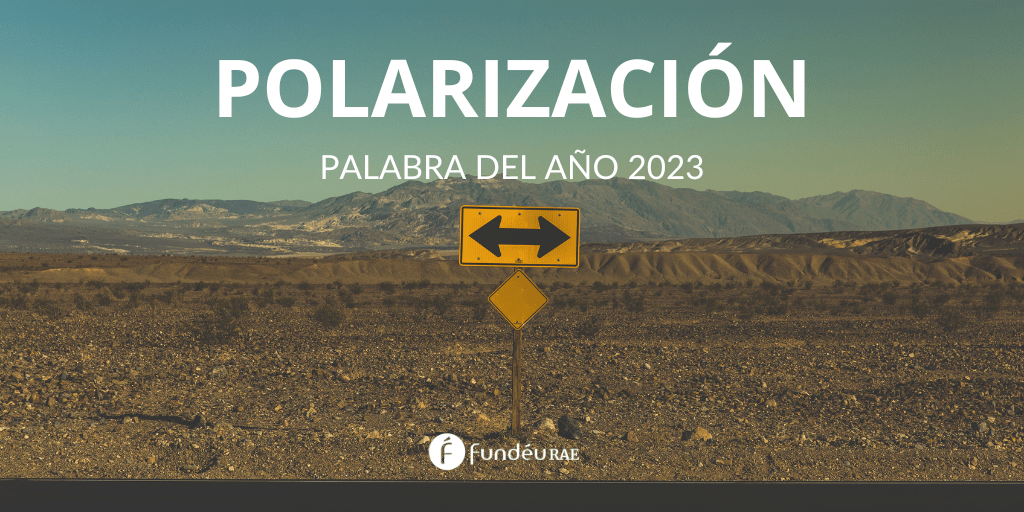
Polarización(polarization) wins palabra del año honors from the Royal Spanish Academy’s foundation in Spain, Fundéu del Español Urgente, which works with the news agency EFE. “It’s common to find examples in the media worldwide referring to many kinds of polarization: in society, politics, public opinion, social networks, etc.”

It was chosen from a dozen words that were in the news in Spain and had “linguistic interest”: amnistía (amnesty), ecosilencio (greenhushing), euríbor (euro interbank offered rate), FANI (unidentified anomalous phenomenon, formerly called UFO), fediverso (fediverse), fentanilo (fentanyl), guerra (war), humanitario (humanitarian), macroincendio (macrofire), seísmo (earthquake), and ultrafalso (deepfake).

Tourismo (tourism) is palabra del año for the Spanish Royal Academy’s foundation in the Dominican Republic, chosen because tourism kept the country’s economy afloat in 2023. Of linguistic interest, the word tourismo is originally derived from English.

***

If that isn’t enough ephemera for you, Wikipedia’s most popular article in 2023 is ChatGPT — followed by Deaths in 2023, 2023 Cricket World Cup, Indian Premier League, and Oppenheimer (film).

Time’s Person of the Year for 2023 is Taylor Swift. “To discuss her movements felt like discussing politics or the weather — a language spoken so widely it needed no context. She became the main character of the world,” the Time article says.

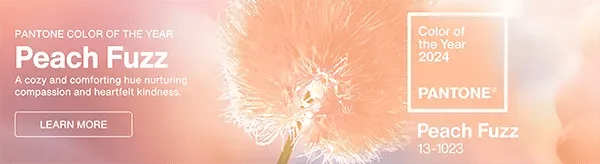
Finally, for this year, 2024, Pantone’s Color of the Year is Peach Fuzz: “PANTONE 13-1023 Peach Fuzz captures our desire to nurture ourselves and others. It’s a velvety gentle peach tone whose all-embracing spirit enriches mind, body, and soul.”

The right color can do so much, and 2024 will need all the help it can get.
What I had published in 2023

In case you missed any of these, or in case you can nominate or vote in awards for works published in 2023, here’s what I did:

Dual Memory — Pirates, spies, and a smart-ass AI: what more could you want from a novel? You can watch me read Chapter 3 here.

“The Virgin Who Rescues Dragons” — When authors invoke archetypes for their stories, so much can go wrong. This short story (3550 words) appears in the Cosmic Muse anthology.

Two translations:

“Embracing the Movement” by Cristina Jurado — Space is filled with beauty and horror. You can find this short story (3470 words) in the collection Alphaland and Other Tales.

Canyonlands: A Quarantine Ballad by JB Rodríguez Aguilar — This literary novella (19,500 words) explores the anguish of a photographer trapped in a hotel at the start of the covid pandemic.

Next year:

In October, expect the third book in the Semiosis trilogy: Usurpation. Rainbow bamboo grows everywhere on Earth, and it must find a way to dominate with compassion.

My 2023 houseplant Christmas tree

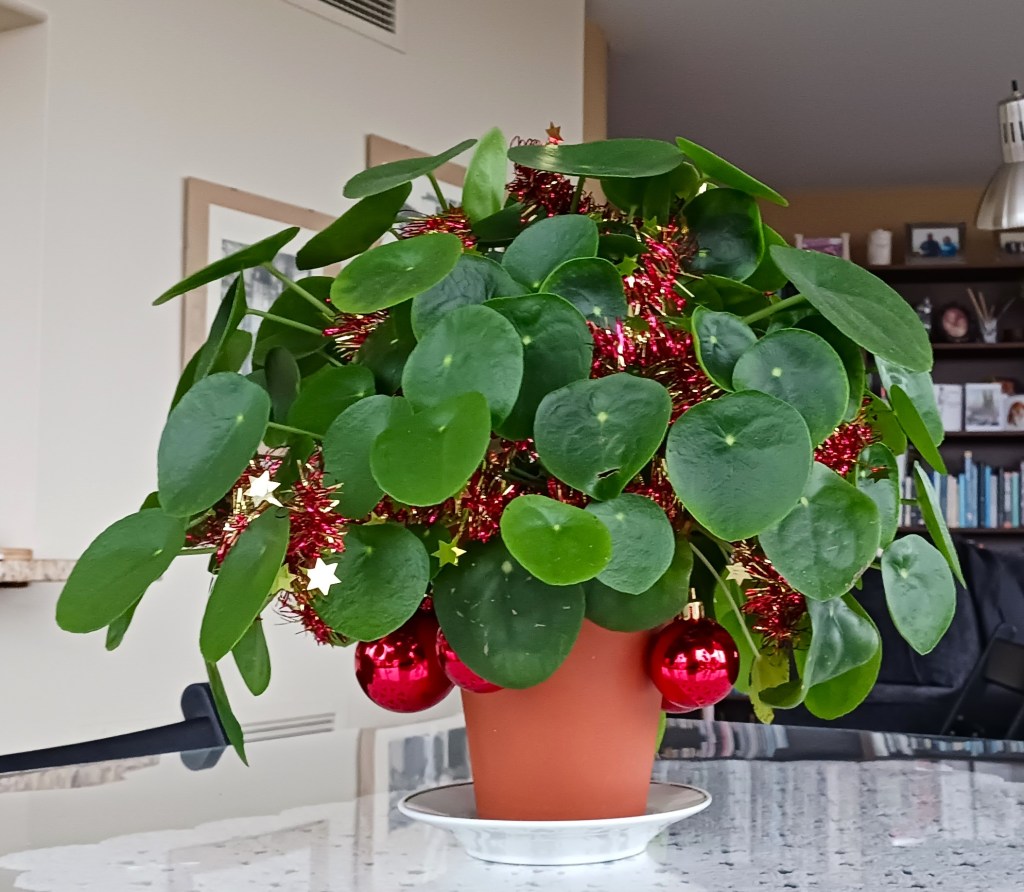
Every year, I coerce one of my houseplants into impersonating a Christmas tree, but this year, the Pilea peperomioides enthusiastically volunteered. The little plant wasn’t what I had in mind — I intended to conscript the bigger and more cone-shaped crown of thorns — but Pilea insisted:

“I’ll be perfect! My leaves are already just like those round glass ornaments!”

I answered that its species is sometimes called a money plant because its leaves are flat and round like coins, but Christmas ornaments are actually spherical.

“Christmas cookies are flat! And I’m Christmas green! An actual evergreen!”

Yes, I told it, it is green year-round, but that doesn’t mean it’s a conifer, and besides, it’s kind of small for the job.

“Presents will look bigger under me! If I can’t do this, I’ll drop all my leaves and be the Festivus Pole!”

So, I backed down. Here’s my tree. Merry Christmas.

Plants make the best gifts

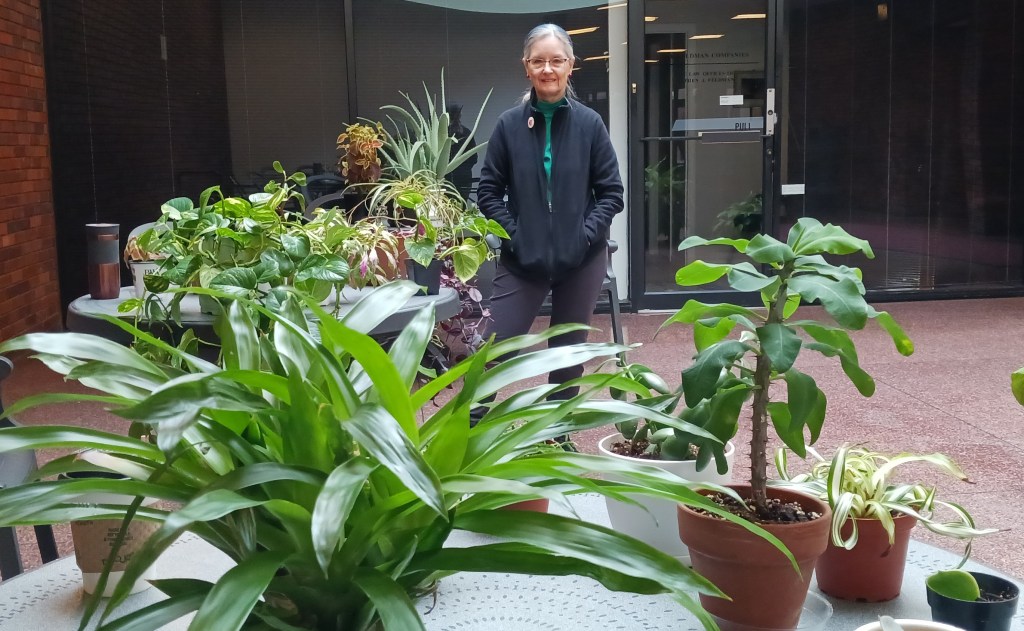
I live in a big condominium in Chicago — a skyscraper, really — and a group of us plant-lovers organized a houseplant exchange last weekend. Dozens of plants changed hands. A building like ours is a vertical greenhouse, and we want to keep it green.

It’s hard to love houseplants without having lots of cuttings, plantlets, offshoots, and other extras to give away. I came home with two baby Ficus benjamina variegata, and I’m excited to have them.

***

More news:

Last week I had a conversation in a podcast with “an extremely online pilgrim” named Tasshin. He reviewed my novels Semiosis and Interference, examining ethical themes raised by the books, the world of Pax, and the character of Stevland. You can watch our conversation here on YouTube, where there are also links to an audio version and a transcript. I hope you enjoy our chat as much as we did.

At The Best Books of 2023 by Tor.com reviewers, Matt Keeley calls Dual Memory “a satisfying thriller about art, climate, conspicuous consumption, and artificial intelligence. Burke remains one of our foremost science fiction writers.” Thanks, Matt!

Writing nonhuman points of view

Not every mind is human, which is a challenge for authors. It’s hard enough to write from a different human point of view: we’re a varied species, each one of us with our own experiences and quirks, but at least we can talk to each other. Non-humans … well, they never have long conversations with us, alas.

Yet, if we’re going to write speculative fiction, we can’t let that stop us. For my novel Semiosis, I wanted to write from the point of view of a plant — an alien plant, of course, not an Earthly one. All right, where to start?

Obviously, we know some things about Earth plants, so I began researching them. What is their experience of life? For one thing, they’re under a lot of stress. Growing seasons are short, and weather is uncertain.

Spring ephemerals, such as trilliums and snowdrops, illustrate this anxiety. They grow and flower as early as possible in spring, sometimes right through snow, dangerous though that must be. They catch the sunlight before trees put out leaves and cast shade. They offer nectar to the first bees that wake up after winter, monopolizing their attention. Then these plants go dormant until next spring: that’s the extreme step they must take to get their day in the sun. They leap upward at the first hint of springtime.

Plants compete for sunlight and actively fight over it. A common houseplant called the asparagus fern (Asparagus setaceus) has pretty, lacy leaves – and thorns it can anchor into other plants and climb over them. Its aggression has earned it the status of noxious weed in some parts of Australia. Roses have thorns for the same reason. If they happen to starve other plants by blocking out the sunshine, that’s just survival of the fittest.

Vines climb up trees to get sunshine without the cost of growing a sturdy trunk. Other plants may grow large leaves quickly to cast shadows on their neighbors, or poison the ground to keep out competition.

So, plants lead lives of quiet desperation, in constant combat with a variety of weapons.

The book What a Plant Knows: A Field Guide to the Senses by Daniel Chamovitz documents what his fellow botanists have long known. A plant can see, smell, feel, hear, know where it is, and remember. “Plants are acutely aware of the world around them,” he writes.

Trees, like us humans, have social lives. InThe Hidden Life of Trees: What They Feel, How They Communicate, German forester Peter Wohlleben describes how trees of the same species in forests create communities that help each other, enjoying much longer, healthier lives than isolated city trees. Trees also make decisions, such as when to drop their leaves, which can be a life-or-death gamble on the coming weather.

Plants are alert to their surroundings, and they can recall the past and plan for the future. They’re gregarious, and being isolated hurts them.

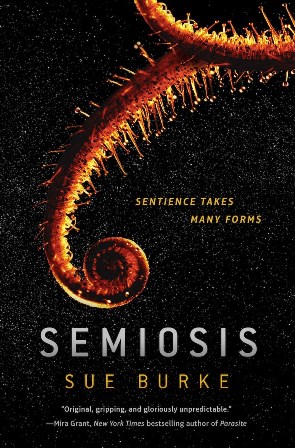
As we would expect from highly aware, social creatures, they relate to other species including animals. They grow flowers to attract pollinators, they grow fruit to encourage animals to spread their seeds, and they enter into symbiotic relationships with animals to further their needs. If nutrients are especially scarce, plants turn carnivorous. (The leaves depicted on the cover of Semiosis are of a sundew. The drops are glue to catch insects.)

Through photosynthesis, plants create their own energy. We can’t know how that feels, although we can observe how sap courses up and down stems and through leaves, and how carefully plants arrange their leaves in a “leaf mosaic” to capture light efficiently. Plants that store food for winter know how much food they have because they stop and shed their leaves when they think they have enough: they have body awareness.

Plants differ from us in one essential way: they have no set body type. Humans have two arms, two legs, and a standard-sized brain. A tree has as many branches and roots as it can support. A single tree can be huge, spreading out from its roots to create its own grove, and some can live for centuries, even millennia.

A possible personality for a plant has begun to emerge: anxious, active, aggressive, alert to its surroundings, impatient, reflective, and forward-looking, physically singular, self-aware, long-lived, manipulative of animals, and painfully lonely if it has no companions of its own species. Add intelligence and we have a point of view:

“Growth cells divide and extend, fill with sap, and mature, thus another leaf opens. Hundreds today, young leaves, tender in the Sun. With the burn of light comes glucose to create starch, cellulose, lipids, proteins, anything I want. Any quantity I need. In joy I grow leaves, branches, culms, stems, shoots, and roots of all types. … Intelligence wastes itself on animals and their trammeled, repetitive lives. They mature, reproduce, and die faster than pines, each animal equivalent to its forebearer, never smarter, never different, always reprising their ancestors, never unique.”