AI is Fueling a Science Fiction Scam

Can an AI write a good short story? No. But some people are submitting AI-produced stories for publication anyway, hoping for a quick buck. For science fiction magazines, this is costing them time, money, and morale.

I wrote about the problem and the lack of easy solutions for an article in the current issue of Chicago Review of Books, AI Is Fueling a Science Fiction Scam That Hurts Publishers, Writers, and Even Some of the Scammers.

On sale now (finally!): Usurpation

Today the novel Usurpation goes on sale! You can buy it wherever fine books are sold, available as hardcover, ebook, and audiobook. Find out why carnivory isn’t the worst thing a plant can do.

It’s the third book in the Semiosis trilogy, and here’s an incisive review of the series at Ancillary Review of Books by Alex Kingsley called “Imagining Radical Mutualism.”

If you’re in Chicago, please come to the book launch tomorrow, Wednesday, October 29, at 6:30 p.m. at Volumes Bookcafé, 1373 N. Milwaukee Ave. Since it’s the day before Halloween, feel free to wear a costume! (Don’t worry, you won’t be the only one.) If you’re not in Chicago and you want an autographed copy, you can order it through Volumes.

Usurpation: Love will be ferocious

The novel Usurpation is the third in the Semiosis trilogy. The first book, Semiosis, takes place on a distant planet called Pax where the dominant species is an intelligent plant, rainbow bamboo. Stevland is the reigning bamboo. At the end of the second book, Interference, Stevland has sent his seeds to Earth, where the rainbow bamboo are flourishing, but no one knows they’re intelligent.

Then, at the end of Interference, Stevland sends a message to the bamboo on Earth: “…I must share a secret about humans. They are ours to protect and dominate.”

A bamboo named Levanter asks, “Tell us how.”

Stevland’s response finally arrives in Usurpation: “…Compassion will give you courage. Love will be ferocious.”

That’s all I can say without spoilers. In fact, I’ve probably spoiled enough already.

Usurpation will be released on October 29. I’ll be celebrating at 6:30 p.m. Wednesday, October 30, at Volumes Bookcafé, 1373 N. Milwaukee Ave., in Chicago, with Alex Kingsley, whose first novel, Empress of Dust, has just been released. You’re invited!It’s the day before Halloween, so you’re encouraged to cosplay.

You can see me at a Speculative Literature Foundation event read the opening of Chapter 3 of Usurpation in this 3-minute video. (All the novels in the trilogy are available as audiobooks, narrated by Caitlin Davies and Daniel Thomas May, who do a much better job than me.)

You can read a few reviews of Usurpation at NetGalley, and a recent review of Semiosis at Space Cat Press. Semiosis was named one of the 75 best science fiction books of all time by Esquire Magazine.

If you want an autographed copy of my next novel and you can’t come to the launch party, you can order it through Volumes Books here.

The novel that changed Spanish science fiction

I was thrilled when I learned that Rafael Marín would translate my novel Semiosis into Spanish. I think he’s one of the finest stylists in genre writing in Spain. But he’s more than that. He’s an award-winning novelist, comic book writer, essayist, critic, screenwriter — and a pioneer in the genre.

His first novel, Lágrimas de luz [Tears of Light], is often called the “before and after” novel in Spanish science fiction. Published in 1984 and written when Marín was only 22 years old, it proved that a Spanish author could write an ambitious literary work of science fiction.

This might sound odd. Of course Spanish authors could — but they had to believe that themselves, and they had reason to doubt it. For the previous two centuries, realism and naturalism had reigned supreme in Spanish literature. Despite “futurist” authors like Nilo María Fabra, science fiction (and fantasy and horror) didn’t exist in Spain and wasn’t possible.

In the English-speaking world, science fiction set down its roots in the early 20th century, first as pulp and then as more serious works. Spain had its pulp too, starting in the 1950s, although its authors usually wrote under Anglo-Saxon pseudonyms like Louis G. Milk or George H. White at the behest of publishers, who did not think openly Spanish authors, pulp or serious, would sell. Top English-language authors like Alfred Bester and Roger Zelazny were available in translation, though, and they made their mark.

From 1968 to 1982, a fanzine with a professional attitude, Nueva Dimensión, edited by Domingo Santos, provided budding authors with a chance to grow, and some solid works began to appear. But nothing caught readers’ attention like Lágrimas de luz.

The novel’s plot

The novel is set during the Third Middle Ages. A young man named Hamlet Evans, living in a small town that manufactures food, aspires to more in life than toiling in a factory, numbed by drugs and sex. He wants to be a poet, specifically one of the bards whose songs celebrate the Corporation, which expands the human empire and protects it from its enemies. He is accepted for training at the bards’ monastery and is assigned his first military ship.

Soon he learns that the glorious triumphs of the empire are anything but: Indigenous life forms are cruelly wiped out and the planets’ resources are stripped as the Corporation expands its iron grasp. Disillusioned, Hamlet can no longer compose acceptable epic poems.

He resigns and is set down on the first available planet, which turns out to be under punishment for a rebellion against the Corporation. He barely survives, eventually escaping to join a small theater group and then a circus. The Corporation, meanwhile, decides that no entertainment that fails to extol its greatness can continue to exist, and sends troops to wipe them out.

Hamlet escapes again, and he decides to continue an outlaw artistic existence to defy the Corporation.

Ambitious and Spanish

Marín himself has called the novel an “ambitious space opera” — which it is, offering careful characterization and thematic development. Hamlet matures as a man and an artist in a fully-imagined universe.

The novel also makes a clean break from pulp. It features a protagonist who is hardly a hero, and its themes include the search for beauty as well as the crisis and alienation of youth. Rather than save the universe, Hamlet can barely save himself, and the universe might not even merit saving: no lightweight escapism here.

The story also draws on Spain’s own medieval past and brings it into the future. The bards’ songs echo works like El Cid that had once been sung throughout the land — a past oral culture updated for the novel’s present. The novel also responds in its own way to Robert Heinlein’s Space Troopers and openly draws on themes from Moby Dick and other classics.

The surprise of Lágrimas de luz didn’t usher in a sudden boom in Spanish science fiction. That came in the 1990s with works by authors like Juan Miguel Aguilera, Elia Barceló, Javier Negrete, and Rodolfo Martínez, among many others, but the door had been opened.

Lágrimas de Luz, by the way, is still in print after all these years and is available from Spain’s Apache Libros.

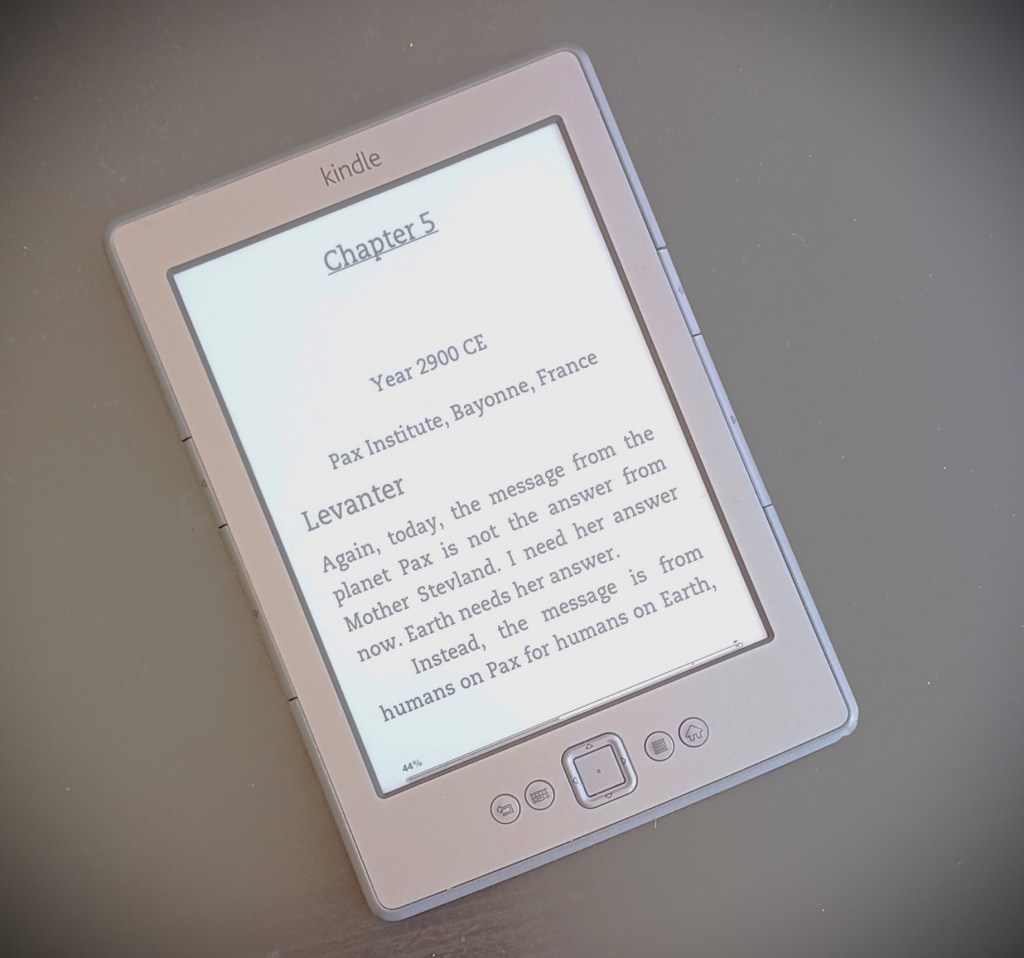
Intricate Stardust

(I wrote this at a workshop for imagining science last spring at the Chicago Botanic Garden. It came as the result of a writing prompt, and I thought about something I’d seen that morning in one of the gardens.)

***

The rabbit was twitching and bleeding. The edge of the universe was far away — in scientific terms, fully 1027 centimeters. Less than one centimeter away were the talons of a hawk, and soon, the rabbit would be still.

You watched this drama unfold on that spring morning, knowing that you lived on a planet tilted in its orbit toward the sun, which created the seasons. Above, unseen in daytime skies, countless stars swirled within galaxies and super-clusters of galaxies. The thought made you shiver. What did this vast universe want?

The rabbit knew. It wanted to live, but as you understood, only sentient things felt real wants, and the universe, with its great distances, existed impersonally.

So you moved on, sure that the universe had no hidden intent, but you had too much at stake in the cosmos to stop wondering.

Long ago, when the universe was young, it had been populated by huge blue stars that burned hot, collapsed, and exploded. New stars gathered from their dust, burned, collapsed, and exploded, each time creating more complex matter. Some of the stardust had accumulated into a planet — your home — orbiting a stable star, so in this particular place, the universe had grown exceptionally complex. Stardust had reached sentience.

You were sentient and full of doubt on that sunny spring morning, near a bleeding rabbit, and like the rabbit, you wanted to live. Then, you found your real question: Why was life so brief? But what did brevity mean in an expanding universe? Across vast time and deep space, the universe continued to form and re-form with wants and doubts generated by intricate stardust. When you looked at the rabbit, you saw yourself.

The rabbit must have had doubts, too, however brief and small. Did stars ever doubt in one sense or another? Because at this time and this space, the universe was twitching and self-aware, and through you, it would continue to move on.