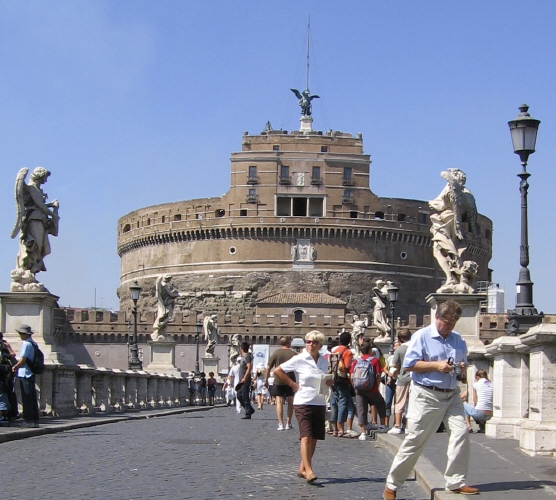
Castel Sant’Angelo in Rome is the ugliest castle I’ve ever seen. My husband and I visited the caput mundi during early August, 2007, and the castle is symptomatic of the eternal city. Its original glory was lost when the monument, like many others, was neglected, abandoned, reused, altered, remodeled, and eventually somewhat renovated and restored for tourist consumption without necessarily much respect, interest, or even knowledge of its previous uses. Sometimes this creates a certain charm, but not in this case.
The castle began as Emperor Hadrian’s mausoleum, completed in 139 AD, a massive stone-clad earthen tumulus 64 meters in diameter, with the ashes of the emperor in a niche in the center. Three centuries later, now more of a natural feature than a building, the cylindrical lump was incorporated into the city’s defensive walls against the gathering barbarian menace; five centuries later, it became a Vatican fortress. Subsequent popes, who used it as a residence during sieges, stacked rectangular living quarters onto the top, renovated previous additions, then added more improvements, resulting in a labyrinth of rooms, stairways, and corridors, some better preserved than others.
Still, it’s fascinating to visit, and although the Emperor’s niche is empty, we paid our respects: Ave, Caesar! Like all my favorite castles, it has a bar, located in the columned gallery Pope Paul III had built all around the upper perimeter of the tumulus. The bar is on the west side, under a trellis of grape vines, with a fabulous view of St. Peter’s Basilica. My husband and I enjoyed tall mugs of Heineken and a late afternoon breeze. When you’re inside looking out, you can’t see the castle. Carpe diem.
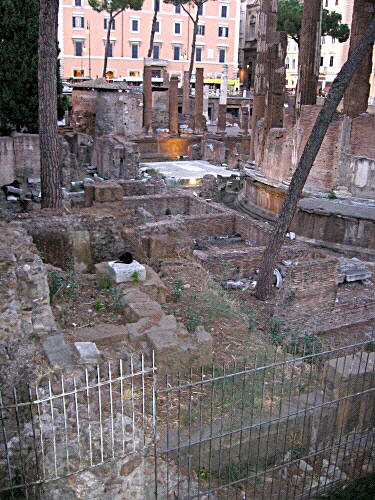
About a kilometer southeast of the castle across the Tiber River, the Area Sacra is a square-block excavation of Republican ruins, the oldest in Rome, discovered in the 1920s. The remnants include four temples and the entrance to the Curia of Pompey, where Julius Caesar was killed. Curiously, the Area is also used as a stray cat sanctuary, with adoptions available. The exact spot of the caedes dictatoris has yet to be excavated and lies under the tracks of Trolley Line 8.
The mortal remains of Divinus Julius were cremated on a pyre in the Forum Romanum, and the ruins of the altar erected to him on that spot have been uncovered by archeologists: a dusty pile of bricks protected by a roof and fence, and when I saw it, several bouquets of fresh flowers had been left as offerings. Apotheosis endures.
And that’s what I did on my summer vacation: veni, vidi, verbi.

 Sue Burke