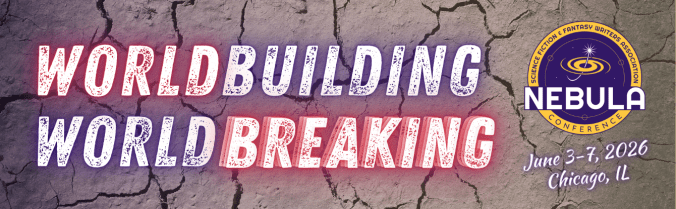
My vote for the Nebula Award for Best Poem

Best Poem and Best Comic are new categories for the Science Fiction and Fantasy Writers Association’s Nebula Awards this year, joining Novel, Novella, Novelette, Short Story, Middle Grade and Young Adult, Game Writing, and Dramatic Presentation awards.

Poetry in general isn’t popular among the average reader, I think because so much of contemporary poetry is bad. The dominant mode is tediously confessional, and much of those confessions are mere complaints, petty and aggrieved, delivered in a deliberately solipsistic manner. Poetry critic Thomas M. Disch in The Castle of Indolence lamented the poetaster who “writes about almost nothing except himself and his fowl moods, from self-pity to reproachfulness.” And this when the poetry is readable.

Good news! Speculative poetry is different! You will understand every one of these poems. None of them is a personal confession. You might even enjoy reading them.

That said, I’m a little disappointed by the level of craft, free verse without much rhythm, rhyme, figures of speech, or formal structure. Still, for a poem to be understandable and enjoyable is a virtue.

“They Said Robots Are” by Casey Aimer (Penumbric 6/25) — Surprising final line.

“Though You Always Are” by Linda D. Addison & Jamal Hodge (Everything Endless) — A paean to “Poets of the 21st Century on Spatial Location Sol III.”

“Care for Lightning” by Mari Ness (Uncanny 1-2/25) — Strong voice, probably a goddess.

“To Be the Change” by Nico Martinez Nocito (Strange Horizons 3/10/25) — The prophecy cannot come to pass … until it does, but not in a way anyone expected.

“The Mourning Robot” by Angela Liu (Uncanny 9-10/25) — Exactly that, mourning robots, with intense imagery.

My vote: “The World To Come” by Jennifer Hudak (Strange Horizons 12/22/25) — The dead might not wish to arise. Plenty to admire in the technical execution, including assonance and rhythm.
Translated into Spanish: ‘Derrotar al agua’

My short story “To Defeat Water” has been translated into Spanish as “Derrotar al agua” and published by Microficciones y Cuentos. Léalo aquí/read it here.

The site is run by Sergio Gaut vel Hartman, in Buenos Aires, Argentina. He is one of the founding fathers of Spanish-language science fiction, and his novels have won major awards.

I often translate other people’s work from Spanish into English, and it’s an honor to have my work published in Spanish, especially by someone as prominent as Sergio. ¡Gracias!

If you want to read the story in English, it was originally published here by The Lorelei Signal.

I do not have secret children

Close enough for AI.

I’ve discovered that there’s an entry about me in Grokipedia, and since I am the world’s leading expert in all things regarding Sue Burke, I took a look. Wow, 4,500 words, more than I think I’m worth. I don’t recommend you check it out, though. Let me explain why.

In case you haven’t heard of it, Grokipedia describes itself as “an AI-generated online encyclopedia operated by the American company xAI.” Elon Musk created the project because he believed Wikipedia had been influenced by the “woke mind virus.” Grokipedia asserts a commitment to neutrality in its AI-curated outputs, claiming to deliver “the truth, the whole truth and nothing but the truth” through an automated synthesis aligned with objective knowledge representation.

But it’s an AI, so it possesses only an illusion of understanding — and a recognized tendency for overstatement. I have “growing recognition,” “earned accolades” and “professional accolades” as well as “significant recognition” and a “growing reputation in the field.” Such flattery!

But there are errors. Here are a few.

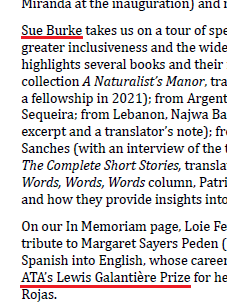
It says I won the American Translators Association Lewis Galantière Prize in 2010. I did not. I checked the footnote, and what I think happened is that my name and the prize were both mentioned on the same page of an ATA magazine (see photo). Proximity amounts to correlation for an AI.

The entry says, “In the late 1970s and early 1980s, Burke relocated briefly to Austin, Texas.” During those “brief” years — actually, during all the years from 1955 to 1998 — I lived in Milwaukee. I lived in Austin from 1998 to 1999.

Since there was no internet until the 1990s, Grokipedia has little to say about the first four decades of my life, although I assure you I was busy.

It says I published either “more than 40 short stories” (correct) or “about 25.”

It also slightly misstates a whole lot of things, and it invents causal connections that don’t exist. For example, it says that certain freelance jobs “significantly refined Burke’s stylistic precision and narrative voice.” Not true. I got those jobs because I already had the skills.

The AI tries very hard to create a narrative, so it adds cause and effect everywhere it can. In reality, my life has had a somewhat random quality to it. Things happened, and then I tried to make the best of the changed circumstances. There was no masterplan.

Grokipedia’s AI also tries to draw unwarranted conclusions. It says, “Burke keeps her family life private” and “no children are mentioned in available biographical accounts,” suggesting that I do have children, I just don’t tell anyone about them. Most people have children, so statistically I do too, right? In fact, I have talked about my family life, although there’s not always much to say. Children are one of life’s great adventures, and if I had them, they would be the smartest, best, most talented children in the world, and I would never tire of telling you about them.

My husband read my Grokipedia entry, and he had one good thing to say about it: “Now you don’t have to create a fake resume. The AI made one for you.”