Fifty years later, we’re getting together again

My high school graduating class, 1973 South Milwaukee Senior High School, will hold its 50th class reunion on July 29. A half-century!

How much has time changed us? Here’s an article I wrote for Reunions Magazine about our 20th reunion. Even then, some of us had already become unexpectedly different.…

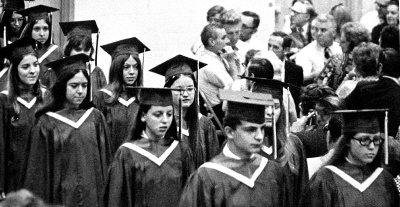
(Photo: From the 1973 Bay Mist yearbook: Salutatorian Ron Wadley and valedictorian Marilyn Stroik lead the graduation ceremony march.)

***

We came out of curiosity. Two decades earlier, in caps and gowns, we had marched 435 strong out of our high school graduation ceremony, heading into a hot, muggy June evening and into our separate, uncertain destinies as adults.

On an equally hot, muggy July evening two decades later, in suits and cocktail dresses, we walked into a hotel banquet hall to see what had happened to us. A committee had worked for almost a year and had located all but 30 of our classmates. Of those, about a third came to the reunion. With spouses, that made a sea of 280 faces at dinner. We could have drowned.

We were rescued by name tags. After a score of years, we had forgotten too many names. Some of us had studied our yearbooks to prepare for this reconnection, but those old books piqued our curiosity more than they jogged our memories.

Beyond that, even in 1973, no one knew every one of our classmates. With so many students, we fell into separate circles, even cliques. We had jocks, greasers, freaks, and “status” (the high achiever, class leader types). Some of these cliques and circles had no use for each other.

Those feelings faded away over the years. Animosities were forgotten as we reacquainted ourselves. Every familiar face, no matter how vague the recollection, had become a friend. We all shared the same long, intense years during the creep toward maturity, and although our paths had diverged, we met with more in common than ever.

“What do you do? Where do you live? Are you married? Any kids?” — simple questions became the start of renewed bonds. We found common ground both from the old days and from the intervening years, and talked and talked and talked. Husbands and wives talked of the happiness of their marriages. Parents talked of their children in terms of joy and amazement.

We talked of careers. We had become pilots, pathologists, housewives, factory workers, police officers, artists, and office workers. There were surprises. Lighthearted teens had heard the calling to God’s work, class clowns and scholars alike were writing plays, and tiny threads of interest had grown into devoted vocations or avocations.

The amazed talk behind the backs of fellow classmates, however, centered on one thing: looks. A few people looked almost exactly as they had in school. Some others had changed beyond recognition.

In fact, many had blossomed. There were men with strong, sculpted faces, and gorgeous women in glamorous dresses who turned heads and confounded old friends who remembered them as — well, not like that.

We saw that our classmates — close friends and former rivals alike — had journeyed to their own place in the world, and on that hot, long July evening, we were reassured. Some had traveled farther away than we ever expected, but not out of reach from one another.

The scene after the end of ‘Dual Memory’

If you’ve read the novel Dual Memory, you know how it ends — and then what happens? For fun, I wrote what might be the next scene. You can read it here.

If there’s a next scene, is there a next book? Honestly, that depends on sales of the first book, and bigger sales are always more encouraging when it comes time to make a hard business calculation. If you enjoyed the novel and want a sequel, recommend Dual Memory to your friends and leave a review wherever you can.

The best sales technique is word of mouth: person-to-person buzz. You can accomplish what no one else can.

I’ll be at Pemmi-Con

I’ll be in Winnipeg, Canada, for Pemmi-Con, the 15th North American Science Fiction Convention, July 20 to 23.

(A NASFiC is held in North America in any year where the Worldcon is outside of North America. This year the Worldcon, World Science Fiction Convention, will be held in Chengdu, China, October 18 to 22.)

Pemmi-Con will host writers, artists, scientists, makers, costumers, and fans, and will showcase First Nations, Metis, and Canadian fantasy and science fiction.

As I write this, apparently I’ll be participating in the programming, but the program hasn’t been announced, so I don’t know what I’ll be doing — besides enjoying the convention, meeting people, learning a lot, and getting inspiration. If you’re there, too, let’s say hi.

A translation: “Twilight in Poley”

A while back, when I was living in Spain, Christian Law Palacín and I translated a collection of poems by Vicente Núñez for the Vicente Núñez Foundation titled Canción antigua: An Old Song.

Vicente Núñez (June 8, 1926 – June 22, 2002) is considered one of the most important Andalusian poets in the second half of the 20th century. In 1982 he won the National Critic’s Award for Spanish Poetry with his collection Ocaso en Poley. Poley is the ancient name of his home town, Aguilar de la Frontera, near the city of Cordova.

I treasured his poems’ lyric musicality and moving metaphors, often centered on hidden love because for many years in Spain he had to hide his gay identity. But I think there is one poem that I managed to capture especially well in English. It’s the title poem of the collection Ocaso en Poley. Here is the poem, my translation — and, why not, a couple of machine translations.

Ocaso en Poley

Si la tarde no altera la divina hermosura

de tus oscuros ojos fijos en el declive

de la luz que sucumbe. Si no empaña mi alma

la secreta delicia de tus rocas hundidas.

Si nadie nos advierte. Si en nosotros se apaga

toda estéril memoria que amengüe o que diluya

este amor que nos salva más allá de los astros,

no hablemos ya, bien mío. Y arrástrame hacia el hondo

corazón de tus brazos latiendo bajo el cielo.

Twilight in Poley (my translation)

If evening has not touched the divine grace

of your dark eyes gazing at the fading

yielding light. If my soul has not sullied

your delightful solid sunken secret.

If no one has seen us. If we can quench

those sterile memories that might defame

this saving love from far beyond the stars,

now not a word, my darling. Let your arms and

pulsing heart pull me deep beneath the sky.


Evening in Poley (via DeepL)

If the evening does not alter the divine beauty

of your dark eyes fixed on the decaying

of the succumbing light. If it does not tarnish my soul

the secret delight of your sunken rocks.

If no one warns us. If in us is extinguished

all sterile memory that amengüe or that dilute

this love that saves us beyond the stars,

let us speak no more, my good. And draw me into the deep

heart of your arms beating under the sky.

sunset at poley (via Google Translate)

If the afternoon does not alter the divine beauty

of your dark eyes fixed on the decline

of the light that succumbs If it doesn’t tarnish my soul

the secret delight of your sunken rocks.

If no one warns us. if it goes out in us

every sterile memory that diminishes or dilutes

this love that saves us beyond the stars,

Let’s not talk now, my goodness. And drag me down

heart of your arms beating under the sky.