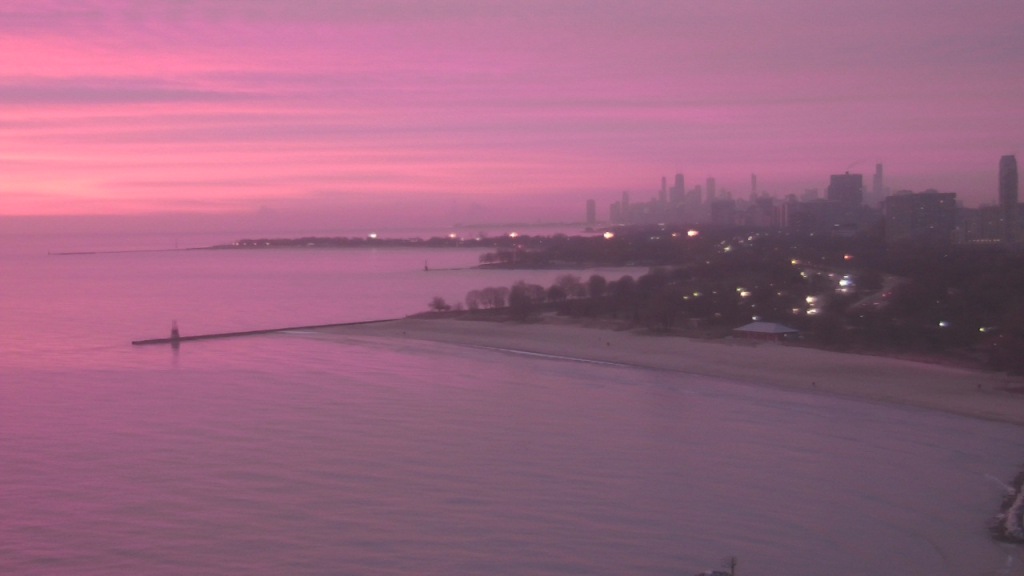
This is a view of Osterman Beach in Chicago from the Weatherbug weather cam website, taken on December 29, 2020, at 6:59 a.m. I can see Osterman Beach from a different angle through the window of the home office where I’m writing this.
But water is blue! So is the sky! Therefore ancient Greeks had problems with the color. Perhaps they couldn’t even see it.
To which I say: hogwash. I live next to an inland sea, Lake Michigan, and it can be a variety of colors, depending on the waves, the turbulence, and the sky. Besides many shades of blue (from pale to deep), the water can also look green, gray, brown, black (at night), and white (in winter), among other colors, sometimes several colors at once.
The sky can display a multitude of colors as well, especially at sunset and sunrise.
And so, on some wonderful mornings, water can be turned, briefly, into wine.
***
Tangentially, there’s this discussion of the color of the sea from Ulysses by James Joyce, about which I have no comment.
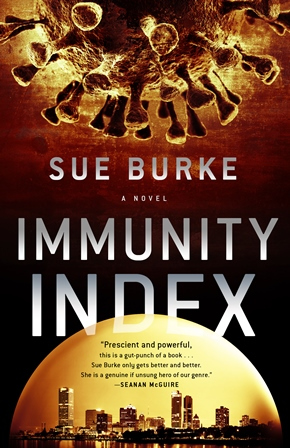
I made two mistakes when I started writing the novel Immunity Index.
The first mistake was to try “pantsing” as a writing technique — that is, to write from the seat of my pants rather than from a plan and an outline. While my first drafts are always shit (which does not make me at all like Hemingway in any other sense), this first draft was especially bad and required nine painful complete rewrites.
The second mistake was trying to tell a story set in the near future. Events in the future, like the things seen in a convex mirror, are closer than they appear.
This vision of the future, however, started back in the 1980s. As a newspaper reporter, I was covering news about AIDS, then a terrifying new disease. One evening, before a meeting, I was chatting with the Wisconsin state epidemiologist. He said that as bad as AIDS was, it could have been worse. He was a gay man, and we both knew that AIDS was already a disaster, and the disaster would keep growing.
He said, though, we were lucky that AIDS was only communicable, not actually contagious. Worse would have been a fatal illness that could be spread as easily as a cold.…
In 2018, I imagined a deadly, contagious coronavirus. It was fiction. Until it wasn’t.
My fictional story, though, is better than our shared reality. For one thing, the novel has a happy ending — and it has suspense, intrigue, adventure, and a woolly mammoth.
I’m about 24,000 days old. Despite everything that’s happened over the last 65 years, one change in the material world stands out to me the most.
When I was born in 1955, fewer than 3 billion people lived on the Earth. According to YaleGlobalOnline, that number reached 7.8 billion in March 2020.
During my lifetime, the world population has more than doubled — and there was hardly a shortage of human beings on the planet 65 years ago. When my parents were born, there were only 2 billion people. In 1804, there was 1 billion.
We should hit 8 billion in 2023, 9 billion by 2037, and 10 billion by 2056.
I can’t imagine a billion people, but I know what population growth has meant to me — this single memory, multiplied by everywhere:
When I was eight or nine years old, my friends and I would ride our bikes from our homes in Greendale, Wisconsin, to Boerner Botanical Gardens, about three miles away. (We were free-range children.) The quiet ride took us through suburbs and past farm fields and groves of trees.
The biggest crossroads was 76th Street at Grange Avenue. Grange, a two-lane country road, had a stop sign, and 76th didn’t, but it held such scant traffic that an eight-year-old had no trouble peddling across it safely.
Less than a decade later, Southridge Mall opened at that corner, and more development followed. Now, as the photo from Google Maps shows, Grange Avenue is a four-lane boulevard plus turn lanes and 76th Street has six lanes, and the crossroad can intimidate anyone not in an SUV. The fields have been paved over. The once-quiet country road bustles day and night.
Everywhere that I’ve lived and visited, roads and buildings grow and grow endlessly.
That’s what billions more people mean to me: more cars, more pavement, and more buildings — but fewer farm fields, fewer trees, fewer kid-friendly spaces, and less peace and quiet.
***
I’ve posted a new article, “What’s a masterpiece worth?” How much did Cervantes get paid for Don Quixote of La Mancha? We don’t really know, but I try to come up with an estimate, and it jives with other estimates. He earned a pittance. Read the article here.
It’s not a sequel to Semiosis and Interference (the sequel, Usurpation, is on the way). Instead, this is the story of separated sisters, a virus, a rebellion — and a cantankerous woolly mammoth.

 Sue Burke